
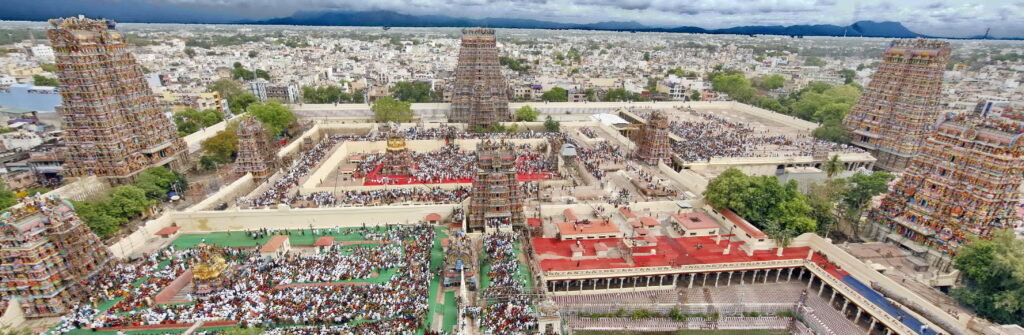
Image Source: எஸ்ஸார்
About Meenakshi Temple
The Meenakshi Temple, also called Arulmigu Meenakshi Sundareswarar Temple or Arulmigu Meenakshi Amman Thirukkovil, is a historic and iconic Hindu temple located in Madurai, Tamil Nadu, India. It is a major pilgrimage site and one of the most prominent landmarks of the city. The temple is dedicated to Goddess Meenakshi, a form of Parvati, her consort Sundareswarar (a form of Shiva); and her brother, Aḻagar (a form of Vishnu). Meenakshi, meaning “fish-eyed” or “rule of the fish” from Tamil, was originally called Thadadakai and is the principal deity, which is unusual for most Shiva temples in South India, where Shiva is typically the primary deity.
Historical Background
The origins of the Meenakshi Temple date back to at least the 6th century CE, as referenced in early Tamil texts and Sangam literature. Pandyan rulers, particularly Emperor Sadayavarman Kulasekaran I (r. 1190–1216 CE), constructed the earliest surviving portions of the temple, including sections of the Sundareswarar Shrine and the central portion of the Meenakshi Shrine. Subsequent rulers like Maravarman Sundara Pandyan I and II expanded the gopurams and pillared corridors during the 13th century.
In the 14th century, the temple suffered destruction by the Delhi Sultanate armies under Malik Kafur, and the temple was closed for nearly six decades. The Vijayanagara Empire restored worship in the late 14th century and repaired the temple. Later, during the 16th and 17th centuries, the Nayak rulers—notably Vishwanatha Nayak and Thirumalai Nayak—further expanded the temple complex, following Shilpa Shastra principles, adding mandapams, gopurams, and artistic embellishments. The British period saw a decline in patronage, though the temple remained active. Modern restoration efforts by the Tamil community culminated in the 1995 Kumbhabhishekam, revitalizing the temple complex. The temple also holds the distinction of being awarded the Swachh Iconic Place of India in 2017.
Architecture and Layout
The temple is a masterpiece of Pandyan and Dravidian architecture, sprawling over 5.7 hectares (14 acres) with a rectangular layout (approximately 240m × 255m) and fortified walls. The design follows concentric squares with streets radiating from the temple center, following Silpa Shastra guidelines.
The complex features 14 gopurams (gateway towers) ranging from 45–50 meters, with the southern gopuram standing tallest at 51.9 meters (170 ft). The oldest eastern gopuram was constructed by Maravarman Sundara Pandyan. Each tower is covered with thousands of brightly painted sculptures, illustrating nearly 4,000 mythological stories. Within the innermost courtyard, the temple houses two main shrines: Meenakshi in the south and Sundareswarar in the north, each topped with gold-plated vimanas.
A sacred temple tank, Porthamarai Kulam (“Pond with the Golden Lotus”), lies within the complex. Numerous pillared halls (mandapams) such as the Thousand-Pillared Hall (Aayirankaal Mandapam), Ashta Shakti Mandapam, Kilikoondu Mandapam, Kambathadi Mandapam, and Vasantha Mandapam display exquisite sculptures depicting deities, mythological stories, and daily life scenes. The halls also include unique features like rotating stone balls inside yali mouths, musical pillars, and spaces for cultural performances.
Deities and Artistic Highlights
The primary deity, Meenakshi, is depicted in a standing posture with bent legs, holding a lotus and a parrot. Sundareswarar is enshrined as a stone linga, while Aḻagar represents Vishnu. The temple also hosts numerous other deities, including Murugan, Ganesha, Lakshmi, Krishna, Saraswati, and 63 Nayanmars, as well as sculptures of kings, queens, and mythological figures. The halls and gopurams are adorned with frescoes, reliefs, kirtimukhas (gargoyles), and murals, including the famous 64 Shiva-lilas, which narrate the repeated destruction and rebirth of Madurai and the temple.
Religious and Cultural Significance
The Meenakshi Temple embodies a confluence of Shaivism, Shaktism, and Vaishnavism, with the symbolic divine marriage of Meenakshi and Sundareswarar illustrating kinship, matrilineal traditions, and the integration of devotional practices. The temple is considered one of the four most important pilgrimage centers in Shaivism and also a cultural hub, supporting art, literature, music, and dance over centuries. Economically, it has historically influenced Madurai’s markets and services due to the constant influx of pilgrims.
Worship and Festivals
Daily worship includes six poojas, featuring rituals such as abhisheka (sacred bath), alangaram (decoration), neivethanam (food offerings), and deepa aradanai (lamp ceremony). Unique nightly rituals involve moving Sundareswarar’s icon to Meenakshi’s chamber.
The temple celebrates numerous festivals, the most prominent being Meenakshi Thirukalyanam, a twelve-day festival in Chithirai (April–May) marking the divine marriage of Meenakshi and Shiva, with processions where Vishnu symbolically gives his sister in marriage. Other festivals include Navaratri, Vasantham, Unjal, Mulai-Kottu, Aavani Moolam, Kolattam, Arudhra Darshan, and Thai Utsavam, all celebrated with grandeur in the temple halls and courtyards.