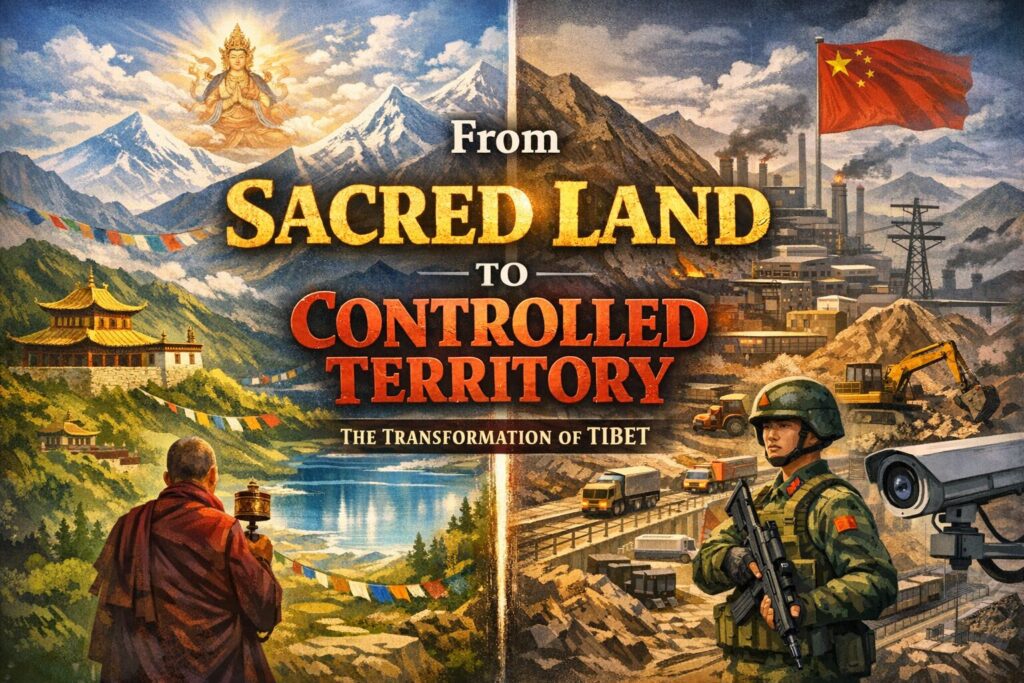
The old Tibetan system—where land, religion, and daily life were woven into one sacred geography —changed profoundly after Chinese rule was established in the 1950s. The shift was not just political; it altered how people related to mountains, monasteries, and the idea of Tibet as a “living religious map.” The change can be understood in stages: ideological, institutional, and environmental.
From Sacred Landscape to Administrative Territory
Traditional Tibet viewed the plateau as a spiritually ordered space: mountains were deities, lakes were living beings, and pilgrimage routes were cosmic paths. After Chinese control, Tibet was redefined primarily as a territory of the modern nation-state rather than a sacred mandala. Maps were redrawn in political terms (counties, prefectures, borders), and land was treated as a resource base—pasture, mineral zone, hydropower source—rather than a religious body. This shifted Tibet from a mythic-religious geography to a bureaucratic geography .
Decline of Monasteries as Geographic Anchors
Before 1950, monasteries acted as the main nodes of the sacred map—spiritual centers, social organizers, and land managers. Under Communist rule, especially during the Cultural Revolution (1966–76), monasteries were:
• closed or destroyed
• stripped of land
• reduced in number and influence
This broke the network that once linked valleys, passes, and rivers through pilgrimage and ritual. The plateau lost much of its function as a ritual landscape and became increasingly a space of roads, military posts, and planned towns.
Replacement of Spirit Geography with Scientific Rationalism
Bon and Buddhist traditions taught that mountains and lakes were inhabited by spirits and deities. The Chinese state promoted a worldview based on:
• materialism
• scientific atheism
• economic development
As a result:
• mountain gods became “superstition”
• sacred lakes became water reservoirs
• pilgrimage became tourism
• beyul (hidden sacred valleys) became ecological zones or strategic valleys
The land was desacralized in ideology, even if people privately retained belief.
Transformation of Pilgrimage into Infrastructure
Traditional movement across Tibet followed sacred routes (kora paths, river valleys, mountain passes). Modern highways, railways, and airfields reshaped mobility. Pilgrimage did not disappear, but it was:
• regulated
• redirected
• often rebranded as cultural tourism
The meaning of travel changed:
Old system → journey as spiritual practice
New system → journey as economic or strategic connection
So the sacred map was overlaid with a transport map .
Environmental Policy vs Sacred Ecology
In the old system, land was protected by fear of spirits and taboo (don’t dig here, don’t pollute this lake, don’t hunt near this mountain). Under Chinese governance, conservation is based on:
• nature reserves
• laws
• relocation of nomads
• scientific management
This has mixed results:
Some areas are ecologically protected,
but protection is no longer grounded in spiritual meaning.
Nature becomes something to manage, not something to negotiate with ritually.
Cultural Memory and Partial Survival
Despite state control, the sacred geography has not vanished. It survives in:
• local pilgrimages
• oral tradition
• symbolic respect for mountains and lakes
• private rituals
But it no longer defines political order or land management as it once did. The “living religious map” has become more of a cultural memory than a governing system.
From Mandala-State to Modern State
Traditionally, Tibet functioned almost like a mandala-state , where spiritual authority structured territory. After Chinese rule, Tibet was absorbed into a centralized nation-state , where:
• law replaces ritual
• development replaces cosmology
• ideology replaces sacred myth
The landscape shifted from being read as a spiritual diagram to being read as:
• a frontier
• a resource zone
• a strategic plateau
Conclusion: A Shift in How Land Is Understood
The deepest change after Chinese rule was not only in politics but in meaning:
Before:
Land = body of deities
Mountains = protectors
Travel = pilgrimage
Power = religious legitimacy
After:
Land = territory
Mountains = resources or borders
Travel = transport
Power = state authority
So the Tibetan Plateau moved from being a living religious map to a managed geopolitical space . The sacred layer still exists emotionally and culturally, but it no longer organizes the entire system of life and governance.