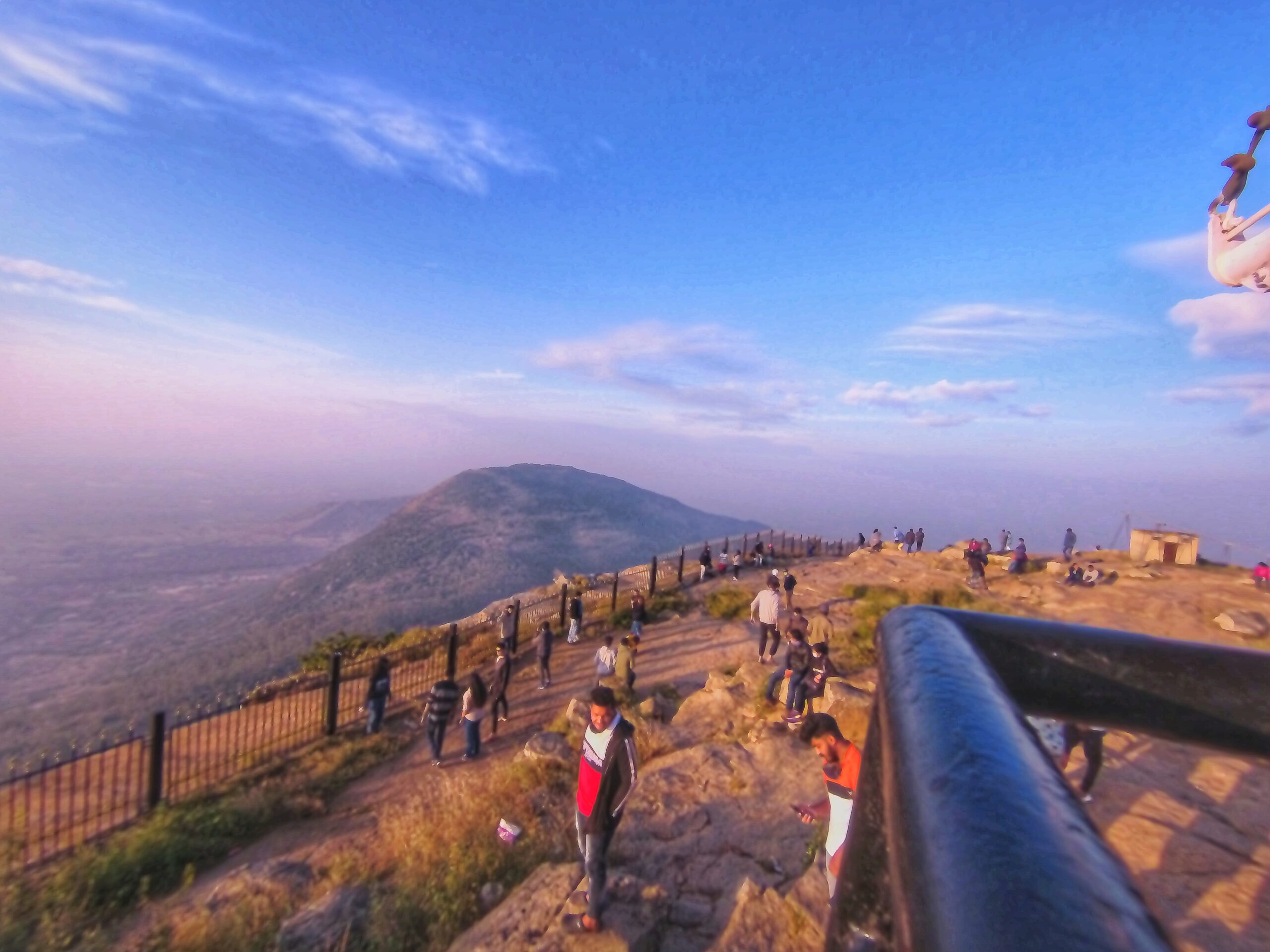
Image Source: Gowtham H K
About Huliyurdurga
If you are a trekking enthusiast in Karnataka, chances are you’ve heard of the Navadurgas—the nine ancient fort hills that once protected the city of Bengaluru.
Savandurga and Nandi Hills are popular weekend getaways so no need of introduction among travelers. But if you are someone who wants to explore less explored places near Bengaluru, then Huliyurdurga is the right choice for you. Located in the Kunigal taluk of Tumkur district, Huliyurdurga is a quite unique rocky structure with a near-vertical ascent. It’s considered one of the toughest treks around Bengaluru despite its relatively short distance.
Location and Historical Significance
Huliyurdurga (literally “Tiger Fort Hill”) rises about 845 meters above sea level. Unlike many other hills that appear elongated, Huliyurdurga looks like a solid mass of rock shaped like an inverted cup—imposing and dramatic against the horizon.
It’s believed the fortification on Huliyurdurga was originally built by Kempe Gowda, the Magadi chief, who fortified several strategic hills around Bengaluru in the 16th century.
The hilltop still bears the ruins of powder magazines, granaries, springs, houses, and even a durbar hall, though most structures today are reduced to foundations. A temple near the base, with finely carved granite pillars in its navaranga (pillared hall), is also attributed to Kempe Gowda or was later expanded under Chikkadevaraya Wodeyar.
Although in ruins, the fort was clearly built for defensive and military purposes, guarding the surrounding countryside.
History of the Fort
The construction of the fort is believed to have been done during the Vijayanagar Empire and later by local rulers and the Kingdom of Mysore.
The fort played a strategic role due to its strategic location and panoramic views of the surrounding area. It was a military outpost and watchtower that played a significant role during the reign of Tipu Sultan and the Wodeyars of Mysore .
Architecture
Made from locally available granite stone, the fort features strong fortification walls. It has a series of gates and narrow pathways, making it difficult for enemies to access.
The fort has several stone-carved tanks and reservoirs to store rainwater, ensuring a continuous supply for its occupants.
The Drive to Huliyurdurga
Travelers usually approach the hill via Magadi Road, a scenic but slightly underdeveloped stretch in terms of eateries. It is best to carry your own breakfast or stop at towns like Magadi or Kunigal before reaching the base.
The Trek Experience
Initial Ascent
The trek begins with a relatively easy climb, marked by steps leading to the Kote Ganapathi Temple. This part is friendly and doesn’t require much effort.
The Tough Climb
The real challenge begins after the temple. Steep vertical climbs on bare rock are particularly tricky, guided by arrows painted on the surface. A near-vertical 10–15 ft rock face with a gap, which demands strength, balance, and sometimes a helping hand.
Ropes or carved footholds would certainly make the climb easier, but the rawness of the trail is part of Huliyurdurga’s adventure. Once you pass this tough patch, the climb becomes smoother across sloping rocks, eventually leading to the summit of the ruined fort.
Descent
Descending the same vertical sections is even more challenging, but locals often guide trekkers to alternate routes that are safer and easier. It is recommended to follow their advice, especially if you are trekking for the first time.
Best Time to Visit
The best time to visit is during the post-monsoon and winter months (October to February), when the weather is cool and the vegetation is lush.
How to Reach Huliyurdurga
Huliyurdurga is a historic hill fort and trekking destination located near Kunigal in Karnataka’s Tumakuru district. It lies approximately 90–95 km from Bengaluru and is popular among trekkers looking for an offbeat adventure close to the city.
By Road
The most convenient way to reach Huliyurdurga is by road. From Bengaluru, take the Bengaluru–Mangaluru Highway (NH 75) towards Kunigal and continue towards Huliyurdurga village. The journey typically takes around 2 to 2.5 hours, depending on traffic conditions. Private vehicles and taxis are the preferred options for most visitors.
By Bus
Regular KSRTC and private buses operate from Bengaluru’s Majestic Bus Station to Kunigal. From Kunigal, local buses and auto-rickshaws are available to reach Huliyurdurga village, which is about 22–24 km away.
By Train
There is no railway station at Huliyurdurga. Travelers can reach nearby railway stations such as Bengaluru City Junction or Maddur and then continue by bus or taxi to Huliyurdurga.
By Air
The nearest airport is Kempegowda International Airport, located in Bengaluru. From the airport, visitors can hire a taxi or drive to Huliyurdurga via Kunigal.
Nearby Attractions
1. Devarayanadurga—A famous hill station with temples and trekking trails.
2. Kunigal Lake – A serene spot for picnics and nature enthusiasts.
3. Shivagange – Another popular trekking destination and pilgrimage site.
Timings and entry fees
The best time to discover the fort is from 6 AM to 5 PM.
Entry to the fort is free.
Google Maps of Huliyurdurga Fort
Huliyurdurga is situated about 65 km from Bengaluru and approximately 28 km from Kunigal in Karnataka.
FAQS
- Q: Where is Huliyurdurga Fort located?
Huliyurdurga Fort is located in the Tumakuru district of Karnataka, near the border with the Bengaluru Rural district. It stands on a rocky hill near Huliyurdurga village, forming part of the Eastern Deccan hill system.
- Q: Who built Huliyurdurga Fort?
The fort is believed to have been originally built during the Hoysala period, later strengthened by Vijayanagara rulers, and eventually used by Nayakas and Mysore rulers, reflecting multiple phases of South Indian military architecture.
- Q: Why is Huliyurdurga Fort historically important?
Huliyurdurga Fort controlled strategic routes connecting Tumakuru, Magadi, and Bengaluru regions, making it an important military outpost during medieval power struggles in southern Karnataka.
- Q: What does the name “Huliyurdurga” mean?
“Huliyur” translates to “village of tigers” in Kannada, while “durga” means fort, indicating the region’s once-forested and wildlife-rich landscape.
- Q: What architectural features can be seen at the fort?
The fort has stone ramparts, watchtowers, bastions, gateways, and rock-cut water tanks, adapted to the natural granite hill for defense.
- Q: Are there temples inside Huliyurdurga Fort?
Yes, remnants of ancient temples and shrines are found within the fort complex, reflecting its role as both a military and religious site.
- Q: How difficult is the trek to Huliyurdurga Fort?
The trek is moderate, involving rocky paths and steep sections, suitable for trekkers with basic experience.
- Q: Is Huliyurdurga Fort open to visitors?
Yes, the fort is accessible year-round, though visiting during early morning or post-monsoon season is recommended.
- Q: What is the best time to visit Huliyurdurga Fort?
The ideal time is October to February, when the weather is cooler and the surrounding landscape is greener.
- Q: Is Huliyurdurga Fort protected by ASI?
Huliyurdurga Fort has historical significance but is not heavily developed or interpreted, requiring visitors to explore responsibly.