
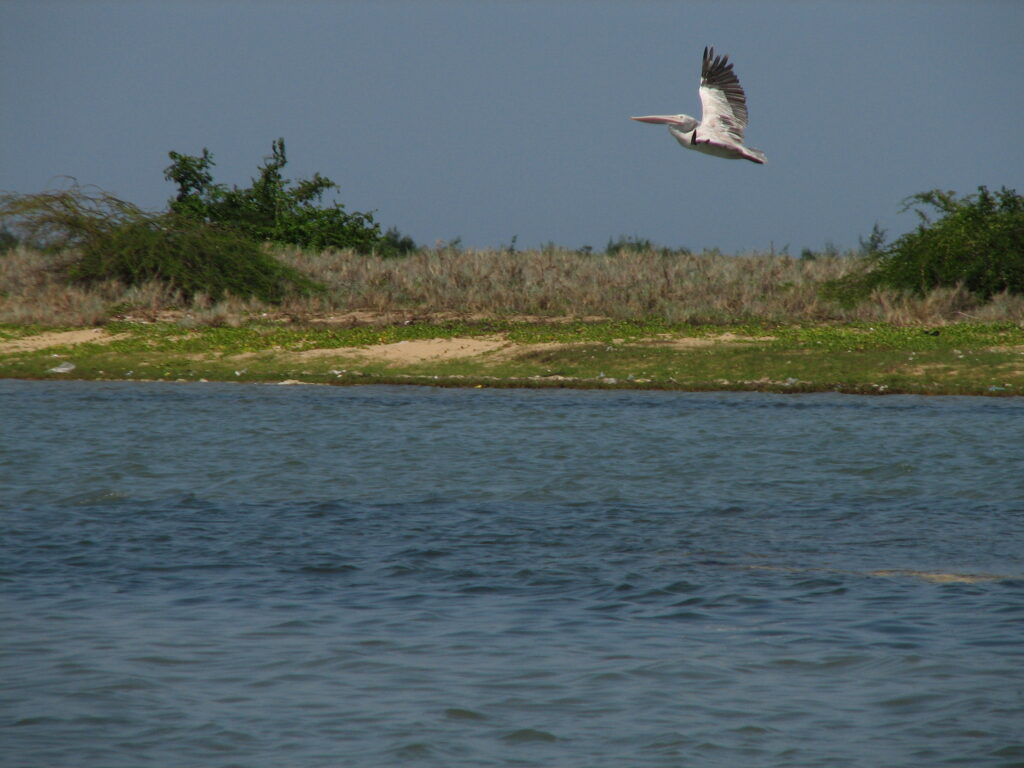
Image Source: McKay Savage
About Pulicat Lake Bird Sanctuary
Pulicat Lake Bird Sanctuary, also recognized as Pulicat Lake Wildlife Sanctuary (IBA Code: IN261, Criteria: A1, A4iii) by BirdLife International, is a protected area dedicated to the conservation of birds and their habitats.
Classified under IUCN Category IV (habitat/species management area), the sanctuary spans across the Tirupati district of Andhra Pradesh and the Thiruvallur district of Tamil Nadu, India. Established in 1976, it covers a total area of approximately 759 km² (293 sq mi), with 327.33 km² managed by the Andhra Pradesh Forest Department and 153.67 km² under Tamil Nadu Forest Department. Additionally, about 108 km² of the sanctuary is designated as a National Park area. Pulicat Lake is notable for being India’s second-largest brackish-water ecosystem, after Chilka Lake in Odisha.
Geography and Climate
Situated at coordinates 13°34′N 80°12′E, Pulicat Lake Bird Sanctuary is a brackish-water ecosystem lying at altitudes ranging from 100 ft (30 m) to 1,200 ft (370 m) above sea level. The climate is tropical, with annual rainfall varying between 800–2000 mm and temperatures ranging from 14 to 33 °C (57 to 91 °F). The combination of freshwater inflows and tidal seawater creates a unique habitat that supports a rich variety of flora and fauna.
Flora
The sanctuary hosts a diverse range of approximately 132 plant species, including both mangrove and coastal vegetation. Prominent plant species include Walsura piscida, Manilkara elengi, Excoecaria agallocaha, Spinifex littoreus, and Calamus viminalis. This vegetation provides crucial cover and nesting grounds for birds and serves as an important ecological buffer for the brackish-water ecosystem.
Fauna
Pulicat Lake is internationally renowned for its avifauna, particularly its migratory bird population. The sanctuary attracts species like greater flamingos, painted storks (Mycteria leucocephala), pelicans, and various other aquatic and terrestrial birds, which use the lake as a feeding and nesting ground. Invertebrates, including planktons, molluscs, insects, coelenterates, and crustaceans, form the base of the food chain. Mammals such as jackals, jungle cats, and black-napped hares also inhabit the area, contributing to its ecological diversity. The lake’s biodiversity attracts hundreds of thousands of visitors annually, making it both an ecological and touristic hotspot.
Threats and Conservation Efforts
Pulicat Lake faces significant ecological threats, the most pressing being the risk of disappearing within 100 years due to siltation. Conservation efforts are underway by both government bodies and non-governmental organizations to protect this vital ecosystem. The Art & Architecture Research, Development and Education (AARDE) Foundation, among others, conducts awareness campaigns and conservation activities to prevent the degradation of the lake and preserve its habitat for future generations.
How to Reach Pulicat Lake Bird Sanctuary
By Air:
The nearest airport is Chennai International Airport (MAA), located approximately 60 kilometers from the sanctuary. Visitors can hire taxis or use buses to reach the lake.
By Rail:
The closest railway station is Sriharikota Road Railway Station, around 25 kilometers away. Regular trains connect Chennai and nearby towns to this station.
By Road:
Pulicat Bird Sanctuary is well-connected by road from Chennai, Tirupati, and Nellore. National Highway NH16 passes close to the sanctuary, and buses, taxis, and private vehicles are available for direct access.