
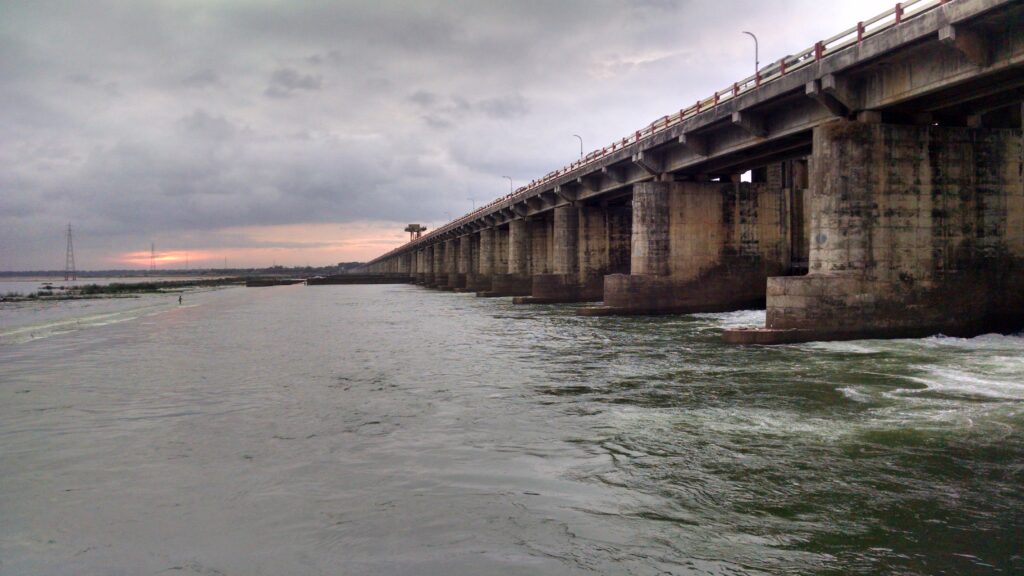
Image Source: Chaniljain
About Dowleswaram Barrage
The Dowleswaram Barrage, built across the Godavari River near Rajamahendravaram (Rajahmundry) in Andhra Pradesh, is one of the most historic irrigation projects in India.
Originally constructed by Sir Arthur Cotton in 1850, this barrage transformed the Godavari Delta into one of the most fertile agricultural regions of the country. Often called the “lifeline of Coastal Andhra,” it continues to play a vital role in irrigation, flood control, and water supply for millions of people.
History and Construction
Before the barrage was built, the Godavari’s waters often went waste into the Bay of Bengal, leaving surrounding lands dry and unproductive. Recognizing the potential of the river, British engineer Sir Arthur Cotton designed and constructed the original anicut at Dowleswaram in 1850, which became a pioneering irrigation project in India.
Later, in 1970, the structure was modernized into the present-day Sir Arthur Cotton Barrage and Road-Cum-Rail Bridge, maintaining its original vision while improving capacity. Today, the barrage stands as both a functioning irrigation system and a monument to Cotton’s engineering genius.
Architecture
The Dowleswaram Barrage is a masonry structure divided into four sections, stretching across 3.5 kilometers (2.2 miles) to regulate the flow of the mighty Godavari. It diverts water through a network of canals, forming the Godavari Delta irrigation system, which irrigates over 2 million acres of farmland in East Godavari and West Godavari districts. The barrage is also used as a road bridge, connecting important towns and easing transportation in the region.
Importance and Benefits
The barrage turned the barren stretches of the Godavari region into lush green fields, earning Sir Arthur Cotton the love and reverence of the local people, who even built a memorial museum in his honor at Rajamahendravaram.
The irrigation support from the barrage makes the delta region one of the largest producers of paddy, sugarcane, bananas, and coconuts in Andhra Pradesh. It also provides drinking water, supports inland fisheries, and helps in flood regulation during monsoons. For generations, the Dowleswaram Barrage has remained the backbone of the Godavari-based economy.
Tourism and Local Attractions
Today, the barrage is not only an irrigation marvel but also a popular tourist attraction near Rajahmundry. Visitors come to witness the mighty Godavari flowing through the gates, especially during the rainy season when the river is at its peak. The site also offers scenic views of the Godavari’s expanse, with boating options nearby.
The Sir Arthur Cotton Museum showcases his contributions, models of irrigation projects, and historical records, making it a must-visit for history and engineering enthusiasts. The nearby Papikondalu Hills, ISKCON Temple, and Godavari Pushkar Ghats add to the charm of the region.
How to Reach Dowleswaram Barrage
By Road: The barrage is just 6 km from Rajamahendravaram city and well-connected by APSRTC buses, taxis, and private vehicles.
By Rail: The nearest railway station is Rajahmundry Railway Station (8 km), a major junction on the Howrah–Chennai line.
By Air: The closest airport is Rajahmundry Airport (15 km), with regular flights from Hyderabad, Chennai, and Bengaluru.