
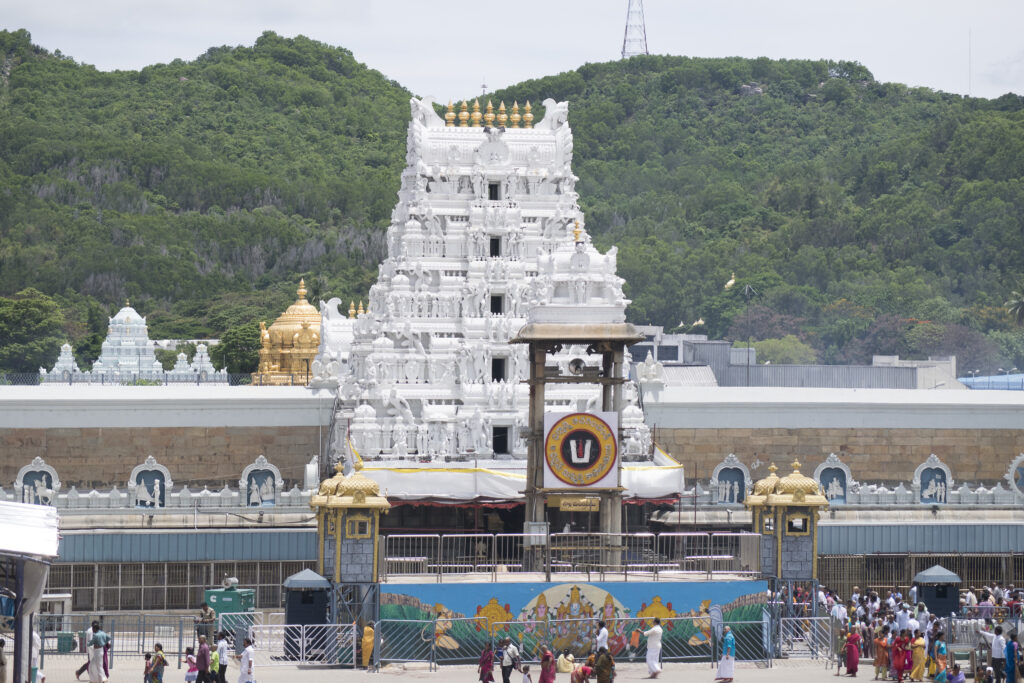
Image Source: Nikhilb239
About Sri Venkateswara Swami Temple
The Sri Venkateswara Swami Temple, popularly known as the Tirumala Temple or Tirupati Balaji Temple, is one of the most sacred and visited Hindu shrines in the world. Dedicated to Lord Venkateswara, an incarnation of Lord Vishnu, the temple is revered as the “Kaliyuga Vaikuntha”, the earthly abode of Vishnu in this age.
The presiding deity, also worshipped as Balaji, Srinivasa, and Govinda, is believed to have appeared to protect mankind during Kali Yuga. Today, the temple is not only the richest in terms of donations but also one of the most visited pilgrimage centers, drawing over 24 million devotees annually.
Location and Setting
Situated in Tirumala, in Andhra Pradesh’s Tirupati district, the temple stands majestically on the Seshachalam Hills, part of the Eastern Ghats. The shrine is located on Venkatadri, the seventh peak, which along with six others symbolizes the seven hoods of Adisesha, the celestial serpent. At an elevation of 853 meters (2,799 ft) above sea level, the temple lies on the southern banks of the sacred Swami Pushkarini tank, a site believed to purify pilgrims before darshan.
History
The origins of the Tirumala temple date back to at least 300 CE, with continuous patronage by dynasties such as the Pallavas, Cholas, Pandyas, and Vijayanagara rulers. The first recorded endowment was made in 966 CE by the Pallava queen Samavai, who donated land and jewels. The Vijayanagara kings, especially Krishnadevaraya, contributed immensely, gifting gold, diamonds, and even gilding the sanctum’s golden roof.
Over time, rulers such as the Maratha general Raghoji I Bhonsle and later administrators from the Golconda Sultanate, French, and Nawab of Carnatic oversaw its affairs. In 1801, the temple came under the East India Company and later passed to local Mahants.
In 1933, the Tirumala Tirupati Devasthanams (TTD) was formed under law, streamlining temple management. Even the Nizam of Hyderabad was a benefactor, making yearly donations. Today, TTD continues as one of the most powerful religious trusts in India.
Sacred Legends
The Tirumala hills are steeped in mythology. The Seshachalam Hills are said to be Adisesha himself, who descended to earth after losing a contest with Vayu. The region is also called Adivaraha Kshetra, where Varaha Swamy resided after slaying Hiranyaksha.
Another legend tells of Sage Bhrigu, who insulted Vishnu during a divine test. Feeling dishonored, Goddess Lakshmi left Vaikuntha, settling in Kolhapur. Vishnu descended as Srinivasa to search for her and eventually married Padmavati, a manifestation of Lakshmi, with help from Brahma and Shiva.
To fund the divine wedding, Srinivasa borrowed from Kubera, and devotees’ donations into the hundi are believed to continue repaying this cosmic loan.
Another popular practice, tonsuring, is linked to the Gandharva princess Neela Devi, who offered her hair to cover the Lord’s injury. Devotees emulate her act as a mark of surrender.
Architecture and Layout
The temple is a magnificent example of Dravidian architecture, designed with intricate gopurams, sanctums, and circumambulatory paths.
Entrances: Three gateways—Mahadvaram (50-foot Raja Gopuram), Vendivakili (Silver Entrance), and Bangaruvakili (Golden Doorway)—lead toward the sanctum.
Sanctum (Garbhagriha): The presiding deity, Venkateswara, stands as a Swayambhu (self-manifested) idol. Devotees may only enter until the Kulasekharapadi.
Ananda Nilayam Vimanam: The golden-topped three-storied tower above the sanctum is gilded with copper plates and a golden kalash, featuring the sacred Vimana Venkateswara, an exact replica of the deity.
Pradakshinams: The temple has two circumambulation paths—Sampangipradakshinam, filled with mandapas and shrines, and Vimanapradakshinam, encircling the sanctum with subsidiary shrines, a golden well, and the hundi.
Deities and Sub-shrines
The sanctum houses the Pancha Beramulu (Five Deities) of Venkateswara:
Moolavirat (Dhruva Beram): The main deity with four arms.
Bhoga Srinivasa (Kautuka Beram): Represents enjoyment and receives daily rituals.
Ugra Srinivasa (Snapana Beram): Fierce form, taken out only once a year.
Malayappa Swami (Utsava Beram): Processional deity for festivals.
Koluvu Srinivasa (Bali Beram): Guardian deity overseeing temple finances.
In addition, sub-shrines are dedicated to Varaha Swamy, Garuda, Narasimha, Kubera, Hanuman, and Vakulamatha. Nearby temples include Padmavathi Temple at Tiruchanur, Srikalahasteeswara Temple at Srikalahasti, and Govindaraja Temple in Tirupati.
Worship, Rituals, and Offerings
The temple follows the Vaikhanasa Agama tradition, with six daily pujas ranging from the dawn Suprabhata Seva to the nightly Ekanta Seva. Weekly rituals include Vishesha Pooja, Ashtadala Pada Padmaradhana, Abhishekam, and Nijapada Darshanam.
Offerings are central to worship. The famous Tirupati Laddu, with GI tag, is the main prasadam, along with pulihora, daddojanam, chakrapongal, and sweets. Hair tonsuring, Tulabaram (weighing offerings), and donations to the hundi are considered acts of piety.
For darshan, pilgrims follow organized queues through the Vaikuntam Queue Complex or climb traditional footpaths (Alipiri Mettu, Srivari Mettu).
Festivals
With over 400 festivals annually, Tirumala truly lives by the saying “Nitya Kalyanam, Paccha Toranam” (Every day is a festival). The grandest celebration is the Sri Venkateswara Brahmotsavam, a nine-day event featuring colorful processions of Malayappa Swami on various vahanams, drawing lakhs of devotees. Other major festivals include Vaikunta Ekadashi, Rathasapthami, Teppotsavam (Float Festival), Pushpa Yagam, Rama Navami, Janmashtami, and Vasanthotsavam.
Religious and Cultural Importance
Tirumala is one of the eight Swayambhu Kshetras of Vishnu and is included among the 108 Divya Desams, celebrated in the hymns of the Alvars. Saints like Ramanujacharya, Annamacharya, and Hathiram Bhavaji have contributed to its religious life. The daily singing of Suprabhatam and the preservation of Annamacharya’s 32,000 kirtanas enrich the temple’s cultural legacy.
Administration and Wealth
The temple is administered by the Tirumala Tirupati Devasthanams (TTD), a trust board under the Government of Andhra Pradesh. It manages temple operations, donations, social services, and free meals for lakhs of pilgrims.
Tirumala is also the richest Hindu temple. As of 2023, its net worth exceeds ₹3 lakh crore (US$35 billion), with deposits of gold and cash from devotees worldwide.