
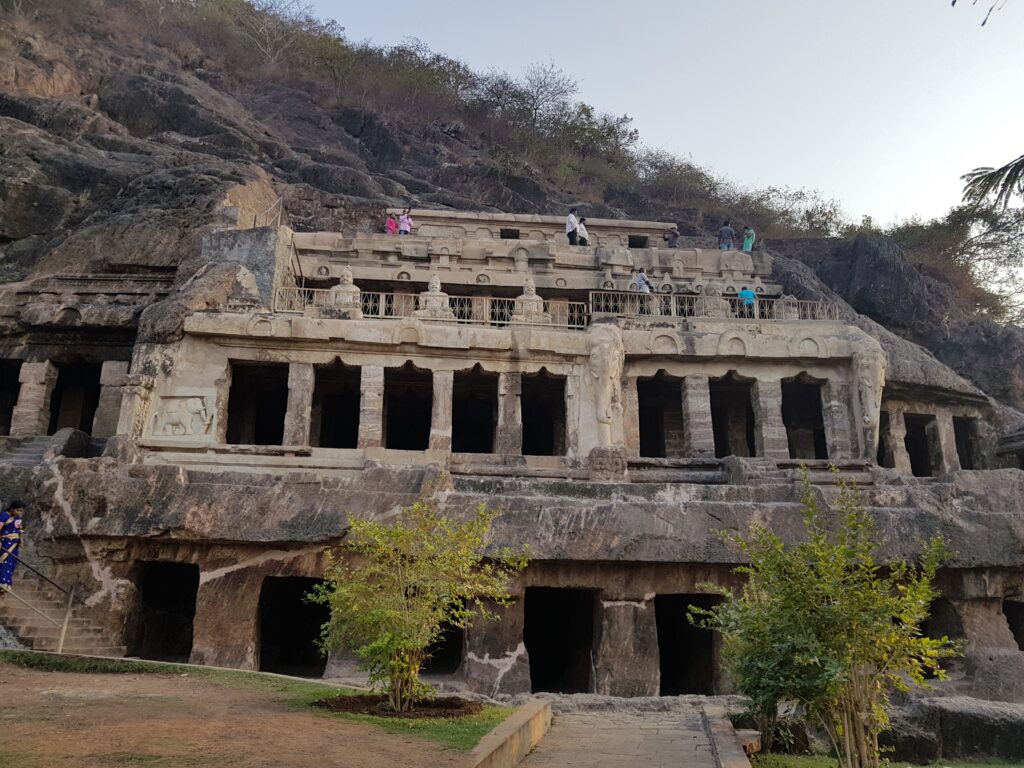
Image Source: Laxmanvety
About Undavalli Caves
The Undavalli Caves are a remarkable example of monolithic Indian rock-cut architecture, reflecting centuries of religious evolution and architectural ingenuity. Located in the Guntur district of Andhra Pradesh, southwest of Vijayawada, these caves are strategically perched on a hillside overlooking the Krishna River, offering a scenic backdrop of lush green countryside. Recognized as a Centrally Protected Monument of National Importance, the caves are not only significant historically but also culturally, attracting scholars, pilgrims, and tourists alike.
The location of the caves provides panoramic views of the surrounding plains, and several smaller rock-cut structures nearby further enhance the historical ambiance, making it an ideal site for understanding South Indian rock-cut heritage.
Historical Background and Chronology
The Undavalli Caves were carved out of solid sandstone between the 4th and 5th centuries CE, primarily under the patronage of the Vishnukundina dynasty, which ruled from 420–620 CE. This era witnessed a flourishing of art and architecture influenced by Gupta stylistic elements, evident in the monastic cells and intricately carved sculptures.
The caves reveal a fascinating trajectory of religious transformation over the centuries:
Jain Origins: The first floor retains Jain architectural motifs, including images of tirthankaras and Jain monastics, similar in style to the Udayagiri and Khandagiri caves. This suggests that the site originally served as a Jain monastic complex.
Buddhist Influence: Subsequent modifications indicate Buddhist usage, transforming parts of the caves into a Bhikkhu monastery. Buddhist artwork on the first level reflects this period.
Hindu Conversion: Finally, the caves evolved into Hindu temples, incorporating images and shrines dedicated to Shiva, Vishnu, and Brahma, along with depictions of various Alwars and Vaishnava deities.
This layered religious evolution makes the Undavalli Caves a unique repository of South India’s syncretic spiritual and cultural history.
Architectural Features and Sculptures
The Undavalli Caves are a four-storey rock-cut complex featuring remarkable craftsmanship, both in structural design and sculptural detailing.
Ground Floor
The base level consists of an unfinished pillared hall, supported by eight pillars and seven doorways. While incomplete, it illustrates the planning techniques of early rock-cut architecture and provides insights into the early stages of carving such massive monolithic structures.
First Storey
The first floor houses a triple shrine, each preceded by a pillared hall. Originally, these shrines were dedicated to the Hindu Trinity—Shiva, Vishnu, and Brahma—and bear traces of earlier Jain and Buddhist influences, reflecting the interplay of religious art forms.
Second Storey
The second floor is the highlight of the complex, featuring a pillared rectangular shrine dominated by a colossal 5-meter-long monolithic statue. Traditionally identified as Vishnu in a reclining posture, closer examination raises questions about its identity:
The statue has an eight-headed serpent instead of the usual five-headed Adishesha associated with Vishnu.
The eyes are closed, and the iconography aligns more closely with Parshvanatha, the 23rd or 17th tirthankara of Jainism.
Additionally, the walls showcase Vaishnava deities, Shiva sculptures, and figures of rishis and Hanuman, along with works attributed to the Chalukyan period, highlighting the continuous contributions of artisans over centuries.
Top Floor
The uppermost level remains unfinished, containing another triple shrine. Its incomplete state provides scholars with a window into ancient construction methods, including pillar placement and shrine design.
Craftsmanship
The carvings in Undavalli Caves demonstrate exceptional skill, particularly in creating high-relief sculptures from a single rock. The integration of multiple religious iconographies in one complex showcases the adaptability and aesthetic sophistication of ancient Indian craftsmen.
Connectivity and Visitor Information
The Undavalli Caves are accessible exclusively by road, with APSRTC bus services connecting Vijayawada, Guntur, and Amaravathi. For a scenic approach, the APCRDA Tourist Bus-cum-Boat service along the Krishna River from the Prakasam Barrage offers a unique view of the hills and surrounding landscape.
Nearby attractions include Akkanna Madanna Caves and Mogalrajapuram Caves, which together form a rich circuit of rock-cut architecture in the Guntur region, providing visitors with a comprehensive cultural and historical experience.
Significance
Listed under categories such as Hindu cave temples, Buddhist caves, Jain rock-cut architecture, the Undavalli Caves continue to inspire admiration for India’s ancient rock-cut architectural heritage.