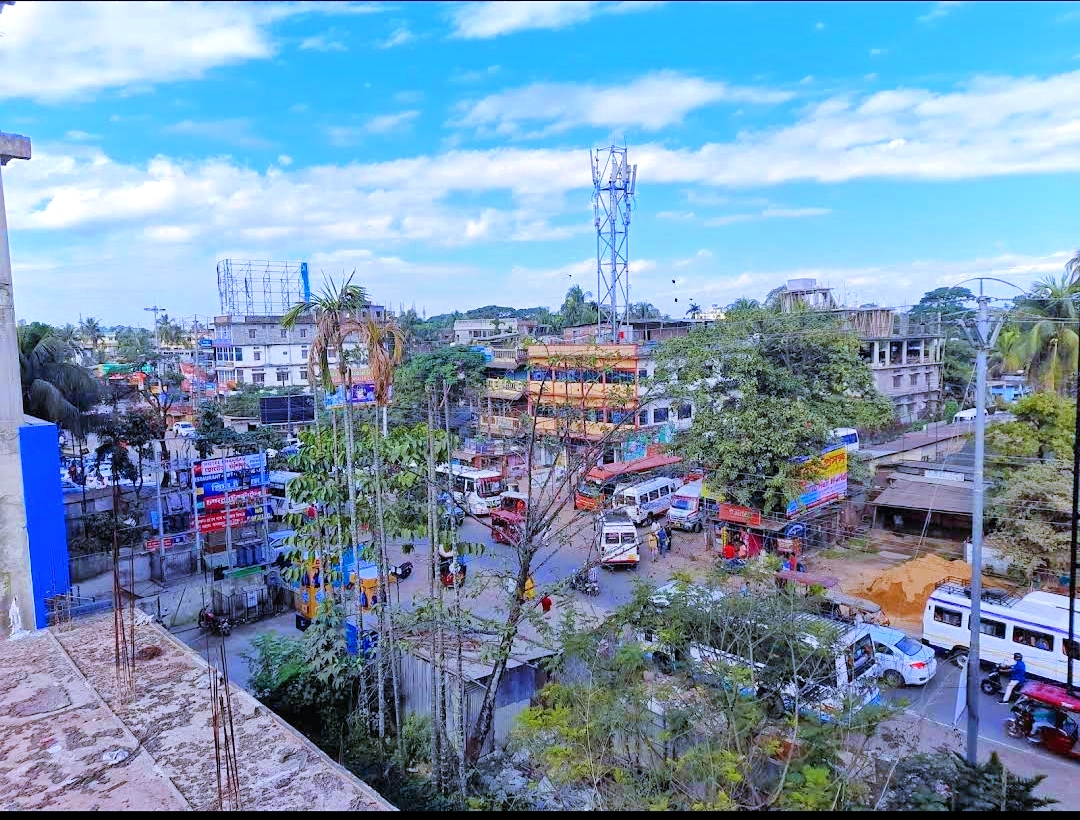
Image Source: Daibi Kamei
Geographical Setting and the Barak Valley Nexus
Silchar is located on the banks of the Barak River in southern Assam, forming the natural urban core of the Barak Valley, which is geographically separated from the Brahmaputra Valley by the North Cachar Hills (Dima Hasao plateau). This physical separation gave Silchar a different historical trajectory from Upper and Lower Assam. The Barak River connects Silchar to the Surma–Meghna river system of present-day Bangladesh, making it part of an eastward-flowing river network toward Bengal, rather than toward the Brahmaputra. This hydrological orientation embedded Silchar within a Bengal-linked cultural and commercial zone, while still remaining politically part of Assam.
Ancient and Medieval Roots in Kachar and Tripura Polities
Historically, the Silchar region formed the core of the Kachari (Dimasa) kingdom, later interacting with Tripura and Bengal polities. It was not part of the Ahom heartland but a southern frontier civilization, shaped by hill–plain interactions and forest economies. The capital of the Kachari kingdom shifted over time, but Silchar’s surrounding area became important as a fertile agricultural basin and as a corridor linking the Brahmaputra Valley to Bengal and Burma. This gave Silchar a political identity rooted in indigenous state formation rather than in Ahom royal culture.
Colonial Integration and Tea–Rice Economy
Under British rule, Silchar developed into an administrative headquarters of Cachar district and was integrated into colonial trade networks through river routes to Sylhet and Calcutta. Unlike Dibrugarh’s tea dominance, Silchar’s economy combined rice cultivation, tea estates in surrounding hills, and timber trade. The colonial administration reshaped land revenue systems and encouraged migration from Bengal, which altered the demographic and linguistic profile of the valley. Silchar thus emerged as a colonial service town, mediating between plantation zones, peasant agriculture, and river trade.
Language, Identity, and the Barak Valley Movement
Silchar holds a unique place in Indian history due to its central role in the 1961 Language Movement, when protesters defending the use of Bengali in Barak Valley were killed by police firing. This event cemented Silchar’s reputation as a city of linguistic assertion and political memory. Unlike the Assamese linguistic nationalism of the Brahmaputra Valley, Silchar’s politics revolved around the protection of Bengali language and cultural rights within Assam. This gave Silchar a distinct identity as a city shaped by language politics and minority consciousness.
Urban Growth and Administrative Centrality
As the largest city in southern Assam, Silchar functions as the administrative, educational, and commercial hub of the Barak Valley. It coordinates governance for Cachar, Karimganj, and Hailakandi districts. Its urban form reflects colonial-era planning mixed with dense riverbank settlements and modern commercial zones. Rather than industrial growth, Silchar’s economy has been driven by trade, services, education, and small-scale manufacturing, reinforcing its role as a regional service city.
Cultural Bridge Between Assam and Bengal
Culturally, Silchar stands at the intersection of Assamese, Bengali, and tribal traditions. Bengali literature, theatre, and music dominate its urban culture, while Dimasa and Manipuri influences persist in surrounding areas. This cultural layering makes Silchar a transitional cultural zone, where festivals, cuisine, and everyday language practices reflect a hybrid identity. It does not mirror Guwahati’s Assamese dominance nor Dibrugarh’s plantation modernity but represents a Barak Valley cosmopolitanism shaped by river connections to Bengal.
Ethnic Composition and Social Landscape
Silchar’s population includes Bengali Hindus, Bengali Muslims, Dimasa communities, Manipuris, and other migrant groups. This diversity arose from colonial-era settlement and the valley’s agricultural productivity. The coexistence of these communities has produced a social environment shaped by negotiation of identity, land use, and language, making Silchar a key site for studying Assam’s internal cultural plurality.
Strategic and Borderland Importance
Silchar lies close to Tripura, Mizoram, and Bangladesh, giving it strategic importance in terms of connectivity and security. It acts as a logistics and transit hub for the southern northeastern states. Historically, control over Silchar meant control over the Barak Valley corridor, linking the plains of Bengal with the hill states of Northeast India. This corridor role remains relevant in contemporary infrastructure planning and border management.
Symbolic Meaning in Assam’s Regional Imagination
In Assam’s regional consciousness, Silchar symbolizes the “other valley”—a place that shares the state’s political framework but follows a different cultural and linguistic path. While Sivasagar represents Ahom sovereignty and Dibrugarh represents tea capitalism, Silchar represents linguistic pluralism and frontier negotiation. It stands for the idea that Assam is not culturally uniform but composed of multiple historical regions with distinct identities.
Conclusion: Why Silchar Matters Beyond Tourism
Silchar is important not merely as a river town or market center but as a historical capital of the Barak Valley, a product of indigenous kingdoms, a colonial service hub, and a site of linguistic struggle. Its geography tied it to Bengal, its history tied it to Dimasa statehood, and its politics tied it to language and identity. To understand Assam as a state of multiple valleys and multiple cultural traditions, Silchar becomes indispensable. It is not just a peripheral city but a structural counterpoint to the Brahmaputra Valley, revealing how geography, language, and history together produce regional diversity within Assam.