
Image Source: juggadery
About Rajgir
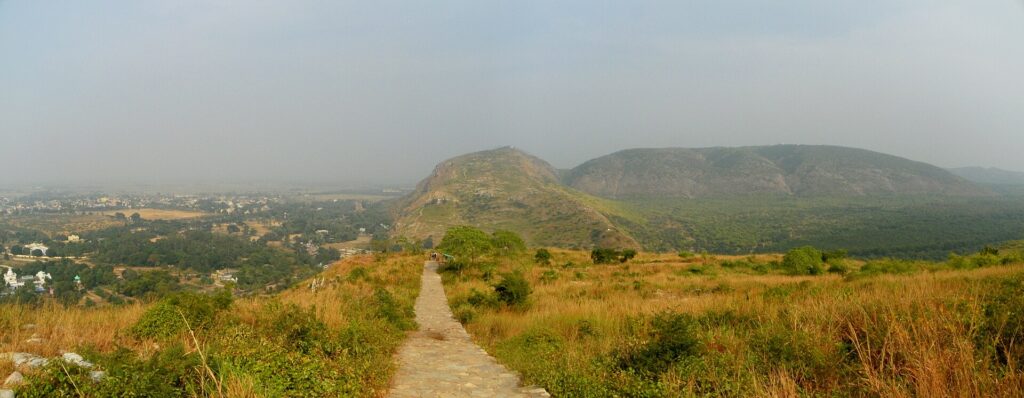
Nestled in the Nalanda district of Bihar, the ancient city of Rajgir holds a special place in Indian history, religion, and culture. Surrounded by five majestic hills, Rajgir is one of the oldest cities in India, dating back to the Magadhan empire.
Known as Rajagriha in ancient texts, this historic town was not only the first capital of Magadha but also a significant site for both Buddhism and Jainism. Today, Rajgir is a popular destination for pilgrims, historians, and travelers exploring the heritage circuit of Bihar along with Nalanda and Bodh Gaya.
History
Rajgir’s importance dates back to the 6th century BCE, when it served as the capital of the Magadha kingdom under rulers like Bimbisara and later Ajatashatru. The city finds mention in Buddhist, Jain, and Hindu scriptures alike.
For Buddhists, Rajgir is sacred because Gautama Buddha spent several years here, delivering sermons and meditating on Gridhakuta Hill (Vulture’s Peak). The First Buddhist Council after Buddha’s Mahaparinirvana was also held in Rajgir.
For Jains, Rajgir is revered as the place where Lord Mahavira spent a significant part of his life. Several Jain temples dot the surrounding hills.
In Hindu epics like the Mahabharata, Rajgir is associated with King Jarasandha, a powerful ruler who fought against the Pandavas. The Jarasandha ka Akhara is believed to be the site of his legendary duel with Bhima.
Rajgir thus became a confluence of religions and philosophies, making it a central hub of spiritual and intellectual activity in ancient India.
Architecture
The Rajgir ancient city ruins reveal its importance as a fortified capital. The remains of massive cyclopean walls—built of large uncut stones—still stand as testimony to its grandeur. These fortifications, stretching over 40 km, are among the oldest surviving stone structures in India.
Key sites within Rajgir include:
Venuvana Vihara – A bamboo grove gifted by King Bimbisara to Buddha, now a serene monastery.
Gridhakuta Hill (Vulture’s Peak) – Where Buddha meditated and preached, now accessible by a ropeway leading to the Japanese Peace Pagoda (Shanti Stupa).
Ajatashatru Fort and Stupa – Built by King Ajatashatru, highlighting Rajgir’s architectural brilliance.
Hot Springs (Brahmakund) – Natural hot water springs, considered sacred and believed to have medicinal properties.
Jain Temples – A chain of temples on Rajgir’s hills dedicated to Lord Mahavira and other Tirthankaras.
These sites reflect Rajgir’s status as both a spiritual retreat and a powerful political center.
Rajgir and Buddhism
Rajgir is inseparably linked with the life of Gautama Buddha. It was here that Buddha spent time in deep meditation, and his followers gathered to preserve his teachings. The First Buddhist Council, convened in the Saptaparni Cave, marked the beginning of the written Buddhist scriptures. Even today, Rajgir attracts pilgrims from Sri Lanka, Japan, Thailand, and Myanmar, making it a global Buddhist site.
Rajgir and Jainism
Equally important in the Jain tradition, Rajgir is associated with Lord Mahavira, the 24th Tirthankara. The surrounding hills house several Jain shrines, including the Sonbhandar Caves, which are believed to have been used by Jain monks. Rajgir remains an important pilgrimage site for the Jain community.
Modern Attractions and Tourism
Rajgir beautifully blends its ancient ruins with modern attractions, making it a well-rounded destination. The Rajgir Ropeway, which takes visitors up to the Shanti Stupa, is one of the oldest ropeways in India and a must-experience adventure. The Rajgir Glass Bridge, inspired by international designs, is a recent addition that attracts tourists.
Nearby, the Cyclopean Wall trail offers trekking opportunities, while the Rajgir Nature Safari provides wildlife experiences. Together, these make Rajgir not just a pilgrimage town but also a hub for cultural and adventure tourism.
Visiting Rajgir
Rajgir is located about 12 km from Nalanda and 100 km from Patna, making it an easy addition to a heritage tour of Bihar. The best time to visit is from October to March, when the weather is pleasant for sightseeing. Rajgir can be combined with nearby attractions such as Nalanda University Ruins and Bodh Gaya, forming the famous Buddhist Circuit of Bihar.