
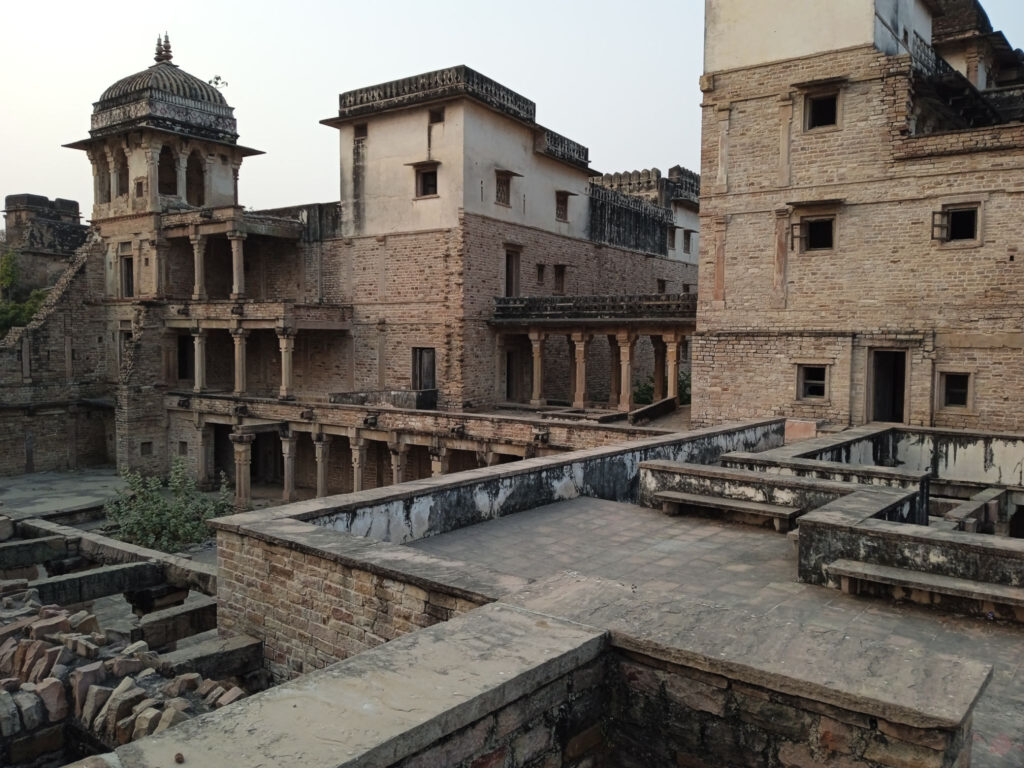
Image Source: Mudit Gupta
Overview of Raja Rani Mahal
Raja Rani Mahal (often written Raja–Rani Mahal or Raj Mahal) is one of Chanderi’s most iconic monuments. A pair of adjoining palaces sits inside the old town (the Andar Sheher) and forms a striking silhouette against the fort and the stone streets of Chanderi in Bundelkhand, Madhya Pradesh.
Where it is and how it fits in Chanderi
The Mahal is located in the inner town near landmarks such as Musa Bawdi (a stepwell/baoli). Chanderi Fort, Kirti Durg, and the cluster of Jain and Hindu temples that forms the historic core of Chanderi are not very far from the palace. According to some resources, Chanderi, an old town that was once known for its mahals and Havelis, has around 220-280 palaces. Today Raja Rani Mahal, one of the fractions, has survived and is a prominent example of this.
Dating and historical layers
According to various scholars and local histories, the complex is made in multi-period. Many styles and inscriptions point to the period of Khilji during the 15th century. It later became the taller Raja Mahal. While other smaller elements were reworked under Bundela patronage in the 17th century.
The palaces were used as a royal residences where several parts functioned, such as a shahi hammam(royal bath).Waterworks(Baolis) were connected to these hammam to support palace life.
Architecture
Raja Rani Mahal is constructed mainly of local sandstone (the same stone that gives much of Chanderi its warm grey-gold tone).
Raja Mahal—an imposing seven-story block with terraces, projecting balconies, and a compact tower-like massing that reads from the fort plateau; internally it is arranged around a large courtyard with colonnaded galleries.
Rani Mahal—a smaller, two-story palace attached by passages and galleries; stylistically different, suggesting an earlier phase or distinct patron.
Courtyards and colonnades—the central open court framed by slender carved pillars is one of the palace’s attractions; details show both Islamic and Rajputate treatments (arches, carved brackets, and chhatris/pavilions on terraces).
Baoli and hammam—the baoli near the complex and references to a shahi hammam speak to integrated water architecture (important in Bundelkhand’s climate).
The Raja Rani Mahal of Chanderi is a classic example of medieval Indian palace architecture. Unlike heavily fortified citadels, it reflects the aesthetic sensibilities and cultural syncretism of central India. The palace emphasizes residential elegance and spatial hierarchy.
Layout and Planning
Raja Rani Mahal follows a rectangular palace plan organized around courtyards. A common layout generally seen in royal residences across Malwa and northern India. The palace sits strategically within the fortified settlement of Chanderi, maintaining a clear separation from military structures while underlining its primarily residential and ceremonial functions.
The planning reflects a hierarchical spatial order, where public, semi-private, and private areas are arranged sequentially. Entry zones lead into open courtyards, which then transition into enclosed chambers and upper-level apartments. This zoning ensured controlled access while maintaining visual openness—an essential principle of royal architecture in the medieval Indian subcontinent.
Construction Materials and Structural Techniques
The palace is predominantly built using locally available sandstone, a hallmark material of Chanderi’s historic architecture. The stonework is notable for its uniform ashlar masonry, carefully dressed blocks, and minimal use of mortar, suggesting high craftsmanship.
Lime plaster was used extensively on interior surfaces, helping regulate indoor temperatures. The thick stone walls act as thermal buffers, keeping interiors cool during Chanderi’s harsh summers and warm during colder months—an early example of climate-responsive architecture.
Courtyards: The Architectural Core
The central courtyards form the heart of Raja Rani Mahal’s architectural design. These open spaces served multiple functions:
Natural light and ventilation for surrounding rooms
Ceremonial gatherings and royal interactions
Climatic moderation through airflow
Architecturally, the courtyards are framed by arcaded corridors and pillared verandahs, creating a rhythmic interplay of light and shadow. The proportions of these spaces reveal careful attention to symmetry and balance, principles deeply embedded in Indo-Islamic architectural traditions.
Arches, Columns, and Structural Ornamentation
One of the defining architectural features of Raja Rani Mahal is its use of cusped and pointed arches, which reflect Indo-Islamic stylistic influences. These arches are structurally efficient and visually graceful, lending the palace a sense of verticality without overwhelming ornamentation.
The columns are relatively slender, often topped with simple capitals, indicating a restrained aesthetic. Rather than heavy decorative carving, the palace relies on structural elegance and spatial harmony as its primary visual language.
Jharokhas, Windows, and Ventilation Design
The palace incorporates several jharokhas (projecting balconies) and recessed windows, especially on upper floors. These elements served both functional and symbolic roles:
Allowed royal women to observe public life discreetly
Enhanced cross-ventilation and daylight penetration
Added visual articulation to otherwise austere façades
Stone lattice screens (jalis), though limited in number, were strategically used to ensure privacy without blocking airflow, a recurring feature in royal architecture of the Malwa region.
Roof Forms and Upper Storeys
The roof structure of Raja Rani Mahal is primarily flat, supported by beams and columns below. Better ventilation and views of the surrounding landscape from upper storeys are reserved for royals. Parapets and low boundary walls on terraces suggest controlled use of rooftops, possibly for leisure, night gatherings, or seasonal movement during warmer months. The emphasis remains on functionality rather than excessive ornamentation.
Minimalist Decorative Philosophy
Unlike contemporary Mughal palaces adorned with intricate inlay and painted surfaces, Raja Rani Mahal follows a minimalist architectural philosophy. Decoration is subtle and restrained, relying on:
Proportional harmony
Repetition of arches and columns
Play of light on stone surfaces
This architectural restraint aligns with regional Malwa aesthetics, where monumentality was expressed through form and scale rather than surface embellishment.
Restoration
For decades the palace was in a state of partial ruin and neglect. Unregulated usage and general wear from weather have damaged upper storeys and plaster. But now the situation has changed over recent years, and local and state-level efforts are being made to stabilize and preserve the complex. Although the complex remains accessible to visitors, parts may be unsafe to visit.
However, some history enthusiasts and visitors are not happy with the efforts. They advocate for ASI involvement or better state funding.
How to Reach Raja Rani Mahal
Access & approach: the Mahal is in the old town (narrow lanes best navigated on foot or two-wheeler). The site is close to other attractions like Chanderi Fort, Pathani Darwaza, Koshak Mahal, and the local bazaar (handloom shops).
Address: P47Q+RHX, near Musa Bawdi, Chanderi, Madhya Pradesh 473446

By Car: You can reach Chanderi by car via NH 52, which connects it to major cities like Bhopal, Indore, and Gwalior. The journey takes around 4-5 hours from Bhopal and Gwalior and 7-8 hours from Indore.

By Train: Chanderi railway station is on the Delhi-Chennai main line, making it easily accessible by train. Several express trains connect Chanderi to major cities like Delhi, Agra, Gwalior, Jhansi, and Bhopal.

By Air: The nearest airport to Chanderi is the Raja Bhoj Airport in Bhopal, which is around 218 km away. You can take a taxi or hire a car from the airport to reach Chanderi. Another option is the Gwalior Airport, which is about 250 km away.
FAQS
- Q: When was Raja Rani Mahal built?
The complex is multi-period: core construction likely dates to the 15th century (Khilji period) with substantial Bundela-era repairs and additions in the 17th century.
- Q: Is there an entry fee?
Many local sources report free or nominal entry; official timings and charges vary, so confirm locally or via Madhya Pradesh tourism.
- Q: What should I not miss inside the Mahal?
The multi-storeyed Raja Mahal tower, the colonnaded central courtyard, the baoli (stepwell) nearby, and terrace chhatris—each offers a different photographic and architectural perspective.
- Q: How does Raja Rani Mahal relate to Chanderi sarees?
The palace sits within the old town, where handloom weaving (Chanderi sarees) is a living craft; parts of the complex have been used by local weavers’ groups such as Chanderiyaan for exhibitions and workshops linking heritage and craft.
- Q: Is the palace safe to explore?
Much is accessible, but several areas are fragile. Follow local guidance, avoid climbing unstable parts, and prefer guided walks through the Andar Sheher for safer exploration.