
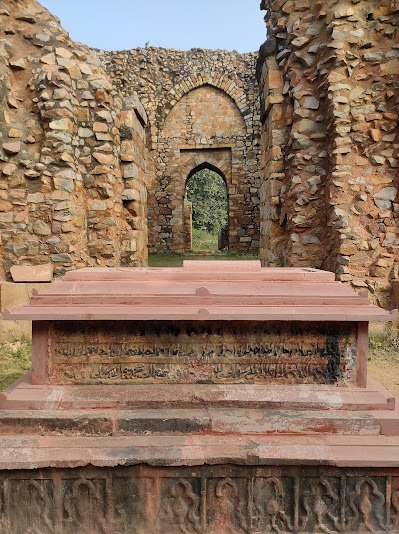
The Birthplace of the True Arch in Indo-Islamic Architecture
Introduction
Balban’s Tomb, located in the historic Mehrauli area of South Delhi, is one of the most important yet understated monuments of medieval India. Unlike the grand Mughal tombs that dominate Delhi’s heritage narrative, this 13th-century structure marks a critical architectural transition during the Delhi Sultanate period. The tomb belongs to Ghiyasuddin Balban, one of the most powerful rulers of the Mamluk (Slave) Dynasty, and is widely regarded as the site where the true arch and dome were first attempted in India. Hidden within the Mehrauli Archaeological Park, Balban’s Tomb holds immense historical and architectural value for scholars, heritage walkers, and students of Indo-Islamic architecture.
Geographical Setting
Balban’s Tomb is situated within the Mehrauli Archaeological Park, a vast heritage zone adjacent to the Qutub Minar complex. Mehrauli occupies a strategic position along the Aravalli hill ridge, which historically offered natural defense and access to water sources such as tanks and stepwells.
This area served as the core of Delhi’s earliest cities, including Lal Kot and Qila Rai Pithora, before becoming a favored retreat and burial ground for rulers and nobles. Surrounded by forests, rocky terrain, and medieval ruins, the tomb’s setting reflects Mehrauli’s long-standing role as both a political and spiritual landscape. Its proximity to monuments like Jamali Kamali Mosque, Quli Khan’s Tomb, and Adham Khan’s Tomb reinforces the area’s layered historical character.
History
Balban, originally a Turkic slave, rose to become one of the most formidable sultans of the Delhi Sultanate, ruling from 1266 to 1287 CE. He strengthened the central authority of the Sultanate, suppressed rebellions, and established a strict administrative system that reinforced royal power. His reign marked a shift toward absolutist monarchy, laying the foundation for later Sultanate governance.
After Balban’s death in 1287 CE, he was buried in Mehrauli, which at the time remained a significant political and ceremonial zone. His tomb was constructed near earlier Sultanate monuments, reflecting continuity in royal burial traditions. Although the tomb fell into ruin over the centuries, its historical importance has only grown due to its architectural innovations.
Architecture
Architecturally, Balban’s Tomb is revolutionary. It is the earliest known structure in India to employ a true arch, constructed using voussoirs rather than corbelled techniques borrowed from earlier Hindu temple architecture. This innovation marks a turning point in the evolution of Indo-Islamic construction methods.
The tomb follows a rectangular plan, built primarily of red sandstone and rubble masonry. While the dome itself has collapsed, archaeological evidence suggests it was among the earliest true domes attempted in the subcontinent. The arches, particularly the western entrance, clearly demonstrate the structural principles of load distribution that later became standard in Sultanate and Mughal architecture.
The interior is austere, with minimal decoration, emphasizing strength and functionality over ornamentation. This architectural restraint aligns with Balban’s personality and governance style—disciplined, authoritative, and uncompromising.
Cultural and Architectural Significance
Balban’s Tomb occupies a unique place in Indian architectural history. It represents the transition from corbelled to true arches, a technique that would later define monuments such as the Qutub Minar complex, Alai Darwaza, and Mughal-era mosques and tombs.
For historians and architects, the tomb is a crucial learning site, offering insight into early Sultanate experimentation with Islamic construction techniques. For visitors, it provides a deeper understanding of Delhi’s evolution as a center of political power and architectural innovation.
Despite its importance, Balban’s Tomb remains relatively less crowded, making it ideal for heritage walks, academic visits, and contemplative exploration within Mehrauli Archaeological Park.
How to Reach
- By Metro:
The nearest metro station is Qutub Minar Metro Station on the Yellow Line. From there, visitors can take an auto-rickshaw or taxi to Mehrauli Archaeological Park. - By Road:
Mehrauli is well connected via Mehrauli–Gurgaon Road, with easy access from Saket, Chhatarpur, Vasant Kunj, and Andheria Bagh. Parking is available near the archaeological park entrance. - By Bus:
Multiple DTC bus routes serve Mehrauli village and nearby landmarks around the Qutub complex.
Visitor Information
- Entry Fee: Free
- Best Time to Visit: October to March; early morning or late afternoon is ideal
- Photography: Allowed
- Ideal For: History scholars, architecture students, heritage walkers, cultural travelers