
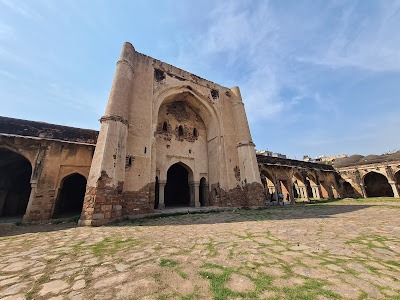
Image Source: Ravneesh
The Grand Congregational Mosque of Jahanpanah
Begumpur Masjid, located in Malviya Nagar, South Delhi, is one of the largest and most architecturally impressive mosques of the Tughlaq period. Built in the mid-14th century as part of Jahanpanah, the fourth city of Delhi founded by Sultan Muhammad bin Tughlaq, the mosque served as the principal congregational (Jama) mosque of the city. Despite centuries of neglect, Begumpur Masjid remains a powerful symbol of Delhi Sultanate ambition and urban planning.
History
Begumpur Masjid was constructed around 1343 AD during the reign of Sultan Muhammad bin Tughlaq. Historical records attribute its construction to Khan-i-Jahan Maqbul, the powerful prime minister (Wazir) of the Sultanate and a prominent patron of architecture.
The mosque was built to serve the religious needs of Jahanpanah, a newly created capital intended to unite the earlier cities of Siri and Lal Kot within a fortified enclosure. As the Jama Masjid of Jahanpanah, Begumpur Masjid was designed to accommodate a large congregation, reflecting the scale and importance of the new city.
However, Jahanpanah’s decline began soon after Muhammad bin Tughlaq’s death. With the abandonment of the city, Begumpur Masjid lost its central religious role and gradually fell into disuse, though its massive structure ensured its survival through the centuries.
Architecture of Begumpur Masjid
Begumpur Masjid is a masterpiece of Tughlaq-era mosque architecture, characterized by strength, spatial complexity, and restrained decoration.
Key Architectural Features
- Vast Rectangular Layout:
The mosque is laid out on a large rectangular plan, designed to hold thousands of worshippers. - Central Open Courtyard:
A spacious open courtyard forms the heart of the mosque, surrounded by covered prayer halls. - Multiple Domes:
The roof is crowned with numerous low domes, creating a distinctive skyline and ensuring structural balance. - Four Minarets:
Tall corner minarets mark the mosque’s boundaries and enhance its monumental scale. - Tughlaq Construction Style:
Built using stone rubble and lime mortar, the mosque emphasizes solidity over ornamentation. - Mehrab and Mihrabs:
The prayer hall contains a central mihrab flanked by multiple smaller mihrabs, indicating accommodation for large congregations.
The mosque’s restrained decoration, limited to geometric forms and structural articulation, reflects the utilitarian ethos of Tughlaq architecture.
How to Reach Begumpur Masjid
By Metro:
The nearest metro stations are Malviya Nagar (Yellow Line) and Hauz Khas (Yellow & Magenta Lines). From there, the mosque is accessible by auto-rickshaw or taxi.
By Road:
Begumpur Masjid is well connected via Press Enclave Road and Aurobindo Marg.
By Rail:
Hazrat Nizamuddin Railway Station is approximately 8 km away.
Nearby Attractions
Begumpur Masjid lies at the heart of the Jahanpanah heritage zone:
- Bijay Mandal
- Satpula Bridge
- Khirki Masjid
- Chor Minar
- Hauz Khas Complex
Visiting Information
- Entry Fee: Free
- Timings: Open daily; prayer times should be respected
- Best Time to Visit: Morning or late afternoon