
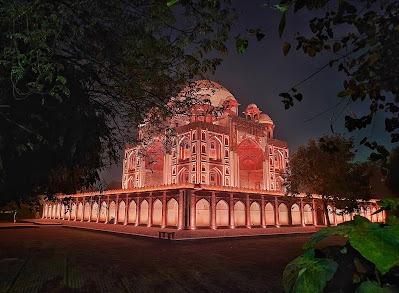
Image Source: Hitesh Raj Bhagat
Standing quietly near Nizamuddin East in South Delhi, close to the celebrated Humayun’s Tomb complex, Khan-i-Khana’s Tomb is one of Delhi’s earliest and most understated Mughal mausoleums. Though less ornate than later Mughal tombs, the monument holds immense historical and architectural value. It marks an important transitional phase in Mughal funerary architecture, paving the way for grander imperial tombs while retaining a dignified simplicity rooted in early Mughal design principles.
History of Khan-i-Khana’s Tomb
Khan-i-Khana’s Tomb was built in 1627 CE as the final resting place of Mirza Abdur Rahim Khan-i-Khanan, one of the most distinguished nobles of the Mughal Empire. He served as the Commander-in-Chief (Mir Bakshi) during the reigns of Emperors Akbar and Jahangir and was widely respected not only as a military leader but also as a scholar, poet, and patron of the arts.
Rahim Khan-i-Khanan was a renowned intellectual who translated the Baburnama from Chagatai Turkish into Persian and composed devotional poetry in Hindi and Persian, earning him a unique place in India’s literary history. His tomb reflects his stature as a nobleman rather than a ruling emperor, explaining its relatively modest scale when compared to imperial Mughal mausoleums.
Historically, the tomb once stood near the banks of the Yamuna River, overlooking a landscape of gardens and pathways. Over time, changes in the river’s course and urban expansion altered the setting, but the monument remains an integral part of Delhi’s Mughal heritage zone.
Architecture
Overall Design and Layout
Khan-i-Khana’s Tomb follows a square plan set on a raised platform, a design that later became central to Mughal funerary architecture. The structure is built around a central domed chamber, with arched entrances on all four sides, reflecting symmetry and balance—key elements of Mughal architectural philosophy.
Dome and Superstructure
The tomb is crowned by a large hemispherical dome, originally clad in stone and once adorned with decorative elements that have largely disappeared over time. The dome rests on a high drum, lending the monument a sense of vertical emphasis despite its restrained ornamentation.
Materials and Construction
Constructed primarily from grey quartzite stone, the tomb was originally faced with red sandstone and marble, much of which was later stripped away during the colonial period for reuse in other buildings. This loss has left the structure bare but also exposes its robust Mughal construction techniques.
Architectural Significance
Khan-i-Khana’s Tomb is often regarded as an architectural precursor to the Taj Mahal. Its square plan, central dome, and four-sided symmetry influenced later Mughal tombs, especially Humayun’s Tomb and, eventually, Shah Jahan’s monumental works. Despite its simplicity, the tomb embodies the evolving refinement of Mughal architectural expression.
How to Reach Khan-i-Khana’s Tomb
By Metro
The nearest metro station is JLN Stadium on the Violet Line. From there, the tomb is about 1.5 km away and can be reached by auto-rickshaw, taxi, or a pleasant walk through the Nizamuddin area.
By Bus
Several DTC buses operate along Lodhi Road and Mathura Road, with stops near Nizamuddin East. From the bus stop, the monument is a short walk.
By Car or Taxi
Khan-i-Khana’s Tomb is well connected by road via Lodhi Road, Mathura Road, and Bhairon Marg. Limited roadside parking is available nearby, so walking the final stretch is advisable.
On Foot (Heritage Walk)
The tomb can be easily included in a Nizamuddin heritage walk, along with Humayun’s Tomb, Isa Khan’s Tomb, Sunder Nursery, and the Nizamuddin Dargah.
Visitor Tips
- Best visited during early morning or late afternoon for softer light and fewer crowds.
- Combine the visit with nearby Mughal and Sultanate monuments for a richer historical experience.
- Entry is generally free, though timings may vary depending on conservation activity.
- Carry water and wear comfortable footwear, especially if walking from Humayun’s Tomb.