
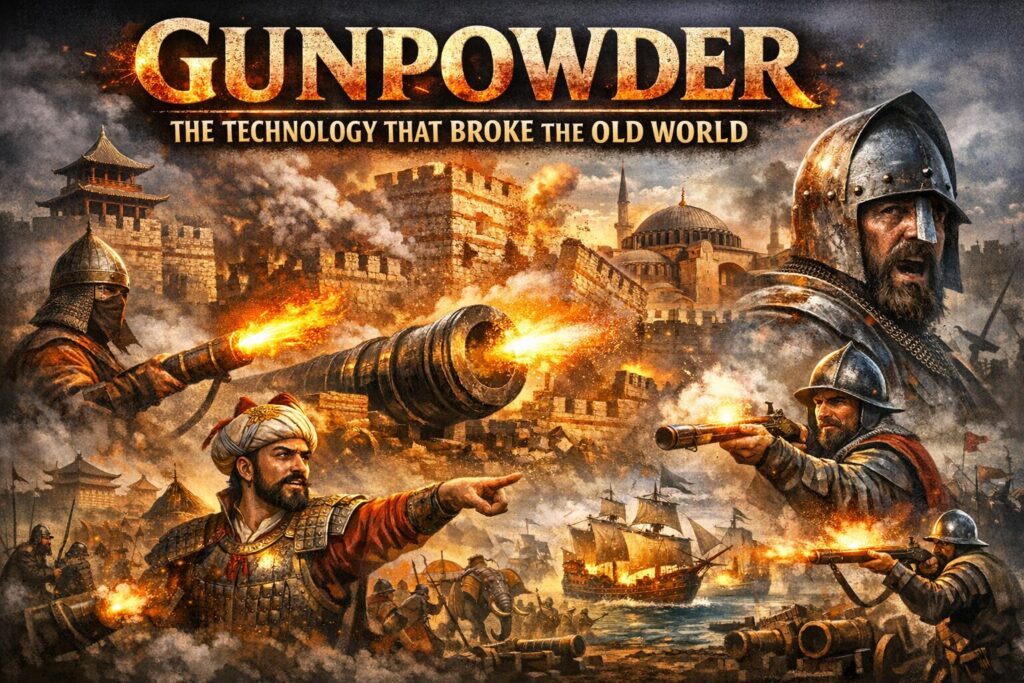
First Use: Fire as a Weapon in China
Gunpowder was first invented in China during the Tang–Song period, initially for fireworks and religious rituals. Its military use began with simple weapons such as fire-lances (bamboo tubes shooting flames and pellets), bombs, and crude rockets. Chinese armies used these against steppe invaders and in internal wars, especially during the Song–Jin conflicts. These early weapons were not yet powerful enough to destroy walls, but they introduced a new idea into warfare: victory could come from chemical energy rather than muscle and steel.
Gunpowder Reaches the Islamic World and Europe
Through Silk Road trade and Mongol conquests, gunpowder spread westward into Central Asia, the Islamic world, and Europe by the 13th–14th centuries. Muslim and European armies began experimenting with cannons and handguns. At first, these weapons were unreliable and slow, but they had a crucial psychological effect. The sound, smoke, and fire of cannons frightened both soldiers and horses, changing battlefield behavior. Warfare slowly shifted from elite armored warriors to mass infantry armed with firearms.
The Fall of Great Walls: Constantinople (1453)
One of the most famous early uses of gunpowder was the Ottoman siege of Constantinople in 1453. The Ottomans used massive cannons to batter walls that had stood for over a thousand years. These fortifications had resisted Persians, Arabs, and crusaders, but they could not withstand sustained artillery fire. Under Mehmed II , the Ottomans proved that cannon could end the age of classical fortifications and medieval siege warfare.
Gunpowder Comes to India: Battle of Panipat (1526)
Gunpowder decisively entered Indian warfare with the invasion of Babur, who brought field artillery and matchlock gunners into battle. At the First Battle of Panipat in 1526, Babur defeated the much larger army of the Delhi Sultanate by combining cannons, defensive carts, and disciplined infantry fire. His victory marked the beginning of the Mughal Empire under Babur . This battle showed that elephants, cavalry charges, and traditional swordsmen could be neutralized by coordinated gunpowder weapons.
The End of Knights and Castles in Europe
In Europe, gunpowder changed warfare by destroying the dominance of armored knights and stone castles. Cannons could break feudal strongholds that once took years to capture. Muskets made expensive armor useless, since even a peasant soldier could kill a noble knight from a distance. This weakened feudal lords and strengthened kings who could afford artillery and gun factories. As a result, centralized states like France and Spain grew powerful, while medieval feudalism declined.
Naval Warfare: Cannons at Sea
Gunpowder also transformed naval combat. Ships armed with cannons replaced boarding-based combat with long-range destruction. European powers used gun-armed fleets to control sea routes and colonies. This allowed relatively small European states to dominate global trade networks and defeat much larger land empires that lacked comparable naval firepower. Control of the seas became as important as control of land.