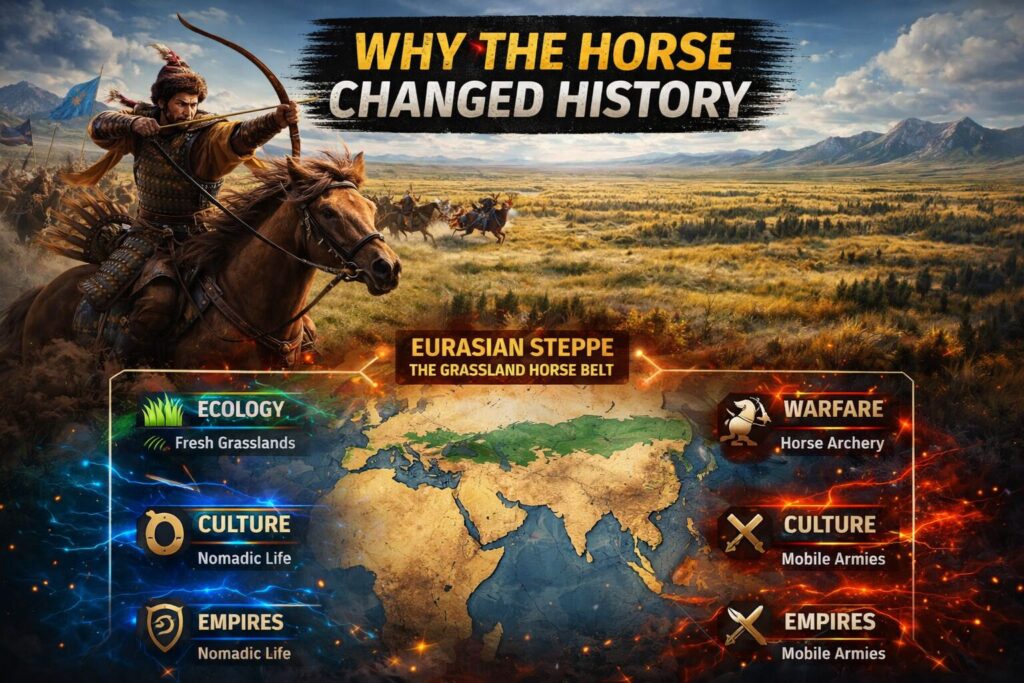
Geography Made the Horse Powerful
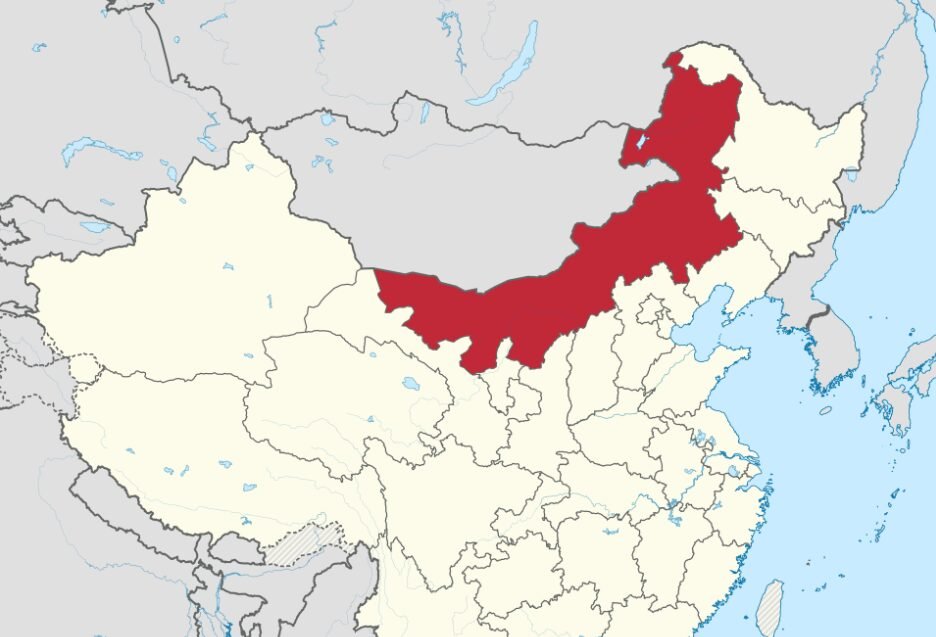
The Eurasian steppe is a vast belt of flat, grassy land stretching from Eastern Europe to Mongolia. It has low rainfall, few forests, and limited farming potential, which made settled agriculture difficult but grazing easy. In such an environment, mobility was more valuable than land ownership. Horses could survive by feeding directly on natural grass and could travel long distances every day.
This allowed steppe peoples to become highly mobile societies, moving with their herds rather than building permanent cities. Over time, this ecological setting created cultures where the horse was not just transport but the foundation of life, economy, and survival.
Horses Created a New Style of Warfare
Horses transformed war by turning speed into a weapon. Mounted warriors could move faster than infantry armies, attack unexpectedly, and retreat before the enemy could respond. The development of horse archery made this even more effective, as warriors could shoot accurately while riding. This style of warfare emphasized encirclement, feigned retreat, and constant harassment instead of direct confrontation. Steppe armies were therefore extremely difficult for slow, supply-dependent empires to defeat.
This military system reached its peak under Genghis Khan , whose armies used horse mobility and strict discipline to build the largest contiguous land empire in history.
Horse Culture Shaped Steppe Society
In steppe societies, horses were central to daily life. Children learned to ride almost as soon as they could walk, and every warrior owned several horses to switch between during long journeys. Wealth was measured in livestock rather than land or gold. Food, clothing, and shelter were linked to animals, especially horses and sheep.
This produced a worldview in which movement was normal and settlement was temporary. Political power depended on controlling herds and migration routes rather than cities and farmlands. Thus, the horse did not just support steppe societies; it shaped their values, economy, and identity.
Why Horse Empires Dominated Sedentary Civilizations ?
Agricultural empires depended on fixed cities, roads, and granaries, which made them predictable and vulnerable. Their armies needed constant supplies and could not easily change direction or speed. Steppe horse armies, in contrast, carried their logistics with them in the form of herds. They could avoid strong defenses, strike at weak points, and vanish into open grasslands. This asymmetry meant that large empires like China, Persia, and Rome often struggled to defeat nomadic cavalry forces, even when they had superior numbers and resources.
Decline of Horse-Based Power
For nearly two thousand years, horses dominated warfare across Eurasia. This changed only with the arrival of gunpowder weapons, professional standing armies, and modern logistics systems such as railways. Firearms reduced the advantage of speed, and centralized states could now move soldiers and supplies faster without relying on grazing land. As a result, the military superiority of steppe horse cultures gradually disappeared, and nomadic empires were absorbed into modern nation-states.
Conclusion: The Horse as a Civilizational Force
Horses were successful on the steppe not merely because they were useful animals, but because they matched the geography perfectly. They enabled a form of civilization based on movement rather than settlement, on herds rather than fields, and on speed rather than walls. This horse-based system produced some of the most formidable armies in history and reshaped political boundaries across continents. In this sense, the horse was not just part of steppe history—it was the engine that drove it.