
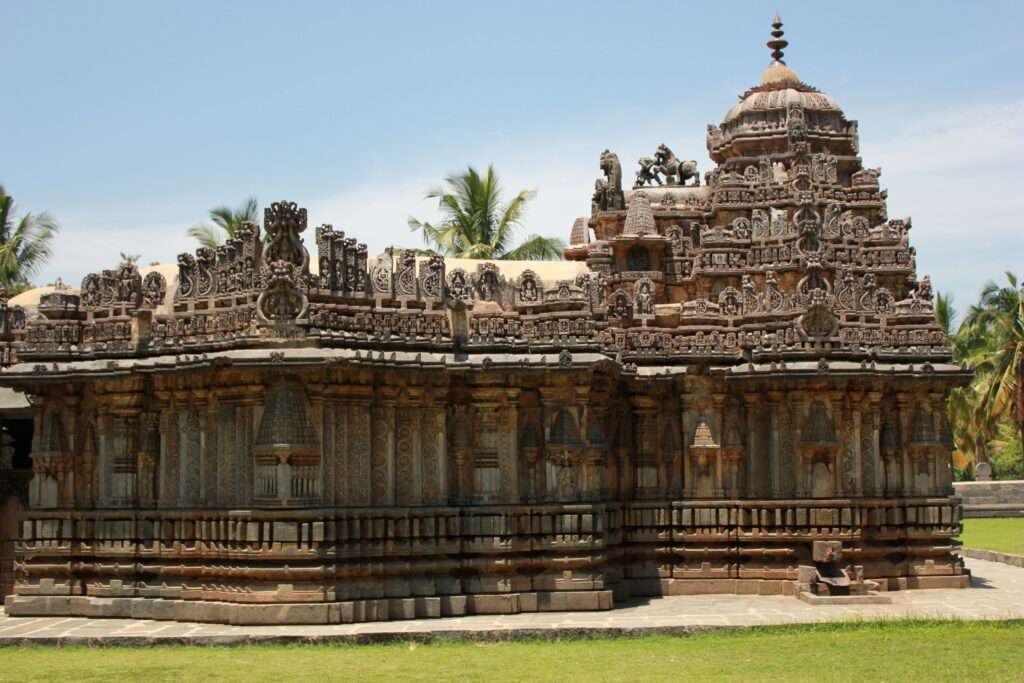
Image Source: Dineshkannambadi
About Amruteshwara Temple
The Amruteshwara Temple, also spelled Amrutesvara or Amruteshwara, is one of the finest surviving monuments of Hoysala architecture, located in the village of Amruthapura in the Chikkamagaluru district, Karnataka. Situated about 67 km north of Chikkamagaluru, 50 km from Shimoga, and 110 km from Hassan, this 12th-century temple remains an enduring symbol of Hoysala artistic excellence and religious devotion.
Historical Background
The temple was constructed in 1196 CE by Amrutheshwara Dandanayaka, a commander under the celebrated Hoysala king Veera Ballala II. Dedicated to Lord Shiva, it represents a medium-sized temple typical of the Hoysalas’ architectural experiments during this period. Inscriptions found near the temple, including those with poems by the medieval Kannada poet Janna, add immense historical and literary value. The temple is also listed under the Archaeological Survey of India (Bengaluru Circle) as a protected monument, ensuring its preservation for future generations.
Architecture and Layout
The Amruteshwara Temple is built in the ekakuta plan, meaning it has a single shrine (vimana) with its own superstructure. The square sanctum enshrines a Shiva Linga and is connected to a closed mantapa (hall), which further opens into a large open mantapa. The closed hall, with its nine bays, also features a side porch leading to a small shrine on the southern side. The open mantapa, remarkable in scale, has twenty-nine bays, making it one of the more spacious halls among medium-sized Hoysala temples.
The lathe-turned pillars supporting the mantapas gleam with polish, showcasing the Hoysalas’ refined stonecraft. The ceilings are intricately carved with deeply domed floral designs, including some of the earliest works of the renowned sculptor Ruvari Mallitamma, who began his career here.
Superstructure and Walls
The shrine retains its original superstructure (shikhara), embellished with miniature decorative towers (aedicules) and fierce Kirtimukha motifs (demon faces). The sukanasi, or nose-like tower above the vestibule, prominently displays the Hoysala royal emblem of Sala slaying a lion, reinforcing dynastic identity.
The temple walls exhibit both simplicity and sophistication. The outer wall is adorned with uniquely spaced circular carvings, while the parapet wall of the open mantapa carries an impressive series of 140 sculptural panels. The base mouldings of the temple, numbering five, belong to the earlier Hoysala style of the 12th century, marking a stage before the more elaborate ornamentation of later temples.
Sculptural Narratives
One of the most striking features of the Amruteshwara Temple is its extensive epic narration in stone. The 140 large panels on the mantapa parapet vividly retell stories from Hindu mythology:
The Ramayana unfolds across 70 panels on the southern wall, arranged in a unique anti-clockwise direction, an unusual feature in temple iconography.
The life of Krishna is captured in 25 panels, showcasing episodes from his childhood and divine acts.
The Mahabharata is depicted in 45 panels on the northern wall, this time following the standard clockwise arrangement seen in Hoysala temples.
These friezes, larger than those in many other Hoysala temples, provide both visual delight and religious instruction for devotees and visitors. Perforated stone windows, decorative scrolls, and miniature towers add to the sculptural richness of the temple.
Cultural and Historical Significance
The Amruteshwara Temple is more than just a shrine; it is a repository of art, literature, and dynastic history. The presence of poet Janna’s verses highlights the cultural vibrancy of the Hoysala court, where architecture, poetry, and devotion intertwined. Architecturally, it stands as a precursor to larger and more elaborate projects like the Veera Narayana Temple at Belavadi.
Even today, the temple remains an active center of worship, drawing devotees as well as heritage enthusiasts. Its peaceful rural setting enhances the spiritual atmosphere, making it an ideal place for both religious reverence and historical exploration.