Image Source: Dinesh Krishnan
About Mahanavami Dibba
Set within the grand ruins of Hampi, the Mahanavami Dibba—also known as the Dasara Dibba—is one of the most fascinating structures from the glorious Vijayanagara Empire. Built in 1513 AD by the celebrated king Krishnadevaraya, this विशाल (impressive) stone platform once served as a royal stage for grand celebrations, ceremonies, and public events.
Today, it stands as a silent witness to the empire’s power, cultural richness, and love for spectacle—offering visitors a glimpse into a time when Hampi was one of the richest cities in the world.
Historical Significance and Royal Celebrations
The Mahanavami Dibba is closely linked to one of the most important festivals of the Vijayanagara period—the Mahanavami festival, which we now associate with Dussehra. After his victorious campaign against the Udayagiri kingdom (in present-day Odisha), King Krishnadevaraya commissioned this platform as a symbol of triumph and royal pride.
From this elevated मंच (stage), the king and members of the royal court would watch elaborate processions, military parades, cultural performances, and even mock war games. It wasn’t just a viewing gallery—it was the heart of celebration, where power, devotion, and artistry came together in spectacular fashion.
Architectural Features and Design
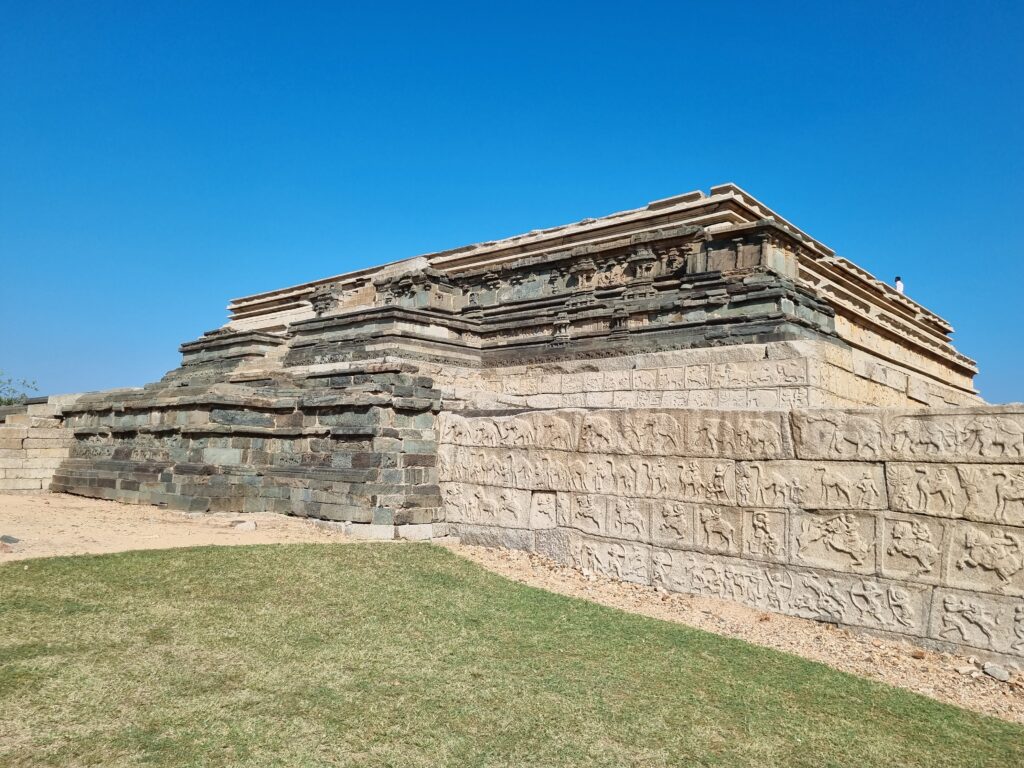
Standing about 12 meters high, the Mahanavami Dibba is a massive, square-shaped platform that dominates the Royal Enclosure of Hampi. Two beautifully designed stairways—one at the front and another at the back—lead visitors to the top, from where you can enjoy panoramic views of the surrounding ruins.
The structure is built in three distinct tiers, each adorned with intricate carvings that tell stories of the past. As you move closer, the level of detail becomes truly remarkable.
Carvings That Tell Stories
The walls of the Mahanavami Dibba are like a stone canvas filled with life and movement. The carvings vividly depict scenes from royal life and festive celebrations.
- The lower panels showcase merchants, royal processions, dancers, musicians, elephants, horses, and other animals
- You’ll also find depictions of foreign traders, hinting at the global connections of the Vijayanagara Empire
- Higher sections reflect ceremonial grandeur, possibly linked to the Mahanavami festivities
These engravings don’t just decorate the structure—they narrate stories of a thriving, cosmopolitan empire and its vibrant culture.
Visitor Experience
Walking around the Mahanavami Dibba feels like stepping into a living history book. The sheer scale of the platform, combined with its artistic details, makes it one of the highlights of any visit to Hampi.
Climbing to the top gives you a sense of what the royal experience might have been like—overlooking vast grounds where celebrations once unfolded. It’s a must-visit for history enthusiasts, photographers, and anyone curious about India’s rich past.
Timings and Entry
- Timings: 6:00 AM to 6:00 PM.
- Entry Fee: Free (as part of the Hampi Royal Enclosure visit).
How to Reach Mahanavami Dibba
Mahanavami Dibba, also known as the “Great Platform” or “Dasara Dibba,” is one of the most significant monuments within Hampi’s Royal Enclosure. This grand ceremonial platform was once used by Vijayanagara kings to witness royal processions, military parades, and Navaratri celebrations. Located in the heart of Hampi’s archaeological zone, it is easily accessible from other major attractions.
By Air
The nearest airport is Jindal Vijayanagar Airport in Toranagallu, situated about 35–40 km from Hampi. From the airport, visitors can hire taxis or cabs to reach the Royal Enclosure. Hubballi Airport, around 150–165 km away, is another option with broader connectivity.
By Rail
The closest railway station is Hosapete (Hospet) Junction, approximately 12–14 km from Hampi. Regular buses, auto-rickshaws, and taxis are available from the station to the monument complex.
By Road
Hampi is well connected by road to major cities like Bengaluru, Ballari, Hubballi, and Hyderabad. KSRTC and private buses operate frequently to Hosapete and Hampi. From Hampi Bazaar or the bus stand, Mahanavami Dibba is about 3–4 km away and can be reached by auto-rickshaw, bicycle, scooter, or on foot while exploring the Royal Enclosure.
Nearby Attractions
Hazara Rama Temple
Located adjacent to Mahanavami Dibba, this temple is famous for its intricate Ramayana carvings and served as the private shrine of the Vijayanagara royals.
Stepped Tank (Pushkarani)
An architectural marvel within the Royal Enclosure, the symmetrical stepped tank showcases the advanced water management systems of the Vijayanagara Empire.
King’s Audience Hall
Believed to have been a venue for royal gatherings and state affairs, the remains of this structure offer insight into the administrative grandeur of the empire.
Queen’s Bath
Situated a short distance away, this elegant bathing complex combines Indo-Islamic architectural elements with royal luxury.
Lotus Mahal
One of Hampi’s most iconic monuments, the Lotus Mahal is celebrated for its graceful Indo-Islamic architecture and ingenious cooling system.
Elephant Stables
Located near the Zenana Enclosure, these impressive chambers once housed the royal elephants and remain among Hampi’s best-preserved structures.
Zenana Enclosure
This fortified area is believed to have served as the royal women’s quarters and contains several important monuments, including the Lotus Mahal.
Virupaksha Temple
The spiritual heart of Hampi, this ancient temple dedicated to Lord Shiva continues to be an active place of worship today.
Travel Tips
- Visit early morning or late afternoon to avoid the heat and crowds.
- Wear comfortable footwear, as the terrain can be uneven.
- Carry water, especially during summer months.
- Hire a guide if you want deeper insights into the carvings and history.
Map and Location of Mahanavami Dibba
Situated just 3.5 km from the Hampi bus stand within the royal enclosure, it’s one of the must-visit sites during a Hampi excursion.
FAQs
1. What is Mahanavami Dibba famous for?
It is famous as a royal platform used by Vijayanagara kings to watch grand Dussehra (Mahanavami) celebrations, processions, and performances.
2. Who built the Mahanavami Dibba?
It was built by King Krishnadevaraya in 1513 AD after his victory over Udayagiri.
3. Where is it located?
It is located within the Royal Enclosure of Hampi in Karnataka.
4. Can visitors climb the platform?
Yes, visitors can climb the steps and explore the top of the platform.
5. What can you see in the carvings?
The carvings depict royal life, festivals, animals, musicians, traders, and scenes from everyday life in the Vijayanagara Empire.
6. Is there an entry fee?
There is no separate entry fee for the platform; it is included in the visit to the Royal Enclosure.