
Image Source:
About Brahma Jinalaya
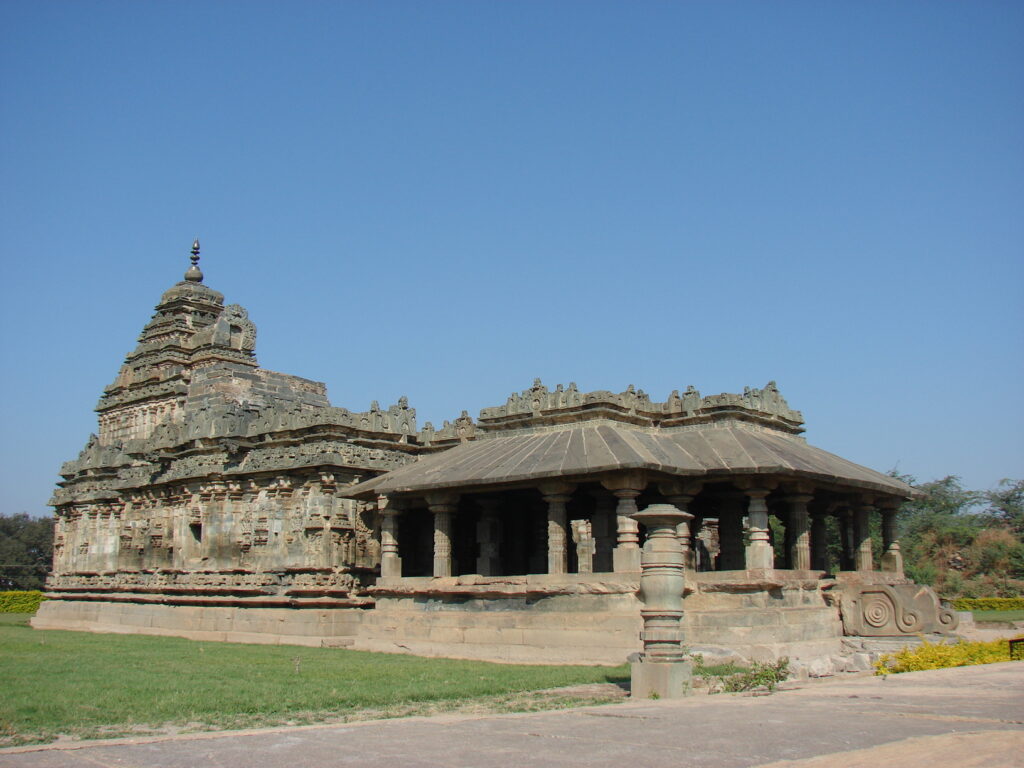
The Brahma Jinalaya, located in Lakkundi in Karnataka’s Gadag district, is one of the most remarkable Jain temples of the Western Chalukya period. Built in the 11th century CE, it stands as a grand symbol of Jain religious patronage, refined stone craftsmanship, and architectural experimentation. It is the largest Jain temple at Lakkundi and one of the best-preserved examples of Kalyani Chalukya architecture, reflecting the religious diversity and artistic brilliance of the age.
History
The temple was constructed in 1050 CE by Attimabbe, a renowned and devout Jain woman patron during the reign of the Kalyani Chalukya king Somesvara I (1042–1068 CE). Attimabbe is celebrated in history as a great philanthropist and promoter of learning, known for distributing thousands of copies of Jain scriptures.
The Brahma Jinalaya, dedicated to Lord Mahavira, the 24th Tirthankara of Jainism, represents both her piety and the Chalukya dynasty’s religious tolerance. The name “Brahma Jinalaya” signifies its grandeur, where Jinalaya means a Jain temple and Brahma denotes greatness.
Architecture
Scale and Layout
The Brahma Jinalaya is the largest Jain temple in Lakkundi, constructed on a spacious high platform (jagati).
It follows a Dravida (southern) style vimana in its sanctum, while integrating unique features of the Western Chalukya style.
The temple plan includes a garbhagriha (sanctum), antarala (vestibule), and a large mahamantapa (pillared hall).
Tower (Vimana)
The sanctum has a Dravidian-style vimana (superstructure), which is unusual for Chalukya Jain temples, making it distinctive in design.
The vimana is decorated with miniature shrines, pilasters, and finely carved motifs, giving it a multi-tiered look.
Sculptural Details
The sanctum enshrines an image of Lord Mahavira in seated posture.
The temple walls are richly ornamented with carvings of floral scrolls, miniature shrines, and Jain iconography.
The doorways feature elaborate makara toranas and celestial motifs, while the ceilings showcase lotus medallions.
Pillared Hall
The mahamantapa is supported by finely crafted lathe-turned pillars, an architectural innovation that reached perfection during the Western Chalukya era.
The polish of the pillars and their geometric precision reflect the technical mastery of Chalukyan sculptors.
Unique Aspects
Patronage by Attimabbe – A rare monument built under the initiative of a woman patron, highlighting the role of Jain women in medieval Karnataka’s cultural and religious life.
Largest Jain Temple in Lakkundi – Unlike the smaller shrines scattered across Lakkundi, the Brahma Jinalaya stands out for its scale and grandeur.
Blend of Styles – The adoption of a Dravidian vimana with Western Chalukya ornamentation makes it a unique architectural experiment.
Cultural Importance – The temple testifies to the flourishing Jain community in Lakkundi during the 11th century, when the town was a major center of religion, trade, and learning.
Cultural and Religious Significance
The Brahma Jinalaya is not only an architectural gem but also a symbol of Jain devotion and philanthropy in medieval Karnataka. It reflects the Jain community’s prosperity in Lakkundi, which was then dotted with temples, stepwells (kalyanis), and basadis. Even today, the temple is an important pilgrimage site for Jains and a heritage attraction for visitors interested in India’s architectural history.
Visiting Lakkundi and Brahma Jinalaya
Location: Lakkundi is about 12 km from Gadag in North Karnataka.
Accessibility: Easily accessible by road from Gadag, Hubballi, and Haveri. Gadag railway station is the nearest railhead, and Hubballi is the closest airport.
Nearby Attractions: Visitors can also explore the Kasivisvesvara Temple, other Jain basadis, and Lakkundi’s famous stepwells like the Musu Kattina Bhavi.