
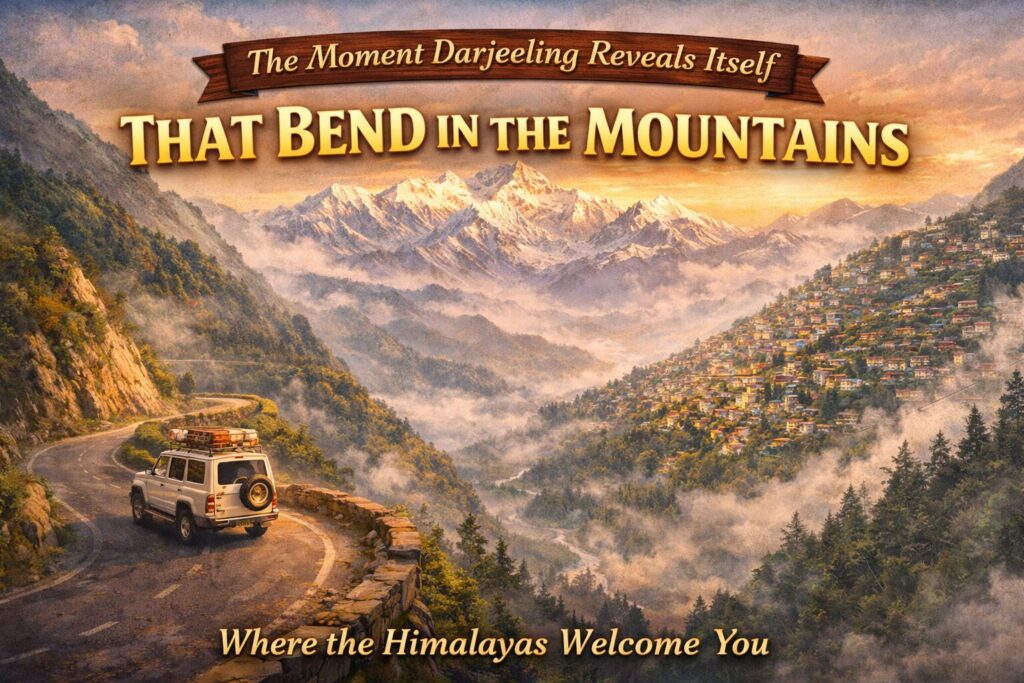
There is always that one bend in the mountains.
You do not know it is the bend until you take it. The road coils upward through mist and silence, climbing from the plains near Siliguri into the cool heights of the Himalayas. Then suddenly, as your vehicle turns that last winding curve, something shifts inside you. The air feels lighter, thinner, scented faintly with pine and damp earth. A strange exhilaration fills your being, as if the mountains themselves have acknowledged your arrival into Darjeeling, perched at an altitude of about 2,042 meters above sea level.
When Darjeeling Was Still a Secret
Long before it became a celebrated hill station, this region was a remote and forested tract, part of the territories of the Kingdom of Sikkim. In the early nineteenth century, officials of the British East India Company were sent to explore these hills. Among them were officers like George Lloyd and J. W. Grant, who trekked through dense, almost impenetrable forests.
The journey was anything but romantic.
They struggled through thick oak and pine forests, tangled undergrowth, and steep, unforgiving slopes. The region was sparsely inhabited, dotted with Lepcha settlements, and covered in wild vegetation, including orchids that clung silently to tree trunks. Progress was slow, exhausting, and often frustrating.
Yet the mountains have their own way of revealing themselves.
One day, as the story goes, the explorers reached a ridge and stepped onto a narrow spur. What they saw before them was nothing short of transformative.
The Moment of Revelation
The clouds parted.
And there it was, the majestic Kangchenjunga Range, the third highest mountain range in the world, rising to 8,586 meters. Its snow clad peaks shimmered in the changing light, appearing almost unreal against the deep green of the surrounding forests.
Below, valleys stretched endlessly, carved by rivers like the Teesta River, which still flows as the lifeline of the region. The view was so overwhelming that the hardships of the journey faded instantly.
In that single moment, a remote Himalayan ridge transformed into a place of immense value. Recognizing its strategic and climatic advantages, the British soon began developing Darjeeling as a sanatorium and summer retreat. By 1835, it had been leased from the Chogyal of Sikkim, marking the beginning of its journey as a hill station.
Almost as if by magic, Darjeeling was born into prominence.
A Hill Station Takes Shape
As the British established themselves here, Darjeeling evolved rapidly. Roads were carved into the mountains, colonial bungalows appeared on ridges, and tea plantations began to spread across the slopes. The cool climate, ranging between 5°C in winter and 20°C in summer, made it an ideal escape from the heat of the plains.
One of the most remarkable developments came in 1881 with the construction of the Darjeeling Himalayan Railway. This narrow gauge railway, now a UNESCO World Heritage Site, connected the hills to the plains, making travel easier while adding a timeless charm to the region. Even today, the small blue toy train winds its way through loops and zigzags, offering one of the most scenic rail journeys in the world.
The Queen with a Tired Crown
Time, however, has a way of reshaping even the most beautiful places.
Today, Darjeeling is often called the “Queen of the Hill Stations,” but the crown sits a little heavily. The town has grown rapidly, and with that growth have come challenges. Water shortages are a recurring issue, especially in peak tourist seasons. Waste management and environmental pressure have affected some of the natural beauty, and during the monsoon months, landslides frequently disrupt life and travel.
Yet, despite all this, the allure of Darjeeling remains intact.
Every year, thousands of travelers make their way here, drawn by something deeper than convenience or luxury.
The Living Charm of Dorje Ling
The name “Dorje Ling,” meaning Place of the Thunderbolt, reflects the region’s spiritual and cultural depth. Influences of Nepali, Tibetan, and Lepcha traditions are visible in everyday life, from monasteries to festivals to food.
Walk away from the crowded Mall Road, and Darjeeling begins to reveal its quieter side. Small villages cling to hillsides, prayer flags flutter in the wind, and hidden trails lead to tiny waterfalls that seem untouched by time.
Then there is the tea, perhaps Darjeeling’s most famous contribution to the world.
Darjeeling tea is often called the “champagne of teas.” Grown at elevations between 600 and 2,000 meters, it is known for its delicate aroma and unique muscatel flavor. The tea gardens, spread across rolling slopes, are not just agricultural spaces but an integral part of the region’s identity and economy.
The View That Never Gets Old
Even today, the true magic of Darjeeling lies in its views.
Early mornings often begin at Tiger Hill, where travelers gather before sunrise. As the first light touches the peaks of the Kangchenjunga Range, the mountains glow in shades of gold and pink, a sight that continues to inspire awe just as it did for those early explorers.
The town itself, with its layered houses, winding roads, and distant mountain backdrop, feels like a living painting.
The Bend Still Awaits
And so, the story comes full circle.
That bend in the mountain road still exists. Every traveler who journeys from the plains into the hills experiences it in their own way. The feeling may be different now, shaped by modern roads and vehicles, but the essence remains unchanged.
Darjeeling is not just a destination built by history, it is a place continuously rediscovered by those who arrive.
Because somewhere between the facts and the feelings, between the past and the present, Darjeeling still holds onto that moment of revelation.
And if you ever find yourself taking that last turn on the mountain road, pause for a moment.
Look up.
The mountains are still waiting.