Image Source: SwastikArora
Ancient and Sacred City
Varanasi, also known as Banaras or Kashi, is regarded as one of the oldest continuously inhabited cities in the world, with a recorded history stretching back more than three millennia. Ancient Hindu scriptures describe it as Kashi, the City of Light, symbolizing spiritual illumination and liberation. It is counted among the Sapta Puri, the seven holiest cities in Hinduism, making it a timeless center of pilgrimage. Archaeological and literary evidence suggests that Varanasi flourished as an urban settlement even in the early Gangetic civilization, serving as a hub of trade, learning, and spiritual discourse.
Buddhist and Jain Heritage
Just about 10 km from the city lies Sarnath, where Gautama Buddha delivered his first sermon after attaining enlightenment, known as the Dhammachakrapravartana. The Dhamek Stupa stands as a powerful symbol of this moment, marking the birth of the Buddhist Sangha. Varanasi is also deeply significant to Jainism as the birthplace of Tirthankara Parshvanatha, the 23rd Jain Tirthankara. This interweaving of Hindu, Buddhist, and Jain traditions makes the region unique in India for its layered religious history.
Medieval and Colonial Influence
During the Mughal period, especially under Emperor Akbar, Varanasi received royal patronage in the form of temple restoration and support for educational institutions. Unlike many cities, its spiritual life continued relatively uninterrupted, even as political powers shifted. In the British era, Varanasi emerged as a major center of Sanskrit learning and nationalist thought. It became a meeting ground for reformers, scholars, and freedom fighters, contributing intellectually to India’s independence movement.
Temples, Ghats, and Spiritual Life
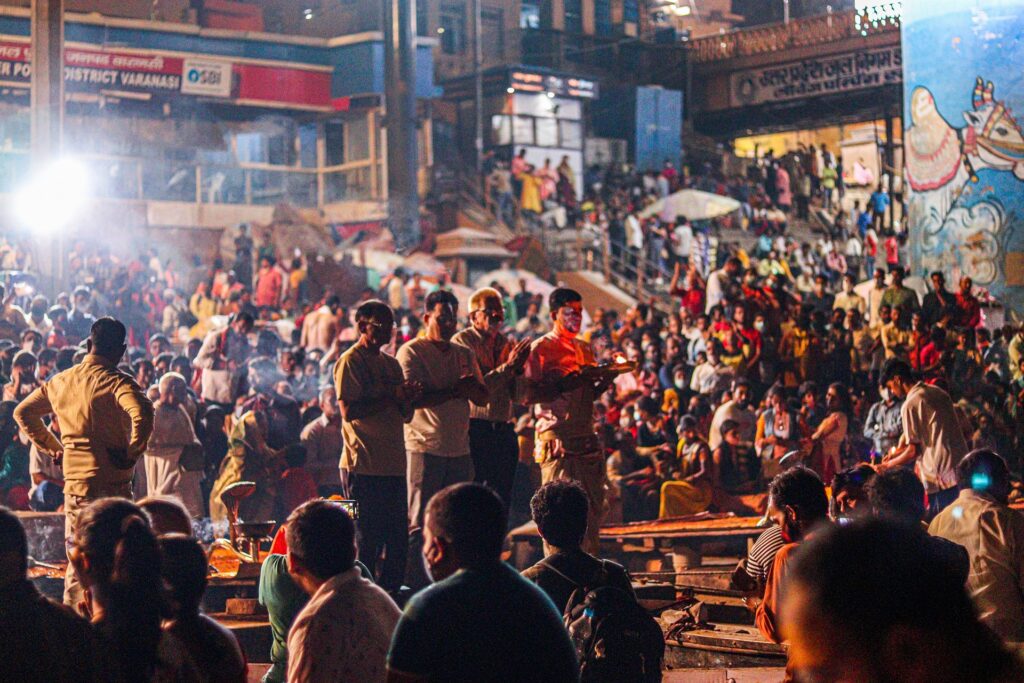
At the heart of the city stands the Kashi Vishwanath Temple, dedicated to Lord Shiva and revered as one of the twelve Jyotirlingas of India. Along the banks of the Ganga stretch more than 80 ghats, including Manikarnika Ghat, the principal cremation site, and Assi Ghat, known for its youthful and devotional atmosphere. The evening Ganga Aarti at Dashashwamedh Ghat is among the most iconic rituals in India, drawing thousands of devotees and visitors daily. A widespread belief holds that dying in Varanasi and being cremated on its ghats grants moksha, liberation from the cycle of rebirth, reinforcing the city’s image as a gateway between life and eternity.
Festivals and Living Traditions
Varanasi’s religious calendar is vibrant with festivals such as Dev Deepawali, Mahashivratri, Holi, and Ganga Mahotsav. Dev Deepawali, celebrated on Kartik Purnima, transforms the ghats into a sea of lamps, reflecting a cosmic spectacle on the river. These festivals blend ritual, music, and community life, ensuring that the city’s ancient traditions remain alive in everyday practice.
Education and Literary Legacy
One of the city’s greatest modern institutions is Banaras Hindu University, founded in 1916 by Pandit Madan Mohan Malaviya. It is among Asia’s largest residential universities and has played a major role in shaping India’s academic and nationalist leadership. Varanasi is also regarded as a global center for Sanskrit education, with institutions like Sampurnanand Sanskrit University preserving classical Indian knowledge systems. The city has inspired and nurtured literary giants such as Kabir, Tulsidas, Munshi Premchand, and Bharatendu Harishchandra, whose works reflect both spiritual depth and social realism.
Economy and Handicrafts
The city is world famous for Banarasi silk sarees, known for their intricate gold and silver zari work and association with weddings and ceremonial wear. Traditional crafts such as wooden toys, metalware, glass bangles, and carpets also support local livelihoods. Tourism, driven by pilgrimage, heritage, and culture, forms the backbone of the urban economy, attracting millions of domestic and international visitors every year.
Geography and Demographics
Varanasi district lies on the left bank of the Ganga in southeastern Uttar Pradesh and covers about 1,535 square kilometers. According to the 2011 Census, its population was around 3.7 million, reflecting a dense and culturally diverse settlement. The region experiences a humid subtropical climate, with extremely hot summers, a monsoon season from June to September, and mild winters, shaping agricultural and daily life patterns.
Music, Arts, and Cuisine
Varanasi is a cradle of Indian classical music, associated with maestros such as Ravi Shankar, Bismillah Khan, and Girija Devi. Its musical traditions are closely tied to temple rituals and devotional performances. The city’s cuisine, featuring Banarasi paan, kachori sabzi, lassi, and thandai, forms an essential part of its cultural identity. These foods are not merely snacks but symbols of hospitality and ritual life.
Global Recognition and Heritage Sites
The city’s spiritual and cultural depth has made it a favorite subject for films, documentaries, and travel literature. In 2015, UNESCO included Varanasi in its Creative Cities Network for music, acknowledging its role as a living cultural center. On the eastern bank of the Ganga stands the historic Ramnagar Fort, once the residence of the Maharaja of Banaras. Built in the 18th century, it houses a museum of royal artifacts and remains central to the Ramnagar Ramlila, a dramatic enactment of the Ramayana tradition.