
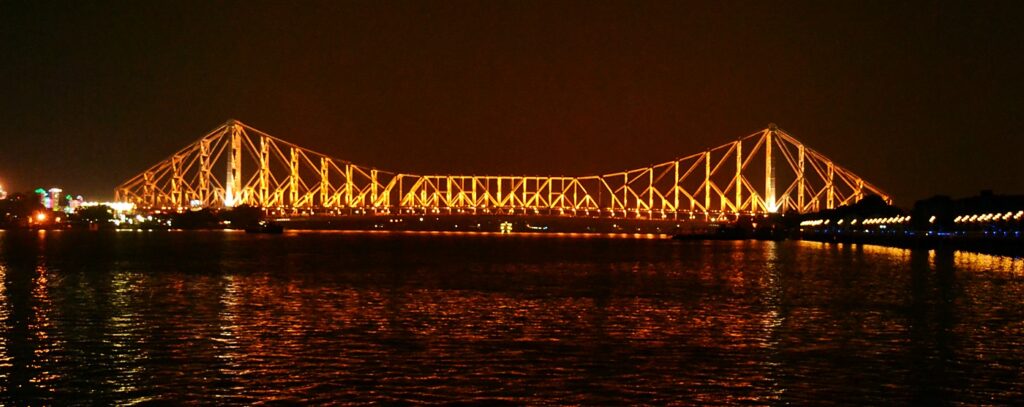
Image Source: Apoorva Karlekar
About Howrah Bridge
The Howrah Bridge, officially named Rabindra Setu, is one of the most celebrated landmarks of Kolkata and a vital engineering marvel of India. Spanning the Hooghly River, it connects the bustling city of Kolkata with the industrial hub of Howrah.
Known for its cantilever design and historical significance, the bridge is not just a means of transport but also a cultural symbol of Bengal’s identity. It represents the colonial legacy, architectural brilliance, and the vibrant heritage of Kolkata.
History
The idea of building a bridge over the Hooghly River dates back to the 19th century, when British authorities realized the need to connect Calcutta (Kolkata) with the western bank.
Construction began in 1936 under the Braithwaite, Burn & Jessop Construction Company and was completed in 1942. During World War II, the bridge became strategically important, serving as a crucial supply route. Later, in 1965, it was renamed Rabindra Setu in honor of the Nobel laureate poet Rabindranath Tagore.
Architecture
The Howrah Bridge is a classic example of cantilever bridge engineering, standing without nuts and bolts, held together entirely by rivets. Measuring 705 meters in length and 97 feet in width, it carries a massive volume of daily traffic, making it one of the busiest bridges in the world. The imposing steel structure weighs over 26,500 tons, symbolizing industrial strength and colonial-era precision engineering.
Cultural and Social Significance
For the people of Kolkata, the Howrah Bridge is more than a structure—it is an integral part of Bengali culture and identity. It has been immortalized in Bengali literature, poetry, and cinema, often symbolizing the heart of Kolkata. The bridge is a daily lifeline for thousands of commuters, linking two vibrant worlds—the Howrah Railway Station, a major entry point into Bengal, and the historic core of Kolkata city.
Tourism and Experience
Tourists visiting Kolkata often find themselves enchanted by the majestic views of the Hooghly River from the bridge. Sunrise and sunset from Howrah Bridge offer spectacular photographic opportunities, with boats and ferries sailing below.
The nearby attractions such as Mullik Ghat Flower Market, Howrah Railway Station, and the ghats of the Hooghly enhance the visitor experience, making the area a lively hub of activity.
How to Reach
The Howrah Bridge is easily accessible from all parts of Kolkata. The nearest major transit hub is Howrah Railway Station, located just at the end of the bridge. From the city side, visitors can reach the bridge via Esplanade, BBD Bagh, or Shyambazar through taxis, buses, and trams.
The Netaji Subhas Chandra Bose International Airport is about 16 km away, making the bridge one of the first glimpses of Kolkata for many travelers.