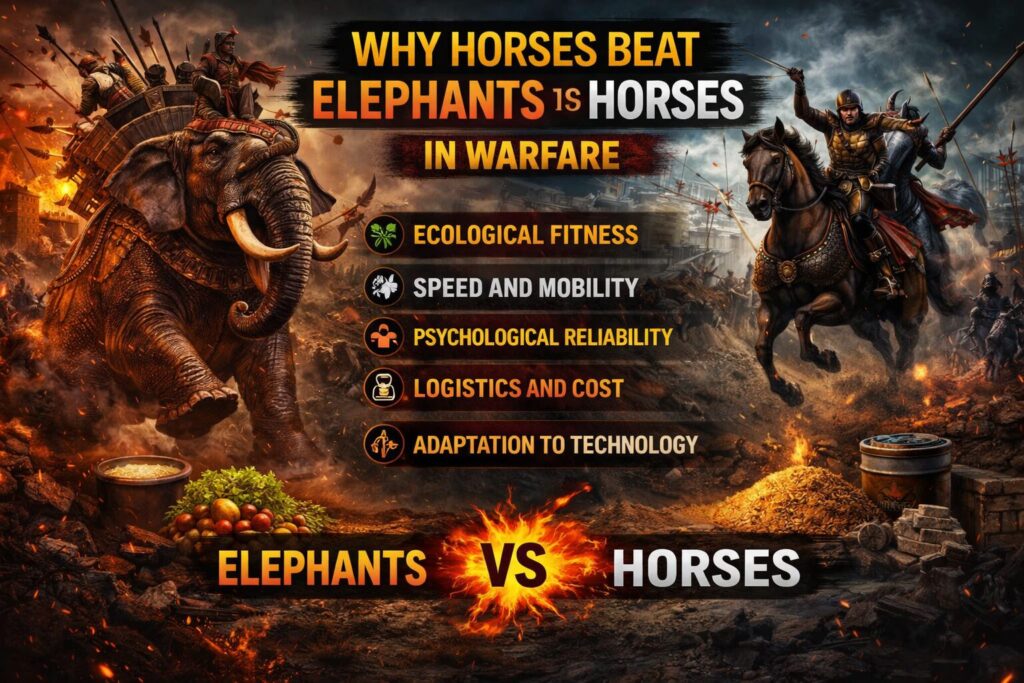
Ecology and Sustainability
Horses succeeded largely because they matched the ecology of open grasslands and temperate plains. They could survive by grazing naturally and could be maintained in large numbers with relatively low human support. Elephants, by contrast, required enormous quantities of food and water every day and depended heavily on forests or riverine environments. This made them difficult to sustain for long campaigns or in dry and open regions. While horses could be bred, raised, and replaced in large herds, elephants were slow to reproduce and difficult to domesticate on a wide scale, limiting their long-term military usefulness.
Mobility and Speed in Warfare
Military success in pre-modern times depended greatly on speed, maneuverability, and endurance. Horses offered all three. Cavalry could travel vast distances, surround enemies, retreat quickly, and strike again. Elephants, although terrifying in appearance, were slow and difficult to control in complex maneuvers. They could charge effectively in a straight line, but they could not perform rapid turns, feigned retreats, or long-distance raids. As warfare increasingly emphasized mobility and flexible tactics, horses proved superior for controlling battlefields and choosing when and where to fight.
Control and Psychological Reliability
Horses, though sensitive animals, could be trained to obey riders and function in disciplined formations. Elephants were intelligent but emotionally complex and prone to panic under stress. Loud noises, fire, or injury could cause them to stampede, often crushing their own troops. This unpredictability made elephants risky assets. Over time, enemies learned countermeasures such as noise, fire, and missile attacks, which neutralized the elephant’s psychological advantage. Horses, in contrast, became more reliable as breeding and training methods improved.
Logistics and Cost of Maintenance
An elephant required several times more food, water, and handlers than a horse. Transporting and supplying elephants placed a heavy burden on armies and states. Horses could be rotated, exchanged, or captured easily, and their fodder was widely available across Eurasia. Elephant forces were expensive and limited in number, meaning that losses were hard to replace. As states moved toward larger and more professional armies, the horse proved to be a far more economical and scalable military animal.
Technological Adaptation
As weapons evolved, the advantage of elephants declined rapidly. Spears, archery, and later firearms reduced their shock value. Once gunpowder weapons appeared, elephants became liabilities rather than assets, since they were large, slow targets. Horses also suffered from firearms, but they adapted better through cavalry tactics, armor, and later integration into gun-based armies. Thus, horses could evolve with military technology, while elephants could not.