Image Source: Taoan Ma
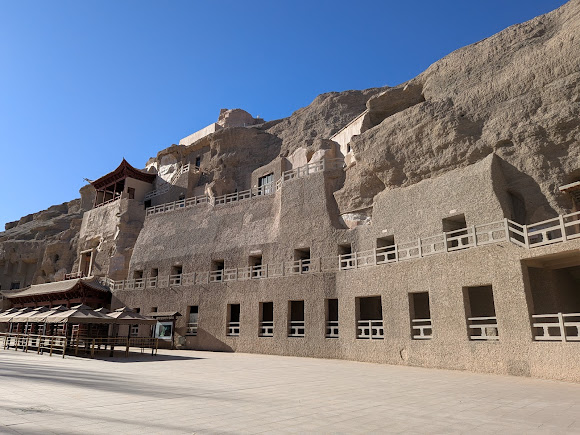
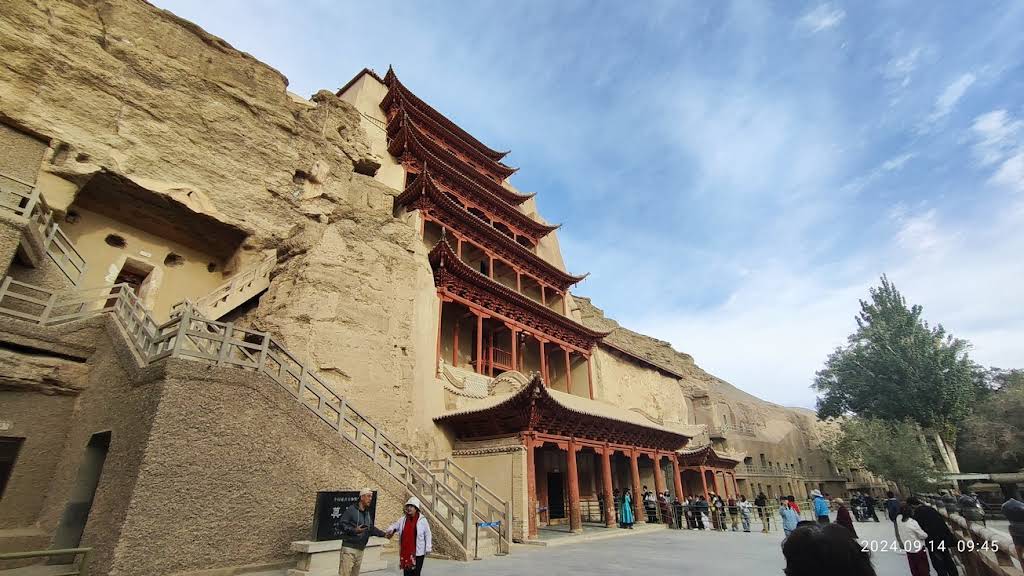
Among the many wonders of the Mogao Caves near Dunhuang, none has captured the imagination of historians, archaeologists, and scholars more profoundly than Library Cave 17. Often referred to simply as the “Library Cave,” this small, sealed chamber preserved one of the greatest collections of ancient manuscripts ever discovered. It is not just a cave filled with texts; it is a time capsule of the intellectual, spiritual, and cultural life of the Silk Road.
Hidden for nearly a thousand years, Cave 17 offers an unparalleled glimpse into a world where civilizations met, religions evolved, and knowledge traveled across vast distances.
Discovery: A Chance Revelation
The story of Library Cave 17 begins in the early twentieth century, around 1900, when a Daoist monk named Wang Yuanlu took it upon himself to care for the neglected Mogao cave complex.
While clearing sand and debris from the caves, Wang noticed a sealed doorway hidden behind a wall painting in one of the chambers. Curious, he broke through the barrier and discovered a small, enclosed room packed tightly with manuscripts, scrolls, paintings, and documents.
What he had uncovered was extraordinary. The cave contained tens of thousands of items, carefully stored and sealed, dating from the fourth to the eleventh centuries.
This accidental discovery would soon draw international attention and spark a race among foreign explorers and scholars to access its contents.
The Nature of the Collection
The manuscripts found in Library Cave 17 are remarkable not only for their quantity but also for their diversity.
They include:
* Buddhist sutras and commentaries.
* Administrative and legal documents.
* Personal letters and contracts.
* Medical texts and calendars.
* Maps and travel records.
These materials were written in multiple languages, reflecting the multicultural environment of Dunhuang.
Languages represented include:
* Chinese.
* Sanskrit from India.
* Tibetan from Tibet.
* Uighur and other Central Asian scripts.
This linguistic diversity reveals the extent to which Dunhuang served as a meeting point for different civilizations.
The Oldest Printed Book
Among the treasures of Library Cave 17 was one of the most important artifacts in the history of printing: the Diamond Sutra, dated to 868 CE.
This text is widely regarded as the oldest known complete printed book in the world, predating Gutenberg’s printing press by several centuries.
Its presence in the cave demonstrates the advanced state of printing technology in medieval China and highlights the role of Buddhism in the dissemination of written knowledge.
Why Was the Cave Sealed?
One of the most intriguing questions surrounding Library Cave 17 is why it was sealed in the first place.
Scholars have proposed several theories.
# Religious Preservation
Some believe the cave was used to store sacred texts that had become worn or outdated. In Buddhist tradition, such texts cannot be simply discarded. Instead, they are preserved in a respectful manner.
# Protection from Invasion
Another theory suggests that the cave was sealed to protect its contents during a time of political instability or invasion. Dunhuang was located at a strategic point along the Silk Road and often changed hands between different powers.
# Monastic Reorganization
It is also possible that the cave was sealed as part of a reorganization of the monastery, with the materials no longer in active use but too valuable to destroy.
Whatever the reason, the sealing of the cave ensured that its contents remained untouched for centuries.
Dunhuang as a Cultural Crossroads
To understand the significance of Library Cave 17, one must consider the role of Dunhuang in the wider context of the Silk Road.
Dunhuang was a gateway between China and Central Asia. Caravans carrying silk, spices, and other goods passed through this oasis town, bringing with them ideas, beliefs, and artistic traditions.
The manuscripts in the cave reflect this dynamic exchange.
For example:
* Indian Buddhist texts were translated into Chinese.
* Tibetan administrative records show political control at certain periods.
* Local documents reveal everyday life in a frontier town.
Library Cave 17 thus serves as a microcosm of Silk Road civilization.
Foreign Expeditions and the Removal of Manuscripts
After its discovery, Library Cave 17 attracted the attention of foreign explorers.
Among the most notable was Aurel Stein, who visited Dunhuang in 1907. He acquired a large number of manuscripts from Wang Yuanlu, often for relatively small sums.
Soon after, the French scholar Paul Pelliot also visited the site and selected valuable texts, particularly those in non Chinese languages.
These expeditions led to the dispersal of the cave’s contents across institutions in Europe and Asia.
Today, manuscripts from Library Cave 17 can be found in:
* The British Library in London.
* The Bibliothèque nationale de France in Paris.
* Museums and collections in China and other countries.
While this global distribution has facilitated research, it has also raised ethical questions about cultural heritage and ownership.
Insights into Everyday Life
One of the most fascinating aspects of Library Cave 17 is that it does not only contain religious texts. It also preserves records of ordinary life.
Documents found in the cave include:
* Tax records and census data.
* Contracts for land and labor.
* Letters between family members.
* Educational materials for students.
These materials provide a vivid picture of life in medieval Dunhuang.
They show that the Silk Road was not just a route for merchants and monks but also a lived space where communities worked, traded, and built relationships.
Religious Diversity and Transformation
Although Buddhism dominates the collection, the manuscripts also reveal the presence of other religious traditions.
There are traces of:
* Daoist practices.
* Manichaean texts.
* Nestorian Christian influences.
This diversity highlights the pluralistic nature of Silk Road society, where different belief systems coexisted and interacted.
The Buddhist texts themselves show a wide range of traditions, from early Indian teachings to later developments in Chinese and Tibetan Buddhism.
Artistic and Material Significance
In addition to manuscripts, Library Cave 17 contained paintings, banners, and printed images.
These artifacts provide insight into:
* Artistic styles and techniques.
* Ritual practices
* The visual culture of Buddhism.
The combination of textual and visual materials makes the cave an invaluable resource for understanding the relationship between art and religion.
Modern Research and Digital Preservation
In recent decades, efforts have been made to study and preserve the materials from Library Cave 17.
One of the most important initiatives is the International Dunhuang Project, which aims to digitize manuscripts and make them accessible to scholars worldwide.
Through digital technology, researchers can now:
* Compare texts from different collections.
* Study languages and scripts in detail.
* Reconstruct the historical context of the cave.
This work is helping to reunite, at least virtually, a collection that was physically dispersed across the globe.
Conclusion: A Window into a Connected World
Library Cave 17 of the Mogao Caves is far more than a hidden chamber filled with ancient texts. It is a window into a world of connection, exchange, and creativity.
From the hands of monks who copied sacred sutras to the merchants who carried ideas across deserts, the cave preserves the voices of a vibrant and interconnected civilization.
Its manuscripts tell stories of faith, trade, governance, and daily life. They reveal a world in which boundaries were porous and cultures were constantly interacting.
In many ways, Library Cave 17 is a reminder that globalization is not a modern phenomenon. Long before the modern era, the Silk Road created a network of exchange that shaped the course of human history.
Hidden for centuries and rediscovered by chance, this cave continues to illuminate the past and inspire our understanding of a shared human heritage.