
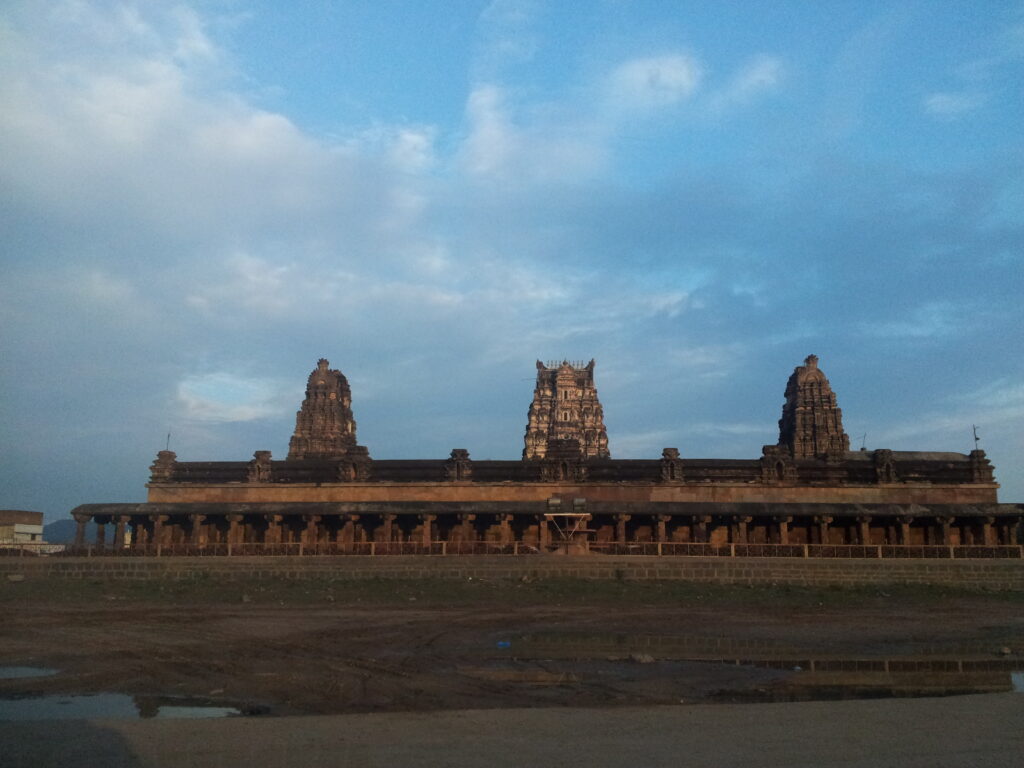
Image Source: Kashyap Kondamudi
About Kodandarama Temple
The Kodandarama Temple at Vontimitta, also known as the Kodanda Rama Swamy Temple, is one of the most prominent Hindu temples dedicated to Lord Rama in Andhra Pradesh.
Situated in kadapa district, it is not only the largest Rama temple in the region but also a magnificent example of Vijayanagara architecture. Recognized as a centrally protected monument of national importance by the Archaeological Survey of India (ASI), it is revered both for its spiritual legacy and artistic grandeur.
Location
The temple is located in Vontimitta town, Vontimitta Mandalam, Kadapa District, Andhra Pradesh. Geographically, it lies at 14°23′00″N 79°02′00″E, about 25 kilometers from Kadapa and near Rajampet. It is also connected to Siddhout through Bakarapeta at a distance of around 16 kilometers.
Within its precincts, the temple houses two sacred tanks, known as Rama Theertham and Lakshmana Theertham, which are considered holy by devotees.
History and Legends
The temple was built during the 16th century, under the patronage of the Chola and Vijayanagara kings. A popular local legend narrates that two robbers, Vontudu and Mittudu, who later became ardent devotees of Lord Rama, constructed the temple.
After completing their devotion-filled work, they turned into stone, giving the place its name, Vontimitta. This intertwining of faith, folklore, and history adds to the temple’s sacred aura.
Architecture
The Vijayanagara-style architecture of the Kodandarama Temple is remarkable in its scale and intricacy. Built in the Sandhara order, the temple is enclosed within a rectangular courtyard surrounded by walls.
Gopurams (Gateways): The complex features three ornate gopurams, with the central five-tiered tower facing east serving as the main entrance.
Mandapa (Rangamantapam): Known as Madhyarangaradapam, this open-air theatre is supported by 32 pillars decorated with exquisite sculptures of apsaras, divine figures like Vishnu and Krishna, and mythical creatures such as yali. The roof is adorned with elegant corbels and decorative brackets.
Sanctum Sanctorum (Garbhagriha): Accessed through the intricately carved antaraalayam, the sanctum houses a unique composite rock image of Rama, Sita, and Lakshmana carved from a single stone. Interestingly, Lord Hanuman, who is usually present with the trio, is absent from this central icon but has a separate shrine in the complex. A rare dancing Ganesha sculpture also adds to the artistic richness.
Deities and Sculptures
The central deities—Rama, Sita, and Lakshmana—are beautifully sculpted, each figure carrying distinct symbolic features.
Lord Rama is shown standing gracefully with a bow in his right hand and an arrow in his left, adorned with sacred ornaments such as kundalas, valayas, and a yagnopavita.
Lakshmana is depicted in a tribhanga posture, holding a bow and wearing a conical crown, waistband, and sacred thread.
Krishna is portrayed in the dvibhanga style, lifting Govardhan Hill with one hand while resting the other on his waist, accompanied by two cows, representing his pastoral charm.
These detailed carvings showcase the mastery of Vijayanagara artisans and their devotion to epic narratives.
Administration and Religious Significance
In 2015, the Tirumala Tirupati Devasthanams (TTD) took over the temple’s administration from the Archaeological Survey of India, following a resolution by the Government of Andhra Pradesh.
Since then, the temple has received renewed attention in both its religious activities and upkeep. It has also been declared the official venue for Sri Rama Navami celebrations at the state level, after the bifurcation of Andhra Pradesh when Bhadrachalam temple went to Telangana.
Festivals and Celebrations
The most significant event at Vontimitta is the Sri Rama Navami Brahmotsavam, celebrated with grandeur and devotion. Thousands of devotees gather for the rituals, cultural programs, music, and religious discourses held in honor of Lord Rama. The temple, thus, continues to be a central hub of Rama devotion in the region.
Literary and Historical Associations
The temple holds a special place in Telugu literary and devotional traditions:
Bammera Potana, the revered poet, lived in Vontimitta and composed his masterpiece, the Maha Bhagavatham, dedicating it to Lord Rama.
Vavilakolanu Subba Rao, often called Andhra Valmiki, translated Valmiki’s Ramayana into Telugu here while worshipping Rama.
The saint-poet Annamacharya, known for his devotional kirtans, is also believed to have visited the temple.
The temple even caught the attention of Jean-Baptiste Tavernier, a French traveler who visited in 1652 and praised its artistic beauty.