
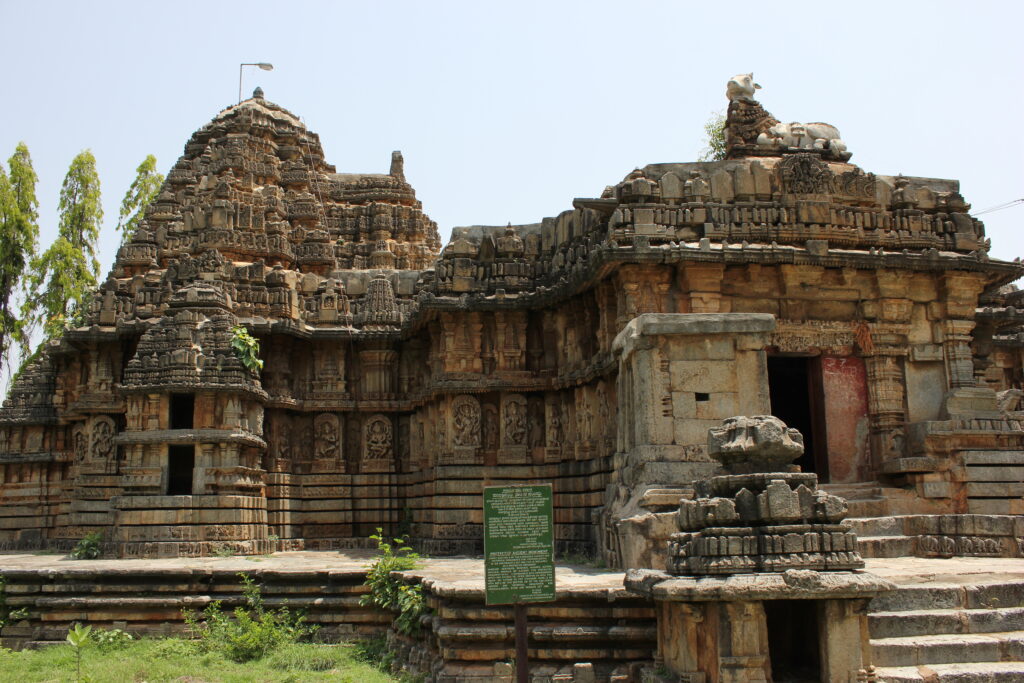
Image Source: Dineshkannambadi
About Someshvara Temple
Tucked away in the quiet village of Haralahalli (formerly known as Gottagadi) in Haveri district, Karnataka, stands the Someshvara Temple, a striking yet little-known example of Western Chalukya architecture. Located just 5 km from Guttal and close to the Tungabhadra River, this temple reflects the artistic brilliance of the 12th century while also highlighting the complex interplay of religion, politics, and community patronage in medieval Karnataka.
History
The Someshvara Temple was initially built as a single-shrine Shaiva temple during the early phase of Chalukyan rule. In the 12th century CE, under the patronage of the Gutta chiefs of Guttavolal, the temple underwent significant expansion. Guided by the Kalamukha Shaiva priest Kalyanashakti, two additional shrines—dedicated to Vikrameshvara and Gutteshwara—were added to the north and south of the main sanctum. This development transformed the monument into a trikuta (three-shrined) temple, an architectural style highly regarded in Karnataka’s medieval temple tradition.
Architectural Layout
The temple’s architecture is a blend of structural simplicity and artistic intricacy, characteristic of the Chalukyan idiom. It comprises three garbhagrihas (sanctums), each connected by its own vestibule and opening into a shared sabhamantapa (assembly hall), followed by a mukhamandapa (porch).
The western shrine stands out as the principal sanctum, emphasized through its larger scale and a four-tiered shikhara (tower), while the northern and southern shrines are smaller, each crowned with a three-tiered tower. The use of a stellate (star-shaped) base and Vesara-style shikhara reflects the Chalukyas’ architectural experimentation, blending northern and southern temple traditions.
Sculptural and Artistic Features
The artistry of the Someshvara Temple lies in its finely executed carvings and symbolic motifs. The entranceways are richly decorated with makara toranas, Gajalakshmi lintels, and panelled jambs guarded by Shaiva dvarapalas. The ceilings of the navaranga are adorned with a carved lotus medallion, a recurring motif in Chalukyan design.
Inside the sabhamantapa, four finely polished central pillars support the roof, while wall niches hold sculptural panels—one particularly striking example being the Sapta Matrikas (Seven Mother Goddesses). The outer walls carry a wealth of iconography, including figures of Mahishasuramardini, Adi-Varaha, Ugra-Narasimha, Surya, Shiva in various forms, and Ganesha. Inscriptions reveal the names of the sculptors, such as Nemoja and Baicoja, offering a rare personal connection to the craftsmen of the era.
Religious and Cultural Significance
The temple is deeply tied to the Kalamukha Shaiva sect, a branch of Shaivism known for its ascetic and ritualistic traditions. Its transformation into a trikuta shrine underlines the religious patronage of priestly leaders and the political power of the Gutta chieftains, who sought to establish Haralahalli as a vibrant religious hub. Beyond its religious function, the temple represents the collective effort of rulers, priests, and artisans in shaping the spiritual and cultural landscape of medieval Karnataka.
How to Reach
Haralahalli is well-connected by road and can be easily reached from nearby towns.
By Road: The temple lies just 5 km from Guttal and about 50 km northeast of Haveri. Local buses and private vehicles are the best options for travel.
By Rail: The nearest railway station is at Haveri, which lies on the Bengaluru–Hubballi line and connects the region with major cities.
By Air: The closest airport is Hubballi Airport (approx. 90 km), offering connectivity to Bengaluru, Mumbai, and other major hubs.