Image Source: גלגל האש/Wikipedia
In the vast spiritual landscape of medieval India, where tantric traditions flourished along rivers, forests, and monastic centers, the figure of Tilopa stands as one of the most enigmatic and transformative masters. He is remembered not as a scholar seated in a monastery, but as a wandering yogi who shattered conventions and revealed a path of direct realization—beyond rituals, beyond scriptures, and beyond the limits of ordinary thought.
Tilopa’s life unfolds like a mystical journey across inner and outer worlds, rooted in the sacred geography of eastern India, particularly regions associated with Bengal. It is here, in a land of rivers and tantric currents, that his story begins.
Early Life: A Worldly Beginning
Tilopa was born into a Brahmin family, traditionally associated with learning and ritual authority. Some accounts suggest he was born in a region that corresponds to modern-day Bengal or nearby areas influenced by the great tantric centers of the time. As a young man, he was well-versed in scriptures and intellectual traditions.
Yet, despite his scholarly upbringing, Tilopa felt a deep dissatisfaction. The rituals he performed and the texts he studied seemed to point toward truth—but never fully revealed it. This inner unrest marked the beginning of his spiritual quest.
Unlike many who sought refuge in structured monastic life, Tilopa’s journey would take him far beyond the boundaries of orthodoxy.
The Turning Point: Encounter with the Dakini
According to traditional accounts, Tilopa’s life changed when he encountered a mystical feminine figure—a dakini. In Vajrayana Buddhism, dakinis are embodiments of wisdom, often appearing in unexpected forms to guide seekers toward awakening.
This dakini instructed Tilopa to abandon conventional life and seek realization through direct experience. She told him that true knowledge could not be found in books alone—it must be lived, embodied, and realized.
This encounter shattered Tilopa’s previous identity. He left behind his scholarly life and stepped into a path that would challenge every assumption he had ever held.
A Life of Unconventional Practice
Tilopa’s spiritual journey did not unfold in monasteries or under the guidance of a single teacher. Instead, he wandered across the Indian subcontinent, receiving teachings from multiple masters—both human and divine.
He worked in seemingly humble and even socially marginal occupations:
* Grinding sesame seeds into oil.
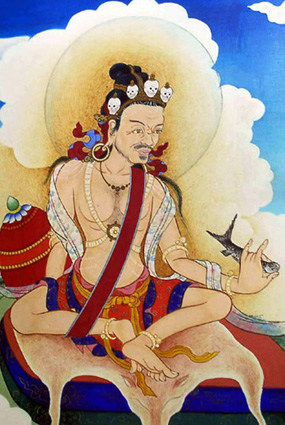
* Serving as a fisherman.
* Living among outcast communities.
These roles were not accidental. In tantric philosophy, everyday life is not separate from spiritual realization. By immersing himself in ordinary and even stigmatized activities, Tilopa broke the illusion that enlightenment belonged only to ascetics or elites.
His practice became a living meditation—integrating body, mind, and environment into a single field of awareness.
The Transmission of Tantric Wisdom
Tilopa is said to have received teachings from various sources, including celestial Buddhas and tantric masters. Among these, the teachings of Vajradhara hold particular significance.
Vajradhara represents the ultimate, formless nature of mind—pure awareness beyond duality. Through visionary experiences and deep meditation, Tilopa realized this state directly.
He did not merely understand these teachings intellectually; he embodied them. His realization was not conceptual—it was experiential, immediate, and transformative.
The Essence of Tilopa’s Teaching
Tilopa’s teachings are often summarized in a radical and paradoxical way. He emphasized that enlightenment is not something to be constructed—it is already present, obscured only by mental habits and attachments.
One of his most famous teachings, often referred to as the “Six Words of Advice,” captures this essence:
* Do not recall.
* Do not imagine.
* Do not think.
* Do not examine.
* Do not control.
* Rest.
These instructions point toward a state of effortless awareness—a mind free from grasping and conceptualization.
For Tilopa, the path was not about accumulating knowledge or performing elaborate rituals. It was about recognizing the nature of mind directly, in the present moment.
Meeting Naropa: The Transmission Continues
The most famous chapter in Tilopa’s life is his relationship with his disciple Naropa.
Naropa was a renowned scholar at the great monastic university of Nalanda, one of the most prestigious centers of learning in the Buddhist world. Despite his intellectual brilliance, Naropa felt that something was missing.
Guided by visions, he left Nalanda in search of Tilopa. When he finally found him, Tilopa did not greet him with lectures or philosophical discussions. Instead, he subjected Naropa to a series of intense and often bewildering trials.
These trials were not acts of cruelty but methods of breaking down Naropa’s ego and conceptual mind. Through hardship, confusion, and surrender, Naropa gradually transcended his intellectual limitations.
The Moment of Awakening
The culmination of Naropa’s journey came in a dramatic and symbolic moment. According to tradition, Tilopa struck Naropa with a sandal—an act that shattered his final attachments and triggered a direct realization of the nature of mind.
In that instant, Naropa awakened.
This unconventional method reflects Tilopa’s teaching style: direct, experiential, and beyond ordinary logic. Enlightenment, in this view, is not a gradual accumulation but a sudden recognition—when all illusions fall away.
Legacy in the Himalayan World
Tilopa’s teachings did not remain confined to India. Through Naropa and later masters, they traveled into the Himalayan regions, particularly into Tibet.
There, his teachings became foundational to the Kagyu school of Tibetan Buddhism, one of the major spiritual traditions of the region. This lineage emphasizes meditation, direct experience, and the transmission of realization from teacher to disciple.
In the high valleys and monasteries of the Himalayas, Tilopa’s influence continues to shape spiritual practice even today.
Tilopa and the Tantric Landscape of India
Tilopa’s life reflects the vibrant and often overlooked tantric landscape of medieval India. This was a time when spiritual practice was not confined to monasteries but extended into:
* Cremation grounds.
* Riverbanks.
* Forest hermitages.
* Urban centers.
Tantric practitioners, or Mahasiddhas, moved freely across social boundaries, challenging norms and redefining the path to liberation.
Tilopa stands as one of the greatest of these Mahasiddhas—a figure who embodied the union of wisdom and everyday life.
Philosophy Beyond Duality
At the heart of Tilopa’s teaching is the idea of non-duality—the understanding that distinctions between self and other, sacred and profane, are ultimately illusions.
He taught that:
* Mind is inherently pure.
* Thoughts arise and dissolve naturally.
* Clinging creates suffering.
By letting go of grasping, one can rest in the natural state of awareness—free, open, and luminous.
This philosophy resonates deeply with the broader currents of Buddhism, while also pushing its boundaries into radical experiential territory.
Conclusion: The Silent Master of Direct Experience
The story of Tilopa is not just a biography—it is a map of transformation. From a learned Brahmin to a wandering yogi, from ritual to realization, his journey challenges us to rethink what it means to seek truth.
He left behind no grand institutions, no elaborate systems of doctrine. Instead, he offered something far more powerful: a direct pointing to the nature of mind.
In a world often dominated by complexity and abstraction, Tilopa’s message remains strikingly simple and profound—truth is not elsewhere. It is here, in the very awareness that is reading these words.
To recognize it, one must only stop searching—and rest.