Image Source: Aotearoa
About Diu Fortress
Standing proudly on the edge of the Arabian Sea, Diu Fortress is one of the most remarkable reminders of Portuguese colonial history in India. Also known as Fortaleza de Diu or Fortaleza de São Tomé, this massive coastal fort dominates the eastern edge of Diu Island and has watched over the sea for nearly five centuries. Built by the Portuguese during the 16th century, the fortress once served as a powerful naval stronghold protecting important trade routes along India’s western coast.
Even today, despite the effects of time and weather, the fort remains impressively intact. Its enormous stone walls, cannons, bastions, and sea-facing ramparts continue to reflect the military brilliance and architectural skill of the Portuguese era. Walking through the fortress feels like stepping into a different century, where echoes of maritime battles, colonial trade, and royal ambitions still linger in the salty sea breeze.
Geographical Setting and Scenic Location
Diu Fortress occupies a highly strategic position at the southern tip of Gujarat’s coastline, near the mouth of the Gulf of Cambay, now known as the Gulf of Khambhat. Surrounded by water and coastal landscapes, the fort was ideally placed to monitor and control maritime activity in the Arabian Sea.
To the west lies the vast Arabian Sea, while rivers and estuaries surround other sides of the island, naturally strengthening its defenses. Historically, this location allowed easy access to major trading ports such as Cambay, Bharuch, and Surat, making Diu an important center for commerce and naval operations.
One of the most striking views from the fortress is the sight of Panikotha Fort, also called Fortim do Mar, standing offshore in the sea. The combination of sea views, crashing waves, old stone walls, and historic watchtowers makes the fortress one of the most scenic heritage sites on India’s west coast.
History of Diu Fortress
The history of Diu Fortress is deeply connected with the rise of Portuguese power in the Indian Ocean. Before the arrival of the Portuguese, Diu was ruled by several local dynasties, including the Chavda Rajputs, the Vaghelas, and later the Gujarat Sultanate. Due to its strategic location, Diu became an important trading port and attracted the attention of foreign powers.
The Portuguese made multiple attempts to capture Diu in the early 16th century but initially failed. Their fortunes changed in 1535 when Sultan Bahadur Shah of Gujarat sought military assistance against the Mughal emperor Humayun. In return for Portuguese support, the Sultan allowed them to establish a fort in Diu under the Treaty of Bassein.
Construction of the fortress began in 1535 and was strengthened significantly by 1546. To build the new fortification, older structures on the island were demolished. Over time, the fortress evolved into one of the strongest Portuguese naval bases in Asia.
The fort witnessed several fierce battles, the most famous being the Siege of Diu in 1538, when Ottoman Turkish forces attempted to expel the Portuguese. Heavy bombardments and naval attacks devastated parts of the fort, yet the Portuguese managed to hold their ground despite suffering severe casualties.
Further attempts by regional rulers to reclaim Diu during 1545 and 1546 also failed. The Portuguese retained control of Diu for more than four centuries, except for occasional attacks, including raids by Muscat-based pirates in the 17th century.
Portuguese rule finally ended in 1961 during Operation Vijay, when India integrated Goa, Daman, and Diu into the Indian Union. Today, a Martyrs Memorial near the Collectorate office honors the soldiers who lost their lives during the operation.
Architecture and Defensive Design
Diu Fortress is an outstanding example of Portuguese military architecture adapted to Indian coastal conditions. Constructed mainly from sandstone and lime mortar, the fort stretches along the coastline with enormous defensive walls overlooking the sea.
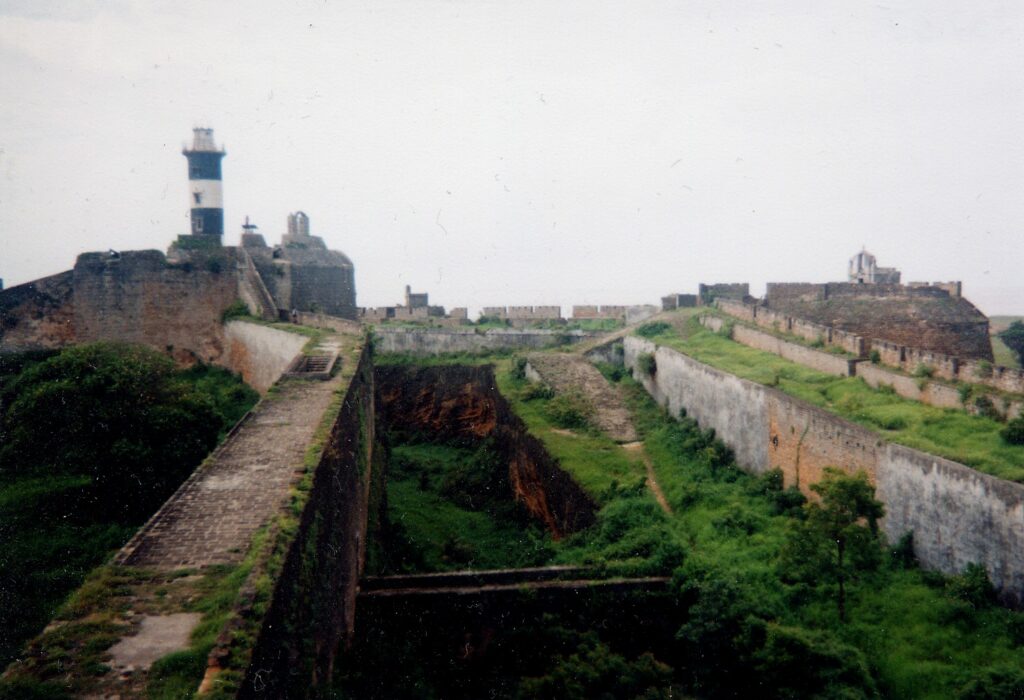
The design of the fortress reflects advanced military planning for its time. It features both outer and inner defensive walls, strong bastions fitted with cannons, and double moats for additional protection. One of the moats was uniquely designed as a tidal moat, carved directly through sandstone rock and connected to the sea.
Originally, the fortress had three gateways, with the main entrance decorated with large stone galleries and windows. The entrance bastion, known as St. George’s Bastion, remains one of the most prominent structures within the complex.
Visitors exploring the fort today can still see massive bronze cannons, iron shells, old storage chambers, ramps, watchtowers, and long corridors built for soldiers and artillery movement. The weathered arches and walls add a dramatic atmosphere, especially during sunrise and sunset when the sea-facing ramparts glow under golden light.
A large lighthouse located at one end of the fort continues to be an important landmark, while the jetty on the northwestern side remains functional even today.
Experience Inside the Fortress
Walking through Diu Fortress is both a historical and visual experience. The fort covers a large area, allowing visitors to wander through open courtyards, bastions, pathways, and gardens lined with ancient artillery.
The sea breeze, the sound of waves hitting the fort walls, and the expansive views of the Arabian Sea create a peaceful yet dramatic atmosphere. Photographers, history enthusiasts, and architecture lovers often spend hours exploring its corners.
The fort is especially beautiful during early morning and evening hours when the sunlight enhances the textures of the old stone structures. During monsoon season, the surrounding greenery and rough sea add another layer of beauty to the site.
Cultural and Historical Importance
Today, Diu Fortress stands not only as a historic monument but also as a symbol of Diu’s multicultural past. The fort reflects centuries of maritime trade, colonial encounters, naval warfare, and cultural exchange between India and Europe.
It has also gained international recognition as one of the “Seven Wonders of Portuguese Origin in the World,” highlighting its global historical significance. For travelers visiting Diu, the fortress remains one of the most important attractions and a key part of the region’s identity.
Best Time to Visit
The best time to visit Diu Fortress is between October and March, when the weather remains cool and pleasant. Summers in Diu can be hot and humid, while monsoons bring dramatic coastal scenery but occasional heavy rains.
Sunrise and sunset are particularly rewarding times to explore the fort, as the views over the Arabian Sea become spectacular.
Nearby Attractions
Panikotha Fort
Located offshore in the Arabian Sea, Panikotha Fort is one of Diu’s most recognizable landmarks. Built by the Portuguese as a defensive outpost, the fort appears to float on the water and offers excellent views of the coastline, especially during sunrise and sunset.
Naida Caves
Just a short drive from Diu Fort, the Naida Caves are known for their fascinating network of tunnels, rock formations, and natural skylights. The caves were formed from stone quarried during the construction of the fort and are now a favorite spot for photography and exploration.
St. Paul’s Church
One of the finest examples of Baroque architecture in India, St. Paul’s Church is admired for its intricately carved façade and beautifully decorated interiors. The church reflects Diu’s rich Portuguese heritage and remains an important religious landmark.
Gangeshwar Mahadev Temple
Situated along the rocky seashore, this ancient temple is dedicated to Lord Shiva. Its five Shiva lingams are partially submerged by seawater during high tide, creating a unique and spiritually significant sight.
Nagoa Beach
Located about 10 km from Diu Fort, Nagoa Beach is famous for its crescent-shaped shoreline, swaying palm trees, and water sports activities. It is one of the best places in Diu to relax, enjoy the sea breeze, and watch the sunset.
How to Reach Diu Fortress
By Air
The nearest airport is Diu Airport, located around 7 kilometers from Diu town. The airport has flight connections with cities like Mumbai and Ahmedabad. Taxis and auto-rickshaws are easily available from the airport to the fortress.
By Train
Diu does not have its own railway station. The nearest major railway station is Veraval Junction railway station in Gujarat, approximately 120 kilometers away. From Veraval, travelers can hire taxis or take buses to Diu.
By Road
Diu is well connected by road with major cities in Gujarat and Maharashtra. Regular buses, taxis, and private vehicles operate from cities such as Ahmedabad, Rajkot, Surat, and Mumbai. The fortress itself is connected to Diu town by a permanent bridge, making access easy for visitors.
Google Maps
FAQs
Who built Diu Fortress?
Diu Fortress was built by the Portuguese Empire during the 16th century after receiving permission from Sultan Bahadur Shah of Gujarat.
Why was Diu Fortress important?
The fort was strategically important for controlling maritime trade routes and defending Portuguese interests along India’s western coast.
What is special about Diu Fortress?
Its massive sea-facing walls, Portuguese military architecture, historic cannons, lighthouse, and scenic coastal views make it one of India’s most impressive coastal forts.
Is Diu Fortress still intact?
Yes, much of the fortress remains well preserved despite partial ruins caused by time, weather, and historical conflicts.
What is Panikotha Fort?
Panikotha Fort, also called Fortim do Mar, is a small sea fort located offshore near Diu Fortress and was used as an additional defense structure.
How much time is needed to explore the fort?
Most visitors spend around 1 to 2 hours exploring the fort and enjoying the surrounding views.
Is there an entry fee for Diu Fortress?
Entry rules and fees may change over time, but the fortress is generally accessible to tourists throughout the year.
What is the best time to visit Diu Fortress?
The winter season from October to March is considered the best time due to pleasant weather and comfortable sightseeing conditions.