Image Source: Dhananjoy Misra
About Great Stupa of Sanchi
The Great Stupa of Sanchi is one of India’s most remarkable Buddhist monuments and a shining example of ancient Buddhist art and architecture. Located in the historic town of Sanchi in Madhya Pradesh, this UNESCO World Heritage Site attracts visitors from around the world who come to admire its rich history, intricate carvings, and peaceful surroundings. Situated just about 1.5 km from Sanchi Railway Station, the monument is easily accessible and makes for a fascinating journey into India’s Buddhist past.
History of the Great Stupa of Sanchi
The Great Stupa has witnessed centuries of Indian history and reflects the evolution of Buddhist architecture over time. It was originally commissioned by Emperor Ashoka of the Mauryan Dynasty in the 3rd century BCE after he embraced Buddhism. The structure initially began as a simple brick stupa built to enshrine sacred Buddhist relics.
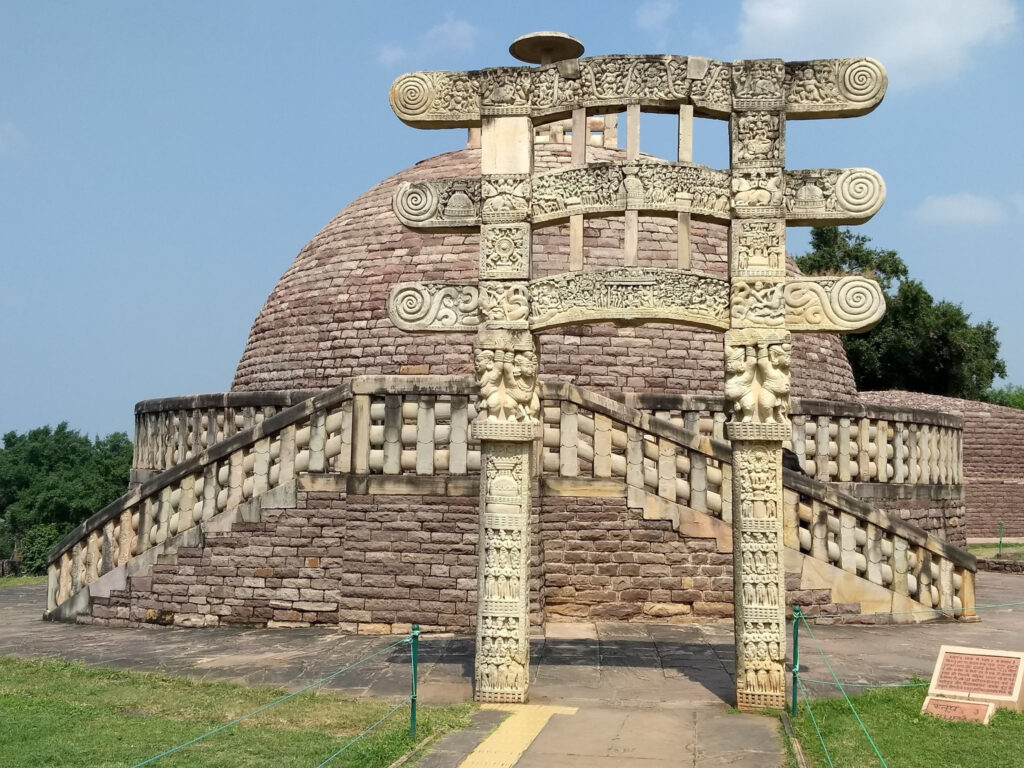
Over the following centuries, the monument underwent several renovations and expansions. During the Shunga period in the 1st century BCE, the stupa was enlarged and rebuilt using stone, giving it much of its present appearance. Later, during the Satavahana period, the beautifully carved gateways, known as toranas, and stone railings were added. These additions transformed the monument into one of the finest examples of early Buddhist art in India.
Architecture and Design
The Great Stupa is an architectural masterpiece that beautifully combines symbolism and spirituality. The massive hemispherical dome, known as the anda, forms the central structure and houses sacred relics. The dome is surrounded by a stone railing and a circular pathway that allows devotees to perform pradakshina (circumambulation), a traditional Buddhist act of worship.
At the top of the dome stands a square enclosure called the harmika, crowned by a central pillar supporting three umbrella-like structures known as chatras. These represent the Three Jewels of Buddhism—the Buddha, the Dharma (teachings), and the Sangha (community).
One of the most striking features of the monument is its four elaborately carved toranas positioned at the cardinal directions. These gateways are decorated with scenes from the life of Buddha, Jataka tales, lotus motifs, animals, and various symbols associated with early Buddhism. The detailed carvings provide valuable insights into the religious and artistic traditions of ancient India.
Other Monuments Within the Sanchi Complex
The Sanchi complex is home to several other important monuments that complement the Great Stupa. Visitors can explore Stupa 2 and Stupa 3, both of which contain important relics and beautiful carvings. Temple 18, dating back to the Gupta period, showcases early temple architecture, while Temple and Monastery 45 offer a glimpse into the lives of Buddhist monks who once lived here.
Another notable attraction is the Great Bowl, a massive stone vessel believed to have been used for distributing food among monks. The complex also includes Bhero Baba Mandir and Shiv Mandir, reflecting the site’s continued religious significance over centuries.
A must-see landmark is the Ashoka Pillar, erected in the 3rd century BCE. Although only parts of the original pillar survive, it remains an important symbol of Emperor Ashoka’s patronage of Buddhism. The pillar originally featured a magnificent lion capital, similar to the one that later inspired India’s national emblem.
Nearby, the Chetiyagiri Vihara houses sacred relics of Buddha’s chief disciples, Sariputta and Moggallana, which were returned to India from Britain in 1952. Every year, during the Chetiyagiri Festival, these relics are displayed for public viewing, attracting thousands of monks, pilgrims, and visitors from across the globe.
Why Visit the Great Stupa of Sanchi?
The Great Stupa offers more than just historical significance—it provides a peaceful environment where visitors can reflect, learn, and appreciate the legacy of Buddhism in India. Surrounded by lush greenery and panoramic views of the countryside, the site is perfect for history enthusiasts, architecture lovers, spiritual seekers, and photographers alike.
Whether you are interested in ancient dynasties, Buddhist philosophy, or India’s architectural heritage, a visit to Sanchi promises a memorable and enriching experience.
How to Reach the Great Stupa of Sanchi
By Air
The nearest airport is Raja Bhoj Airport in Bhopal, located approximately 55 km from Sanchi. Taxis and private cabs are readily available from the airport to reach the monument.
By Train
Sanchi Railway Station is the nearest railhead and is located about 1.5 km from the Great Stupa. Auto-rickshaws and local transport are available from the station. For better connectivity, visitors can also travel via Bhopal Junction, which is around 48 km away.
By Road
Sanchi is well connected by road to major cities in Madhya Pradesh. Regular buses and taxis operate from Bhopal, Vidisha, Indore, and nearby towns. The drive from Bhopal to Sanchi takes roughly 1 to 1.5 hours.
Local Transport
Auto-rickshaws, taxis, and private vehicles are the most convenient ways to reach the hilltop complex from Sanchi town and railway station.
Nearby Attractions
- Ashoka Pillar, Sanchi – Remains of the famous pillar erected by Emperor Ashoka.
- Chetiyagiri Vihara – Houses sacred relics of Sariputta and Moggallana.
- Sanchi Archaeological Museum – Displays sculptures, inscriptions, and artifacts excavated from the site.
- Great Bowl of Sanchi – An enormous stone bowl used by Buddhist monks.
- Stupa 2 and Stupa 3 – Important Buddhist monuments featuring ancient relics and carvings.
- Udayagiri Caves (around 13 km) – Rock-cut caves known for Gupta-era sculptures and inscriptions.
- Vidisha (around 10 km) – An ancient city with several historical and archaeological attractions.
- Heliodorus Pillar, Besnagar – A remarkable ancient pillar dedicated by a Greek ambassador to an Indian king.
Maps
FAQs
What is the Great Stupa of Sanchi famous for?
The Great Stupa is famous for being one of the oldest stone structures in India and one of the finest examples of Buddhist architecture and sculpture.
Who built the Great Stupa of Sanchi?
The original stupa was commissioned by Emperor Ashoka in the 3rd century BCE and later expanded by the Shunga and Satavahana dynasties.
Is the Great Stupa a UNESCO World Heritage Site?
Yes, the Buddhist monuments at Sanchi were designated a UNESCO World Heritage Site in 1989.
What are the timings of the Great Stupa of Sanchi?
The Sanchi monuments are generally open from sunrise to sunset. Visitors should check the latest timings before planning their trip.
How much time is needed to explore Sanchi?
Most visitors spend 2–4 hours exploring the Great Stupa and the surrounding monuments within the archaeological complex.
What is the best time to visit Sanchi?
The best time to visit is between October and March when the weather is pleasant and ideal for sightseeing.
Can photography be done at the site?
Yes, photography is generally allowed in the open areas of the complex, making it a great destination for history and architecture enthusiasts.
Is Sanchi suitable for a day trip from Bhopal?
Yes, Sanchi is one of the most popular day-trip destinations from Bhopal and can easily be covered in a single day along with nearby attractions like Vidisha and Udayagiri Caves.