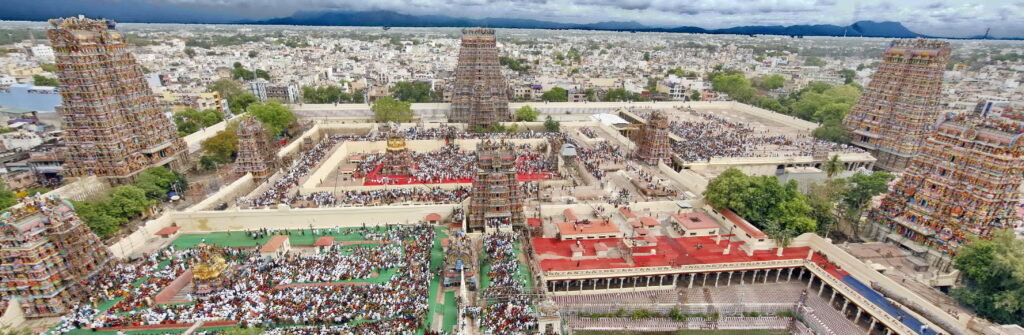
Image Source: எஸ்ஸார்
About Meenakshi Temple
The Meenakshi Temple, officially known as Arulmigu Meenakshi Sundareswarar Temple, is one of India’s most magnificent Hindu temples and the cultural heart of Madurai in Tamil Nadu. Revered by millions of devotees every year, this ancient temple is dedicated to Goddess Meenakshi, an incarnation of Goddess Parvati, and Lord Sundareswarar, a form of Lord Shiva. Unlike most Shiva temples in South India where Shiva is the principal deity, Meenakshi Temple is unique because Goddess Meenakshi occupies the central place of worship, reflecting the region’s rich traditions and devotion to the Divine Mother.
The temple is not only an important pilgrimage destination but also one of the finest examples of Dravidian architecture. Its towering gateway structures, colourful sculptures, intricate carvings, and vibrant festivals make it one of Tamil Nadu’s most visited landmarks. Situated in the bustling streets of Madurai, the temple continues to be the city’s spiritual, cultural, and social centre.
Historical Background
The origins of the Meenakshi Temple can be traced back to at least the 6th century CE, with references found in early Tamil literature and Sangam texts. However, the present structure owes much of its grandeur to the Pandya dynasty. King Sadayavarman Kulasekaran I is believed to have built the earliest surviving portions of the temple during the 12th and early 13th centuries, including parts of the Meenakshi and Sundareswarar shrines.
The temple underwent further expansion under later Pandya rulers, who added towering gopurams, spacious corridors, and elaborate mandapams. During the 14th century, the temple suffered severe damage when Malik Kafur invaded Madurai. Worship came to a halt for several decades until the Vijayanagara Empire restored the temple and revived religious activities.
The temple reached its present magnificence during the 16th and 17th centuries under the Nayak rulers, especially Vishwanatha Nayak and Thirumalai Nayak. They constructed many of the grand halls, towering gateways, and artistic masterpieces that visitors admire today. Despite changes through the colonial period, the temple remained an active place of worship. Extensive restoration work in the modern era culminated in the grand Kumbhabhishekam held in 1995, while the temple was also recognised as a Swachh Iconic Place of India in 2017.
Architecture and Highlights
Spread across nearly 14 acres, Meenakshi Temple is an architectural masterpiece built in the classic Dravidian style. The temple complex is enclosed by massive walls and follows a carefully planned layout based on ancient Shilpa Shastra principles.
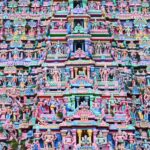
One of the temple’s most striking features is its 14 majestic gopurams, each decorated with thousands of brightly painted sculptures depicting gods, goddesses, saints, mythical creatures, and scenes from Hindu epics. The southern tower, rising to about 52 metres, is the tallest and dominates Madurai’s skyline.
Inside the temple, visitors will find two main sanctums dedicated to Goddess Meenakshi and Lord Sundareswarar, each crowned with beautifully gilded vimanas. At the centre lies the sacred Porthamarai Kulam, or Golden Lotus Tank, where devotees traditionally pause before entering the inner shrines.
The temple is also famous for its beautifully carved mandapams, including the Thousand Pillared Hall, Ashta Shakti Mandapam, Kilikoondu Mandapam, Kambathadi Mandapam, and Vasantha Mandapam. Every pillar showcases remarkable craftsmanship, while attractions such as musical pillars, rotating stone balls within yali sculptures, and detailed carvings make the complex an architectural wonder.
Deities and Artistic Beauty
Goddess Meenakshi is portrayed holding a lotus and a parrot, symbolising prosperity, wisdom, and compassion. Lord Sundareswarar is worshipped in the form of a Shiva Linga, while Lord Azhagar (Vishnu) also holds a special place in the temple, reflecting the harmony between Shaivism and Vaishnavism.
Apart from the main deities, the temple houses shrines dedicated to Lord Ganesha, Lord Murugan, Goddess Lakshmi, Lord Krishna, Goddess Saraswati, and the revered 63 Nayanmars. The walls and ceilings are decorated with colourful murals, sculptures, and frescoes, including depictions of the famous 64 Thiruvilaiyadal (divine acts of Lord Shiva), which narrate the legends associated with Madurai.
Religious and Cultural Importance
Meenakshi Temple is much more than a place of worship. It represents centuries of Tamil culture, devotion, art, music, dance, and literature. The temple beautifully brings together the traditions of Shaivism, Shaktism, and Vaishnavism, making it one of India’s most spiritually significant temples.
For centuries, the temple has influenced the growth of Madurai’s economy, markets, and traditional crafts. Even today, the streets surrounding the temple are filled with flower vendors, brassware shops, textile stores, and eateries serving authentic Madurai cuisine, offering visitors a complete cultural experience.
Worship and Festivals
Daily worship at the temple follows centuries-old traditions with six poojas performed throughout the day. These include sacred bathing rituals (abhishekam), decoration of the deities (alangaram), food offerings (neivedyam), and the evening deepa aradanai.
One of the temple’s most unique ceremonies takes place every night when the symbolic image of Lord Sundareswarar is ceremonially carried to Goddess Meenakshi’s chamber, representing their divine union.
The biggest celebration is the Chithirai Festival, held during April and May, which includes the grand Meenakshi Thirukalyanam (celestial wedding of Meenakshi and Sundareswarar). The colourful processions, decorated temple cars, music, and traditional performances attract lakhs of devotees from across India. Other major festivals celebrated here include Navaratri, Arudhra Darshan, Aavani Moolam, Vasantham Festival, Thai Utsavam, and Unjal Festival.
How to Reach
Meenakshi Temple is located in the heart of Madurai city and is easily accessible by road, rail, and air. Madurai Junction Railway Station is just about 1.5 km from the temple, making it a short auto-rickshaw ride or even a pleasant walk through the city’s bustling streets. Madurai International Airport, located around 12 km away, offers regular flights connecting Madurai with Chennai, Bengaluru, Hyderabad, Mumbai, Delhi, and several international destinations. Local buses, taxis, app-based cabs, and auto-rickshaws are readily available from all parts of the city. Visitors arriving by private vehicle can use designated parking areas near the temple, though exploring the surrounding streets on foot is the best way to experience the local markets and traditional atmosphere.
Nearby Attractions
- Thirumalai Nayakkar Mahal.
- Gandhi Memorial Museum.
- Koodal Azhagar Temple.
- Vandiyur Mariamman Teppakulam.
- Kazimar Big Mosque.
- St. Mary’s Cathedral, Madurai.
- Banana Market, Madurai.
- Puthu Mandapam.
- Vaigai River.
- Alagar Kovil.
- Pazhamudircholai Murugan Temple.
- Samanar Hills.
- Athisayam Theme Park.
Maps
FAQs
1. What are the temple timings?
The temple is generally open from around 5:00 AM to 12:30 PM and 4:00 PM to 9:30 PM. Timings may vary during festivals.
2. Is there an entry fee?
General entry is free. However, there are separate charges for special darshan, museum access, and photography in permitted areas.
3. Can non-Hindus visit the temple?
Yes. Visitors of all faiths are welcome to explore most parts of the temple, though access to the innermost sanctum may be restricted.
4. What is the best time to visit?
October to March offers pleasant weather for sightseeing. The Chithirai Festival (April–May) is the best time to experience the temple’s grand celebrations.
5. Is there a dress code?
Visitors are expected to wear modest, traditional, or respectful clothing. Footwear must be removed before entering the temple complex.
6. How much time should I plan for the visit?
Most visitors spend around 2–3 hours exploring the temple, while those interested in its architecture and museum may need longer.
7. Are mobile phones and cameras allowed?
Photography is restricted inside the main temple areas. Mobile phones and cameras may need to be deposited at designated counters depending on current temple regulations.
8. Is the temple suitable for families and senior citizens?
Yes. The temple welcomes visitors of all ages, although it can become crowded during weekends and major festivals.