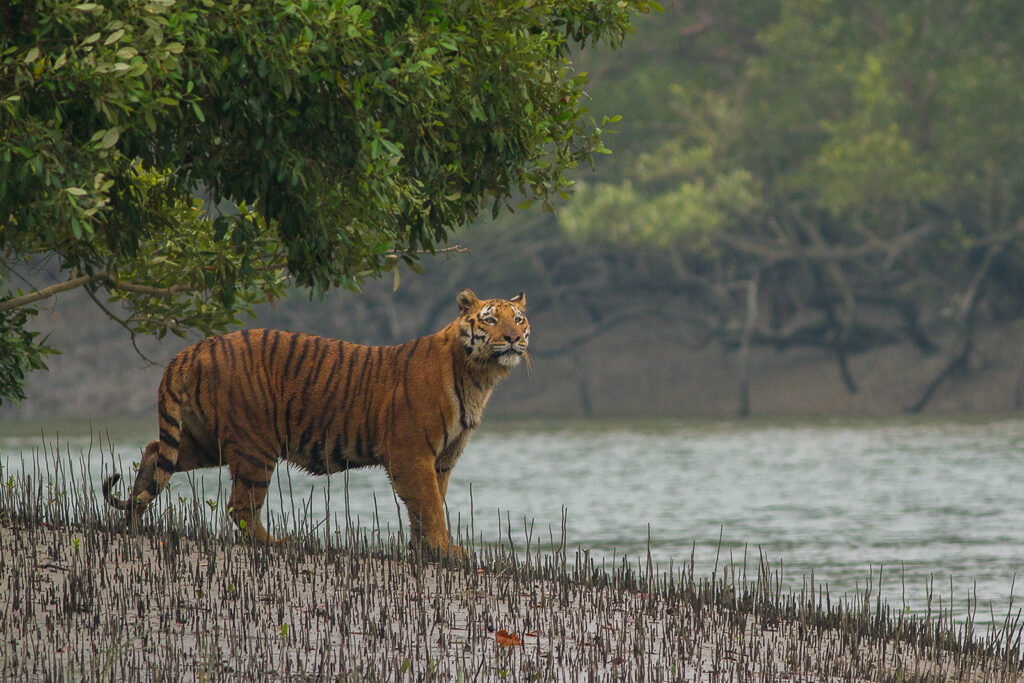
Image Source: Soumyajit Nandy
About Sundarbans National Park
Sundarbans National Park, located in West Bengal, is one of the most unique and biodiverse ecosystems in the world. Recognised as a UNESCO World Heritage Site, it is famous for its dense mangrove forests, vast tidal waterways, and as the largest habitat of the Royal Bengal Tiger. Spread across nearly 1,330 square kilometres, the Sundarbans is also home to a variety of rare flora and fauna, making it an ecological treasure and a must-visit for nature lovers, wildlife enthusiasts, and eco-travellers.
Attractions and Experiences
The park is best known for the Royal Bengal Tigers, who are uniquely adapted to swim across creeks and hunt in the mangroves. Besides tigers, it is also home to saltwater crocodiles, fishing cats, spotted deer, wild boars, Gangetic dolphins, and a rich birdlife including kingfishers, herons, and migratory species. Boat safaris are the primary way to explore the park, as the entire region is interlaced with rivers, estuaries, and creeks. Popular watchtowers like Sajnekhali, Sudhanyakhali, and Dobanki provide vantage points for wildlife sightings.
Cultural and Ecological Importance
The Sundarbans are not only ecologically significant but also hold immense cultural and livelihood value. Local communities rely on fishing, honey collection, and forest products, while traditional folklore revolves around the Bonbibi deity, worshipped as the protector of the forests. The mangrove ecosystem plays a crucial role in protecting coastal Bengal from cyclones and tidal waves, acting as a natural barrier.
Best Time to Visit
The ideal time to visit Sundarbans is from November to March, when the weather is cooler and more pleasant for boat safaris. The monsoon season is best avoided due to heavy rains and strong tides.
How to Reach
By Air: The nearest airport is Netaji Subhash Chandra Bose International Airport, Kolkata (about 120 km away).
By Rail: The closest railway stations are Canning (48 km) and Namkhana, connected to Kolkata.
By Road: Regular road transport is available from Kolkata to Godkhali, the main gateway to Sundarbans.
By Water: From Godkhali and nearby jetties, visitors need to take motorboats or launches to enter the National Park area.
Nearby Attractions
- Sajnekhali Bird Sanctuary (Approx. 5–10 km by boat)
A popular birdwatching destination featuring a watchtower, Mangrove Interpretation Centre, crocodile enclosure, and a wide variety of resident and migratory birds. It is one of the main entry points to the Sundarbans. - Sudhanyakhali Watch Tower (Approx. 8 km by boat)
One of the best wildlife-viewing spots in the Sundarbans, offering opportunities to see Royal Bengal Tigers, spotted deer, wild boars, crocodiles, and numerous bird species. - Dobanki Watch Tower (Approx. 15 km by boat)
Famous for its elevated canopy walk, this watchtower provides panoramic views of the mangrove forest and excellent opportunities for wildlife observation. - Bonnie Camp (Approx. 30 km by boat)
One of the highest watchtowers in the Sundarbans, Bonnie Camp offers breathtaking views of the surrounding mangrove forests and is a popular destination for nature enthusiasts. - Netidhopani Watch Tower (Approx. 25 km by boat)
Known for its ancient temple ruins and rich wildlife, this watchtower combines history, mythology, and opportunities to observe the unique mangrove ecosystem. - Jharkhali Tiger Rescue Centre (Approx. 40 km)
An educational conservation centre where visitors can learn about tiger rescue and rehabilitation while exploring landscaped gardens and interpretation exhibits.
Google Maps
FAQs
1. Where is Sundarbans National Park located?
Sundarbans National Park is located in the South 24 Parganas district of West Bengal, India, within the Ganges–Brahmaputra–Meghna Delta.
2. Why is Sundarbans National Park famous?
The park is renowned for its Royal Bengal Tigers, the world’s largest mangrove forest, rich biodiversity, estuarine crocodiles, diverse birdlife, and UNESCO World Heritage Site status.
3. What is the best time to visit Sundarbans National Park?
The ideal time is November to February, when the weather is pleasant and wildlife sightings are more frequent.
4. Can visitors see Royal Bengal Tigers?
Yes, although tiger sightings are not guaranteed. Visitors may also see spotted deer, wild boars, crocodiles, monitor lizards, otters, and many bird species.
5. How do visitors explore the park?
The park is explored mainly through guided boat safaris, which travel along rivers and creeks to designated watchtowers.
6. Is an entry permit required?
Yes. Visitors need entry permits issued by the Forest Department, and registered boats with authorized guides are required.
7. How much time is needed to explore the park?
A 2–3 day trip is recommended to experience multiple watchtowers, boat safaris, and the park’s unique ecosystem.
8. How can I reach Sundarbans National Park?
Visitors typically travel by road from Kolkata to Godkhali, Sonakhali, or other ferry points, from where boats provide access to the national park.