Introduction
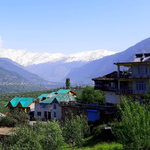
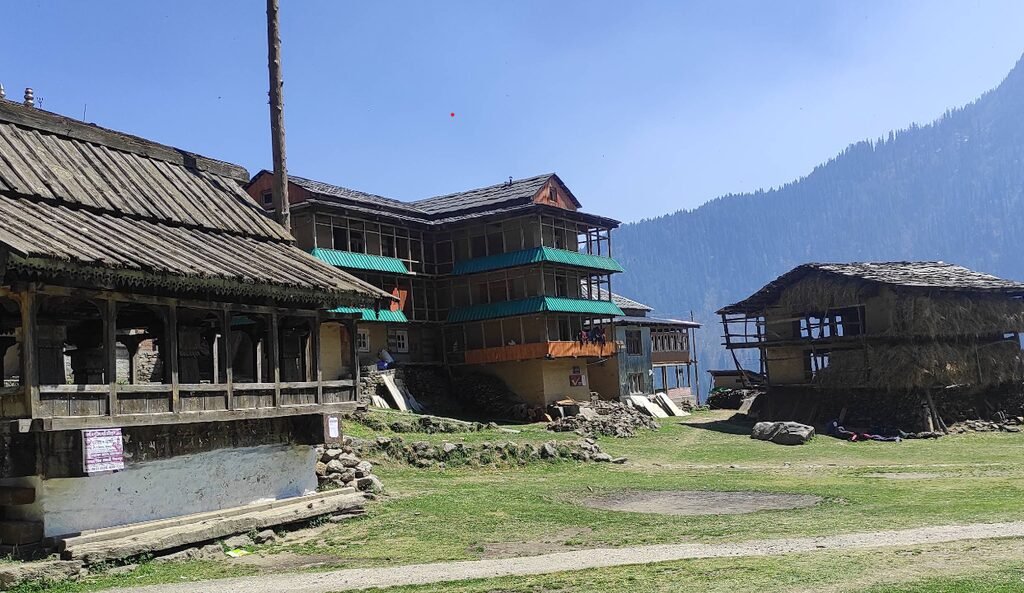
Perched on a mountain slope above the forests of Tirthan Valley, Sharchi is one of the more distinctive villages in the Banjar region of Kullu district, Himachal Pradesh. Its elevated setting, traditional houses, agricultural terraces and views across the surrounding Himalayan landscape give it a character different from the riverside settlements below.
Sharchi lies at an approximate elevation of 2,100–2,200 metres (around 6,900–7,200 feet), although the exact altitude varies depending on the point measured within the settlement. Unlike villages situated directly along the Tirthan River, Sharchi occupies higher ground, which creates a different landscape of mountain slopes, forest edges and cultivated land.
The village was once more difficult to reach because of its mountain location. Road access has made travel more convenient, although the approach remains a mountain journey rather than a drive through a broad, level valley. Sharchi is increasingly known among travellers looking for quieter destinations around Tirthan Valley, particularly those interested in traditional architecture, village life and nature walks.
The village is also geographically connected with the wider landscape surrounding the Great Himalayan National Park (GHNP), a UNESCO World Heritage property known for its Himalayan biodiversity. Sharchi is not itself inside the park’s core protected area, so visitors planning a trek should distinguish between exploring the village and entering a protected forest or trekking zone.
Geography and Landscape
Sharchi lies in Banjar tehsil of Kullu district, above the main Tirthan Valley landscape. Its elevated position gives it a different perspective from riverside settlements such as Gushaini and Nagini. Instead of spending the entire day beside the river, visitors can explore a landscape shaped by mountain slopes, fields, scattered houses and forested ridges.
The surrounding terrain is typical of the middle Himalayan belt, where settlements occupy areas suitable for cultivation and construction between steep slopes and forested land. The appearance of the landscape changes with elevation, aspect and season. Broadleaf woodland, coniferous trees, cultivated plots and grassy clearings may all occur in the wider area, although their distribution varies from one hillside to another.
The natural landscape around Sharchi includes:
- Forested mountain slopes: Patches of coniferous and broadleaf forest contribute to the green character of the surrounding hills.
- Terraced agricultural fields: Cultivated land follows the contours of the slopes, making productive use of the limited level ground.
- Grazing areas and small clearings: Open spaces near the village and in the surrounding hills provide a contrast to the forest.
- Mountain drainage channels: Small streams and seasonal watercourses carry water down the slopes, especially during the wetter months.
- Panoramic viewpoints: The village’s elevated position can offer views across neighbouring ridges and valleys when the weather is clear.
Sharchi is sometimes described as a village surrounded by alpine meadows. This description needs some qualification. Alpine vegetation is generally associated with higher elevations above the main tree line, whereas the landscape around Sharchi is more accurately described as a mixture of mountain forest, cultivated land and local clearings.
The wider region has a close relationship with the Great Himalayan National Park Conservation Area, whose protected landscapes extend across several valleys and elevation zones. The park’s biodiversity is one of the reasons Tirthan Valley attracts hikers, naturalists and birdwatchers. However, the presence of forests near Sharchi does not mean every nearby trail enters the national park or provides access to its higher-altitude habitats.
For travellers, Sharchi’s main geographical attraction is the transition between village life and the surrounding mountain environment. The view from a field edge, a quiet lane or a forest-facing homestay may be as rewarding as a formal viewpoint, particularly during clear mornings and evenings.
Demography and Settlement
Sharchi is a substantial rural settlement compared with many small hamlets in the surrounding mountain landscape. According to Census 2011-based village records, it had a population of 2,413 people living in 454 households. The reported geographical area is approximately 345 hectares, or 3.45 square kilometres. These figures describe the census village and should not be confused with the population of the entire Sharchi area or the wider Tirthan Valley.
The village is recorded in Banjar tehsil of Kullu district. Available village-directory records associate it with Kandhidhar Gram Panchayat, an administrative detail worth keeping distinct from the village’s own name.
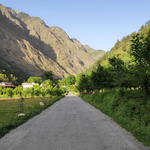
The settlement is spread across the terrain rather than arranged as a compact urban centre. Houses, agricultural plots and local lanes follow the available slopes and terraces. This pattern reflects the practical requirements of mountain living, where access to cultivable land, water and roads influences where homes are built.
As in many Himalayan villages, agriculture, livestock, local services and employment outside the settlement may all contribute to household livelihoods. Tourism has added another economic opportunity, with some properties catering to visitors interested in the region’s landscape and cultural traditions.
Census data provides a useful demographic baseline, but it should not be treated as a current population count. Migration, changing household sizes and employment patterns can alter the village’s population over time. The 2011 figures remain valuable historical data, but a more recent official count would be needed to describe present-day population levels confidently.
For visitors, Sharchi’s size is also a reminder that this is a living village, not simply a tourist attraction. The fields, homes, temples and lanes are part of an inhabited landscape. Exploring them respectfully helps travellers appreciate how tourism fits into the everyday life of the community.
Traditional Architecture
One of the most interesting aspects of Sharchi is its traditional Himalayan building character. Older houses in the Kullu region often use combinations of timber and stone, with sloping roofs, wooden balconies and construction methods adapted to cold weather and the seismic conditions of the Himalayas.
A particularly well-known regional tradition is Kath-Kuni architecture, in which layers of timber and stone are arranged in an interlocking pattern. Thick wooden beams are placed between stone courses, creating walls that differ visibly from modern cement-and-brick construction. The technique reflects generations of local knowledge about available materials, structural behaviour and the demands of mountain weather.
Kath-Kuni buildings can have useful insulating properties, and their timber-and-stone construction can provide flexibility under certain earthquake forces when properly built and maintained. However, earthquake performance depends on the entire structure, workmanship, materials, maintenance and local conditions. It would be misleading to claim that every traditional house is automatically earthquake-proof.
The architectural landscape of Sharchi should also be described carefully. Traditional timber-and-stone houses are part of the wider Kullu heritage, but it has not been independently established that every older building in Sharchi uses a pure Kath-Kuni construction system. Modern buildings and renovated homes may use concrete, brick, metal roofing and other materials.
Traditional houses in the region may feature:
- Stone walls combined with timber elements.
- Sloping roofs designed to deal with rain and, where relevant, snowfall.
- Wooden balconies and exterior galleries.
- Multi-level layouts adapted to sloping ground.
- Local materials selected according to availability and household resources.
Slate roofing has been used in parts of Himachal Pradesh, but roofing materials vary from house to house. The same applies to decorative woodwork and balcony design.
For travellers interested in architecture, Sharchi provides an opportunity to observe how buildings respond to mountain terrain and local traditions. It is also worth visiting Chehni Kothi in the wider Banjar region, a much better-known example of traditional timber-and-stone architecture. Comparing the two can help visitors understand both the continuity and the variation in Himachali building traditions.
Rural Economy and Daily Life
Life in Sharchi has traditionally depended on agriculture, livestock and the use of the surrounding mountain landscape. Terraced fields allow residents to cultivate slopes that would otherwise be difficult to farm, while orchards and small plots provide additional sources of food and income.
Crops grown in the wider Banjar and Kullu region include maize, wheat, barley, peas, potatoes and seasonal vegetables. The combination of crops varies with elevation, exposure, water availability and the agricultural practices of individual households. Apple cultivation is also important in suitable parts of Kullu district, although the presence and scale of orchards differ between settlements.
Livestock rearing has traditionally complemented agriculture. Cattle and other animals can provide milk, manure and additional resources for rural households. Seasonal work may include preparing fields, sowing crops, harvesting, collecting fodder and maintaining terraces or irrigation channels.
The Times of India’s 2025 travel feature on Sharchi describes farming, weaving and cattle rearing as part of the village’s traditional way of life. These activities help explain the cultural landscape, although the extent to which each remains a source of income today can vary between households.
Rural livelihoods are not static. Education, migration, employment in nearby towns, transport improvements and tourism all influence how people earn a living. Some residents may combine agriculture with salaried work, local services or hospitality rather than depending on a single occupation.
Tourism has created opportunities for homestays, guesthouses and small businesses. Visitors can contribute to the local economy by choosing locally run accommodation, eating at village establishments where available and hiring knowledgeable local guides for suitable excursions.
It is important, however, not to romanticise village life as completely self-sufficient or unchanged for centuries. Sharchi is a contemporary community balancing traditional practices with modern needs. Its cultural value lies partly in this continuity and adaptation.
Culture and Local Traditions
Sharchi belongs to the wider cultural world of Kullu, where village deities, temples, seasonal festivals and community gatherings remain important. In many parts of the region, local deities are central to religious life and may be associated with village identity, agricultural cycles and relationships between neighbouring communities.
Village temples are not only places of worship. They can also serve as focal points for community gatherings, ceremonies and festivals. Traditional music, processions and folk performances form part of the cultural life of Kullu, although the specific rituals and festival calendar differ between villages.
A local account associated with Sharchi describes a ceremonial flagpole or wooden pillar connected with a temple ritual. This is an interesting detail, but the exact temple, the timing of the ceremony and whether the pillar is replaced annually should be verified with a reliable local source before being presented as a definitive description of a formal village festival.
For travellers, the best way to learn about Sharchi’s traditions is to ask local hosts about the village temple, the presiding deity and any public celebrations taking place during the visit. These conversations can reveal how religious institutions continue to shape community life.
Visitors should approach temples and ceremonies respectfully. Ask before taking photographs, follow any instructions about entering sacred spaces and avoid interrupting rituals for pictures. A festival is first and foremost a community event, not a performance arranged for tourists.
Culture in Sharchi is also expressed through everyday activities: the maintenance of houses, work in the fields, food preparation, local speech and the seasonal movement between settlements. These ordinary details can provide a more meaningful understanding of the village than a brief visit focused only on photographs.
Trekking and Nature Exploration
Sharchi has potential appeal for hikers and nature travellers because of its elevated setting and its location within the wider mountain landscape of Banjar and Tirthan Valley. Walking through the village and its surrounding countryside can offer views of terraced fields, forest edges and neighbouring ridges.
However, Sharchi should not automatically be described as the official starting point for several established treks into the Great Himalayan National Park. Trail access, routes and permission requirements depend on the specific destination. A village walk, a forest hike and a multi-day trek into a protected area are different activities and need different levels of preparation.
Outdoor activities in and around the village may include:
- Village-to-village walks: Local routes can connect settlements and provide a closer look at rural landscapes.
- Forest walks: Short hikes may follow established paths through nearby woodland, depending on local access and current trail conditions.
- Nature photography: Forest edges, agricultural terraces and mountain views offer changing scenery through the seasons.
- Birdwatching: Quiet walks can provide opportunities to observe common Himalayan forest birds, particularly during the morning.
- Longer trekking excursions: More demanding routes in the wider region may require a local guide, advance planning and any applicable park permissions.
Before setting out, ask your host or a knowledgeable local guide which trails are currently accessible. Online maps may not show every village path accurately, and a line on a map does not establish that a route is open, safe or suitable for visitors.
Weather is an important consideration. Trails can become slippery after rain, while mist can reduce visibility and make navigation harder. Carry drinking water, suitable footwear and a charged phone, but do not rely on mobile connectivity being available everywhere.
For protected-area treks, consult the official Great Himalayan National Park website for park information and access guidance. Follow any guide or permit requirements that apply to your intended route.
The greatest reward of walking around Sharchi may not be reaching a distant summit. A slower route through the village, with time to observe local architecture and the changing views across the hills, can be just as memorable.
Wildlife and Natural Environment
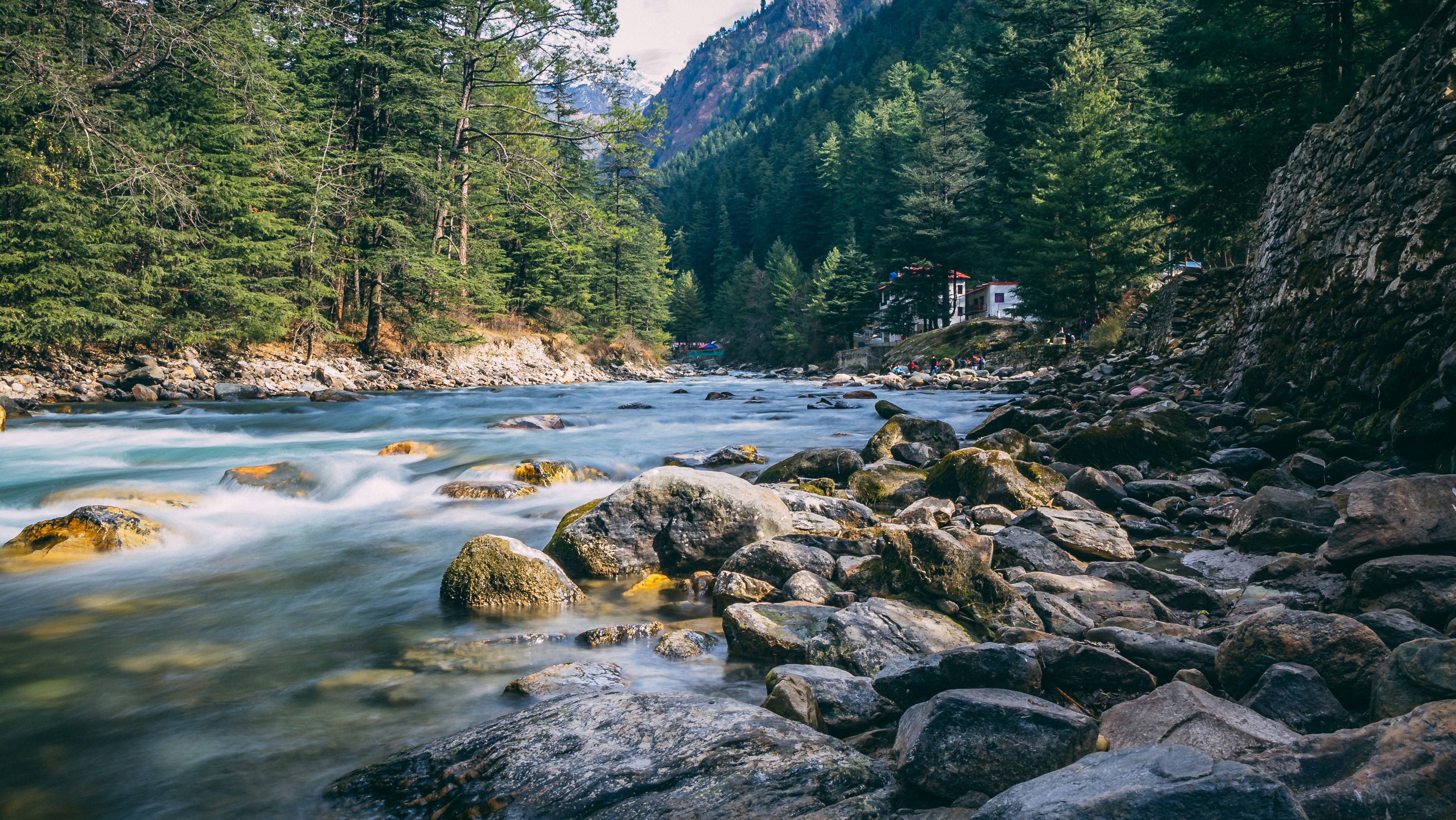
The wider Tirthan and Banjar landscape forms part of a diverse Himalayan ecological region. Forests, streams, agricultural land and higher mountain habitats support a range of birds, mammals and other wildlife. The protected Great Himalayan National Park landscape is particularly important for conservation because it includes habitats across substantial changes in elevation.
The forested slopes around Sharchi may support woodland birds, woodpeckers, flycatchers and other species associated with Himalayan forests. The wider region is also known for notable wildlife such as the western tragopan and Himalayan tahr, but these should not be presented as animals visitors can expect to see directly from the village.
The distribution of wildlife depends on habitat, altitude, season and human disturbance. Larger mammals are often elusive, and many birds are easier to hear than to see. A quiet morning walk may offer better opportunities for observation than a busy afternoon beside a road.
For responsible wildlife watching:
- Keep a respectful distance from birds and animals.
- Avoid feeding wildlife or leaving food scraps in the forest.
- Do not play loud music or repeatedly use recorded calls to attract birds.
- Stay on established paths where possible.
- Take all rubbish back with you.
Sharchi’s environmental value is not limited to the presence of rare animals. Its fields, forests, watercourses and settlement form part of a wider mountain ecosystem. Responsible travel can help reduce pressure on this landscape, particularly as tourism develops and more visitors seek accommodation in rural areas.
Tourism and the Changing Landscape
For many travellers, Sharchi remains less familiar than the better-known accommodation centres of Tirthan Valley. Its relative distance from the main river corridor and its traditional settlement character give it a different atmosphere from places where tourism is concentrated directly beside the water.
Improved road access has made it easier for visitors to reach the village, while the growth of interest in rural tourism has encouraged some local properties to welcome guests. Homestays and small guesthouses can give travellers a chance to stay within a village setting rather than in a larger commercial centre.
Tourism brings potential benefits. It can create income for local households, support small businesses and encourage interest in traditional architecture and cultural practices. Visitors who stay longer and use local services may contribute more directly to the village economy than those who make a short stop solely for photographs.
At the same time, tourism can create pressure on water supplies, waste management, roads and building land. New construction can alter the appearance of a village, while poorly managed visitor activity may disturb residents and the surrounding environment.
Sharchi’s future as a travel destination will depend partly on how these changes are managed. Locally run accommodation, responsible building practices and clear guidance for visitors can help maintain a balance between economic opportunities and the qualities that make the village distinctive.
The village should not be described as completely untouched by tourism or as a place where life has remained unchanged for centuries. It is more accurate to see Sharchi as a living Himalayan settlement adapting to new opportunities while retaining aspects of its rural and cultural identity.
How to Reach Sharchi
Sharchi is located in the Banjar region of Kullu district and can be approached by road from the wider Kullu and Tirthan Valley area. Travellers generally reach the region via the Aut side and then continue towards Banjar and the valley roads. The final approach to Sharchi involves mountain roads, so journey times depend on traffic, road conditions, weather and the exact starting point.
The route is different from travelling only to a riverside settlement such as Nagini or Gushaini. Sharchi lies higher on the mountain terrain, and the final ascent should be checked before setting out.
By road: A private car or taxi provides flexibility, particularly for travellers carrying luggage or planning to visit several villages. Confirm the current road condition with a local accommodation provider before departure. Some access roads may be narrow, steep or affected by rain and roadworks.
By public transport: Travellers can look for services towards Banjar and nearby parts of Tirthan Valley, then confirm locally whether a bus or shared vehicle serves the route to Sharchi. The availability and frequency of transport can vary, so allow extra time for connections.
From Gushaini and Nagini: These riverside settlements can be combined with Sharchi in a wider Tirthan Valley itinerary. However, the route involves climbing to a higher settlement, and the actual travel time depends on the chosen road, starting point and conditions. Check the route rather than assuming that the villages are connected by a short, direct walk.
Before travelling, confirm whether your accommodation has vehicle access and parking. If the property is located away from the main road, ask whether a short walk is required to reach it. Avoid driving on unfamiliar mountain roads after dark when possible, particularly during rain, fog or winter conditions.
Best Time to Visit Sharchi
Sharchi can be visited in different seasons, but the landscape, road conditions and walking opportunities change throughout the year.
Spring, from March to April, brings fresh vegetation and gradually milder daytime weather. It is a good period to explore the village and its surrounding fields, although nights can still be cold.
Summer, from May to June, is generally pleasant for travellers escaping the heat of the plains. Clear days can offer good views across the surrounding hills, and walking conditions may be favourable when the weather is stable. This is also a popular travel period, so confirm accommodation availability in advance.
The monsoon, from July to September, brings greener slopes but also the risk of heavy rain, slippery trails, landslides and road disruption. Travellers should keep their plans flexible and avoid exposed slopes or swollen streams. Check the weather and road situation before setting out.
Autumn, from October to November, can provide clear skies and comfortable daytime conditions for village exploration and photography. As temperatures fall, mornings and evenings become colder.
Winter, from December to February, can bring freezing nights, cold winds and occasional snow in the surrounding higher areas. Snowfall at Sharchi itself should not be assumed. Check local forecasts, road access and heating arrangements before booking a winter visit.
For a first visit focused on village walks, architecture and mountain scenery, late spring, early summer and autumn are useful periods to consider. The best choice still depends on current weather, road conditions and the kind of outdoor activity planned.
Responsible Travel Tips
Sharchi is an inhabited mountain village, and a respectful visit should take account of both its cultural traditions and the needs of residents.
Stay on established lanes and paths rather than walking through private fields or orchards without permission. Ask before photographing residents, homes or religious ceremonies. Keep noise low, especially in the evening, and follow local guidance when visiting temples.
Carry reusable water bottles and take rubbish back with you. Avoid leaving food waste along walking routes, and do not disturb livestock or wildlife. If you plan a forest walk or a longer trek, check the route and any applicable access requirements before leaving.
Choose accommodation that explains its approach to waste, water and local employment. Buying food and services locally can help distribute tourism income beyond a single business.
Mountain travel also requires practical preparation. Carry warm clothing even in summer, use footwear suited to uneven paths and allow extra time for road journeys. During the monsoon, do not underestimate the risk of landslides and rapidly changing conditions.
Most importantly, remember that Sharchi is not simply a scenic backdrop. Its houses, fields, temples and community spaces are part of everyday village life. Travelling slowly and respectfully allows visitors to appreciate the place without putting unnecessary pressure on it.
Conclusion
Sharchi offers a different perspective on Tirthan Valley. Set above the main river corridor, the village combines an elevated mountain landscape with traditional settlement patterns, cultivated slopes and a cultural identity connected with the wider Kullu region.
Its population and agricultural landscape show that Sharchi is a substantial living community rather than an isolated cluster of holiday cottages. Traditional timber-and-stone architecture, local religious customs and changing rural livelihoods add depth to the experience, while its position within the broader mountain region makes it appealing to visitors interested in nature and walking.
The village can also be included in a wider journey through Banjar and Tirthan Valley, alongside places such as Gushaini, Nagini and Chehni Kothi. Travellers should verify local road access and trekking arrangements, particularly when planning excursions towards protected areas.
For those seeking mountain views, traditional village life and a slower Himalayan experience, Sharchi offers a rewarding alternative to the busier destinations of Himachal Pradesh. Its appeal lies not only in the scenery, but in the opportunity to understand how people live, work and maintain their cultural traditions in a high mountain environment.