Image Source: Shikhar Singh
A Literary Landmark of Mughal-era Shahjahanabad
Ghalib Ki Haveli, located in the narrow lanes of Ballimaran in Chandni Chowk, Old Delhi, is one of the most evocative literary heritage sites in India. This historic residence is associated with Mirza Asadullah Khan Ghalib (1797–1869), the legendary Urdu and Persian poet whose works continue to shape South Asian literature. More than a preserved house, the haveli represents the intellectual, cultural, and emotional landscape of 19th-century Delhi, a city witnessing the decline of the Mughal Empire.
History
Mirza Ghalib spent a significant part of his adult life in this haveli during the later Mughal period, particularly under the reign of Bahadur Shah Zafar, the last Mughal emperor. Delhi at the time was a center of poetry, philosophy, and refined culture, but also a city facing political decay and economic hardship.
Ghalib lived here during some of the most turbulent years in Delhi’s history, including the Revolt of 1857, which devastated the city and dismantled its cultural institutions. His famous letters (Ghalib ke Khatoot), written during and after this period, offer firsthand accounts of famine, destruction, and the collapse of an entire way of life. Many of his iconic Urdu ghazals and Persian verses, marked by existential reflection, irony, and philosophical depth, are believed to have been composed while he resided here.
After Ghalib’s death in 1869, the haveli gradually fell into neglect. Over time, much of the original structure was lost due to urban congestion. Recognizing its cultural importance, the Archaeological Survey of India (ASI) later restored the surviving portion and converted it into a museum and memorial dedicated to the poet.
Architecture
Architecturally, Ghalib Ki Haveli reflects the typical residential style of Mughal-era Shahjahanabad, adapted to the dense urban fabric of Old Delhi.
Originally, the haveli was far larger, comprising multiple rooms arranged around inner courtyards. Today, only a section of the original structure remains. The surviving building is modest in scale, emphasizing function over ornamentation, which was common for middle-ranking intellectuals and courtiers of the time.
Key architectural features include:
- Narrow entrances and thick walls, suited to Old Delhi’s climate
- Simple arches and alcoves, reflecting late Mughal domestic design
- Minimal decorative elements, highlighting a scholarly rather than aristocratic lifestyle
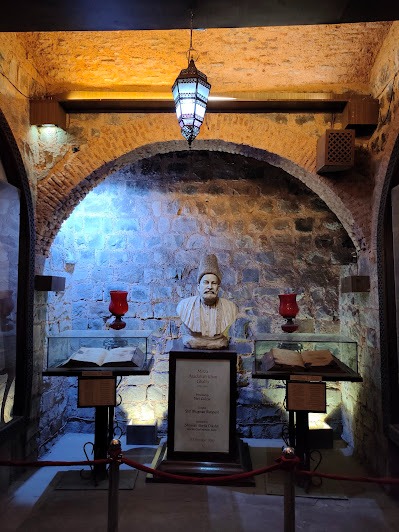
The restored interior now functions as a museum, displaying portraits of Ghalib, excerpts from his poetry, reproductions of manuscripts, calligraphic panels, and contextual information about his life and times. The understated architecture complements the contemplative nature of Ghalib’s literary legacy.
Cultural and Literary Significance
Ghalib Ki Haveli is not merely a historical house—it is a symbol of Delhi’s literary soul. Ghalib’s poetry transcended conventional themes of romance, delving into metaphysics, selfhood, fate, and divine ambiguity. His work bridged Persian classical traditions and emerging Urdu literary forms, influencing generations of poets across India and Pakistan.
The haveli stands as a reminder of a time when poetry shaped public discourse, when mushairas (poetic gatherings) were central to cultural life, and when Delhi was a living archive of ideas, languages, and artistic expression.
How to Reach Ghalib Ki Haveli
By Metro:
The nearest metro station is Chandni Chowk (Yellow Line). From the station, the haveli is about 1 km away and can be reached by walking or cycle-rickshaw.
By Road:
Chandni Chowk is well connected to central and north Delhi. Due to narrow lanes in Ballimaran, private vehicles are not advisable. Parking is available at designated points near Chandni Chowk.
By Foot:
The final approach to Ghalib Ki Haveli must be done on foot, as the lanes around Ballimaran are extremely narrow and bustling.
Nearby Attractions
A visit to Ghalib Ki Haveli can easily be combined with other heritage sites in Old Delhi:
- Chandni Chowk: Historic market street dating back to the Mughal era
- Jama Masjid: One of India’s largest mosques, built by Shah Jahan
- Red Fort (Lal Qila): UNESCO World Heritage Site and symbol of Mughal power
- Chashma Dil Khush: A historic stepwell located near the haveli
- Ballimaran Bazaar: Traditional shoe market known for handmade footwear
- Dariba Kalan: Famous for silver jewelry and old Delhi craftsmanship
Visiting Information
- Entry Fee: Free
- Timings: Generally open during daytime hours (closed on Mondays and public holidays may vary)
- Ideal Time to Visit: Morning or early afternoon, preferably on weekdays to avoid crowds