Introduction
Sarkidhar is a relatively lesser known hill village in Mandi district of Himachal Pradesh, where small mountain lakes, forested slopes, Buddhist meditation caves and traditional settlements create an experience different from the state’s more commercialised hill stations. Located above Rewalsar, a town renowned for its religious significance among Hindus, Buddhists and Sikhs, Sarkidhar offers an opportunity to explore the quieter countryside surrounding one of Mandi’s most distinctive cultural destinations.
Unlike destinations such as Manali and Shimla, Sarkidhar is not primarily about hotels, crowded markets or a well developed network of tourist attractions. Its appeal lies in walking along village paths, visiting hilltop temples, discovering small lakes and observing the spiritual traditions that continue to shape local life.
The village is particularly interesting for travellers who want to understand the landscape around Rewalsar beyond its famous sacred lake. Here, the experience extends from the religious centre of Rewalsar into the surrounding hills, where isolated settlements, lesser known water bodies and hillside trails create a different perspective on the region.
According to the travel account published by FoodRavel, visitors can explore Buddhist caves, hike to Naina Devi Temple, walk to Kunt Bhyog Lake and descend towards Rewalsar. These activities make Sarkidhar more than a conventional trekking destination. It is a place where nature, pilgrimage and village exploration come together.
Geographical Setting: Understanding Sarkidhar and Rewalsar
Sarkidhar lies in the hilly landscape of Mandi district, in the vicinity of Rewalsar. It should not be confused with Janjehli Valley and the high altitude trekking areas associated with Seraj, which form a different part of the district.
Rewalsar lies at approximately 1,360 metres above sea level, according to the Himachal Pradesh government’s wetland information. The surrounding terrain consists of hills, wooded slopes, small valleys and settlements connected by winding roads and footpaths. The wider area also contains several small lakes, including those associated with local religious traditions and legends.
Sarkidhar’s landscape is better understood as a network of inhabited hills and scattered natural features than as a single high altitude mountain ridge. Travellers may encounter cultivated land, dry or sparsely vegetated slopes, wooded patches and viewpoints overlooking neighbouring valleys.
This is an important distinction for planning a visit. Sarkidhar should not automatically be described as a 3,000 metre trekking destination. FoodRavel identifies Naina Devi Temple, one of its principal attractions, at approximately 1,830 metres. The elevation gain and walking distance will depend on the starting point and the route chosen.
The area’s scenery can also vary considerably with the season. A visit in spring may bring warmer conditions and changing vegetation, while the monsoon can make footpaths slippery. Clear weather is particularly useful for enjoying distant mountain views from the higher points.
Why Is Sarkidhar Known as the Hill of Lakes?
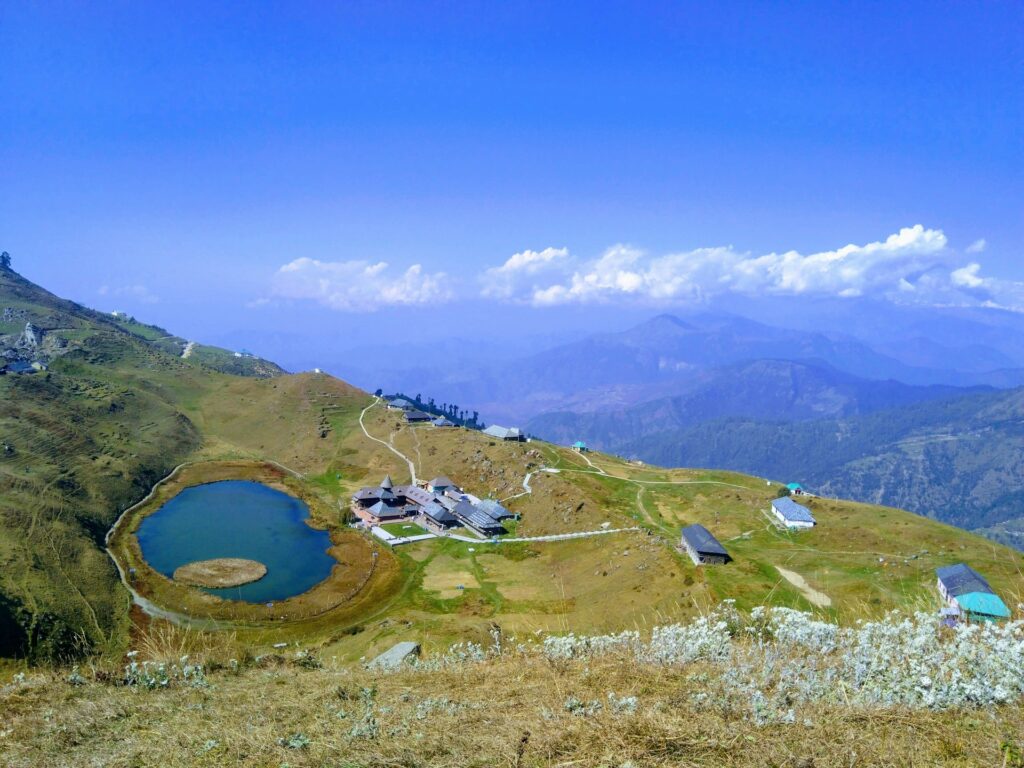
One of Sarkidhar’s most distinctive features is its association with a group of small lakes.
The name is commonly explained through the words sar, meaning lake, and dhar, referring to a ridge or hill. The village is traditionally associated with seven lakes, although FoodRavel reports that only three remain as water bodies, with others having dried up.
This account makes Sarkidhar particularly interesting from a geographical perspective. Instead of visiting a single famous lake, travellers can explore a landscape whose identity is connected with several smaller water bodies.
The lakes should not, however, be assumed to be equally accessible, permanently full or equipped with visitor facilities. Their condition can change with rainfall, seasonal water availability and local environmental conditions.
Kunt Bhyog Lake
Kunt Bhyog is one of the best known lakes associated with Sarkidhar and is described by FoodRavel as the largest of the remaining lakes. The account notes that the lake contains water and fish and recommends visiting early in the morning.
The walk to Kunt Bhyog can be an enjoyable way to begin the day. Early morning is generally quieter than the middle of the day, allowing visitors to experience the surrounding countryside without rushing between attractions.
The lake is also associated with local mythology. Its name is linked to Kunti, the mother of the Pandavas in the Mahabharata tradition. Local legends connect the lake with the Pandavas, although such stories should be understood as part of the region’s cultural heritage rather than as independently verified historical events.
Visitors should avoid disturbing the water, feeding wildlife indiscriminately or leaving rubbish around the shoreline.
Things to Do in Sarkidhar
1. Explore the Buddhist Meditation Caves
One of the more unusual attractions of Sarkidhar is its collection of Buddhist caves.
Rewalsar is an important centre of Buddhist heritage, particularly because of its association with Padmasambhava, also known as Guru Rinpoche. Buddhist traditions connect the great teacher with the spread of Buddhism into Tibet. The town itself contains monasteries alongside Hindu temples and a Sikh gurdwara.
The Buddhist caves around Sarkidhar provide another dimension to this spiritual landscape. According to FoodRavel, several caves are scattered across different locations, with monks using some of them for meditation. The travel account also mentions a nunnery in the area.
These are not necessarily conventional tourist attractions with reception counters, information boards or regular opening hours. Some caves may be locked or inaccessible to visitors.
For travellers interested in Buddhist geography and Himalayan religious traditions, these sites offer a reason to explore the countryside beyond the main religious complex at Rewalsar.
Visitors should respect the privacy of monks and nuns, avoid entering locked spaces and seek local permission before photographing religious sites or people.
2. Visit Naina Devi Temple on the Hilltop
Naina Devi Temple is one of the principal attractions associated with Sarkidhar.
The temple stands on a hilltop at approximately 1,830 metres above sea level, according to FoodRavel. The elevated position makes the journey as interesting as the destination, particularly for visitors who enjoy combining a religious visit with a short hike.
From the temple area, travellers can enjoy views towards the Bahl Valley and surrounding hills when visibility is good. The wider landscape includes the hills and valleys around Sarkidhar and neighbouring parts of Mandi district.
The temple can be approached by road, and FoodRavel reports that bus services operate towards it. Some visitors also walk from their accommodation or nearby settlements, using local paths and shortcuts.
The exact walking distance depends on the starting point. Travellers should ask locally about the condition of the route rather than relying on an assumed trekking distance.
There are shops and a guesthouse in the vicinity of the temple, according to the travel account. However, facilities and payment options may change, so it is sensible to carry cash and sufficient drinking water.
An important geographical clarification is necessary here: this is the Naina Devi Temple associated with the Sarkidhar and Rewalsar area. It should not be confused with the much more famous Shree Naina Devi Temple in Bilaspur district, which is a separate pilgrimage destination.
3. Walk to the Lakes in the Early Morning
A lake walk is one of the simplest ways to appreciate Sarkidhar’s quieter surroundings.
Rather than treating the village as a destination that can be explored only through long treks, visitors can set aside time for short walks between their accommodation, the surrounding countryside and accessible lakes.
Kunt Bhyog is a particularly worthwhile starting point. The landscape around the lake provides opportunities to observe local vegetation, the changing appearance of the hills and the relationship between settlements and natural water bodies.
Morning walks can be especially rewarding because the village is generally quieter before the day’s activities begin.
However, not every lake is necessarily connected by an established walking trail. Travellers should confirm the route with local residents and avoid assuming that the seven traditionally associated lakes can all be visited in one continuous circuit.
4. Hike Through the Surrounding Hills
Hiking is another major reason to visit Sarkidhar.
The surrounding slopes and village paths offer opportunities for informal exploration, from short walks to more demanding excursions. FoodRavel describes walking approximately five to six kilometres on some days while exploring the area.
The most suitable hike will depend on the weather, fitness level, available daylight and local trail conditions. A walk to Naina Devi Temple, a visit to a nearby lake and an exploration of the surrounding settlement can be combined into a relaxed day outdoors.
Sarkidhar should not automatically be presented as a marked trekking destination with standardised trail distances and difficulty grades. The routes described by travellers may include local paths and shortcuts that are not formally signposted.
A local guide is advisable for unfamiliar routes, particularly where trails enter wooded areas or pass through isolated terrain.
Avoid hiking after dark. FoodRavel also reports local concerns about large wild animals in the surrounding countryside. Travellers should take such concerns seriously, stay on known paths and follow local safety advice.
5. Walk Towards Rewalsar
Rewalsar is the natural starting point for understanding Sarkidhar’s religious and cultural setting.
FoodRavel reports a road distance of approximately 9 to 10 kilometres between Rewalsar and Sarkidhar. The account also describes a narrow downhill shortcut discovered near the Buddhist caves.
This distinction between the road and footpath is important. A walking route may be considerably shorter than the road journey, but it may also be steep, uneven or difficult to follow without local guidance.
Travellers who enjoy walking can ask residents whether the shortcut is currently accessible. Others can use road transport, including available local bus services.
Rewalsar is the area’s principal service centre, with shops and facilities that are not necessarily available in Sarkidhar itself.
The town is also worth exploring in its own right. Rewalsar Lake, Buddhist monasteries, Hindu temples and Gurudwara Shri Rewalsar Sahib create a distinctive religious landscape in which three major religious traditions are represented.
The connection between Sarkidhar and Rewalsar therefore works in both directions: Sarkidhar offers a quieter exploration of the surrounding hills, while Rewalsar provides a deeper introduction to the region’s religious heritage and everyday life.
6. Enjoy Quiet Evenings and Village Life
Sarkidhar is particularly suited to travellers who prefer a slower pace rather than a tightly packed sightseeing schedule.
FoodRavel describes peaceful evenings spent watching clouds and stars from a homestay terrace, sometimes accompanied by a bonfire. Such experiences depend on the accommodation and local conditions, but they illustrate the appeal of spending time in the village rather than visiting only its individual attractions.
An evening can be spent resting after a hike, talking with local hosts or observing the changing light across the surrounding hills.
Because Sarkidhar has relatively limited visitor infrastructure, it is best approached as a rural stay rather than a conventional resort destination. Travellers should confirm whether their accommodation provides meals, heating, hot water and outdoor facilities before arrival.
Bonfires should be arranged only with the host’s permission and where conditions permit. They should never be lit near dry vegetation or left unattended.
Sarkidhar’s Religious and Cultural Landscape
Sarkidhar’s importance becomes clearer when viewed in relation to Rewalsar.
Rewalsar is sacred to Hindus, Buddhists and Sikhs. The Himachal Pradesh tourism authorities identify the town with Padmasambhava, the Buddhist teacher associated with the spread of Buddhism into Tibet. Hindu traditions connect the area with sage Lomas, while Sikh heritage is represented by Gurudwara Shri Rewalsar Sahib.
The surrounding landscape includes temples, monasteries, small lakes and places associated with local legends. These religious traditions form part of the region’s cultural geography and help explain why seemingly ordinary hills and water bodies can hold special significance for local communities.
For visitors, the most meaningful way to experience this heritage is to combine sightseeing with respectful observation. Religious sites should not be treated simply as photographic locations, and local customs may determine whether particular areas can be entered or photographed.
Sarkidhar’s Buddhist caves and hilltop temple add to this wider cultural setting. They also demonstrate that the religious landscape of Rewalsar extends beyond the central lake into the surrounding settlements and hills.
Best Time to Visit Sarkidhar
Sarkidhar can be visited during different seasons, but the experience varies according to temperature, rainfall and trail conditions.
March to June: Spring and early summer are suitable for village walks, temple visits and lake exploration. Conditions can become hot, particularly during the day, so early morning and late afternoon are preferable for hiking. FoodRavel’s April visit also illustrates that Sarkidhar should not automatically be expected to look lush and cool simply because it is in Himachal Pradesh.
July to September: The monsoon can bring greener surroundings and rainfall, but slippery footpaths, muddy tracks and reduced visibility may make hiking less comfortable. Check local conditions before setting out.
October to November: The post monsoon period can offer pleasant conditions for walking and sightseeing, depending on rainfall and the weather in a particular year. Clear days may provide better visibility across the surrounding hills.
December to February: Winter visits can offer a quieter atmosphere, but temperatures may be cold and outdoor conditions less predictable. Snowfall in Sarkidhar should not be treated as a regular occurrence. Check current forecasts and local advice rather than planning a snow trek on the assumption that the village will be snow covered.
For most visitors, the most useful approach is to select dates according to the intended activity. Lake walks and temple visits require less favourable weather tolerance than longer hikes through isolated terrain.
How to Reach Sarkidhar
Step 1: Reach Mandi
Mandi is the principal regional gateway for a trip to Sarkidhar and Rewalsar.
The town is connected by road with destinations including Chandigarh, Shimla and Manali. Travellers arriving from Delhi can take a bus or travel by road towards Mandi, then continue to Rewalsar and Sarkidhar.
Travel time from Delhi varies according to the starting point, traffic and road conditions. It is better to check the actual route before departure than to rely on a fixed journey time.
Step 2: Travel from Mandi to Rewalsar
Rewalsar lies approximately 24 to 25 kilometres from Mandi by road, according to government tourism sources.
Buses and taxis provide ways to reach the town, although the availability and frequency of services should be checked for the intended travel date.
Rewalsar is an important stop because it offers access to accommodation, shops and other basic services before visitors continue towards Sarkidhar.
Step 3: Continue from Rewalsar to Sarkidhar
FoodRavel gives an approximate road distance of 9 to 10 kilometres between Rewalsar and Sarkidhar.
Visitors can investigate local bus services or arrange a taxi, depending on the destination within the village. The final distance may vary according to the accommodation, temple or trailhead being visited.
Those who intend to walk should confirm the starting point and route locally. A road route and a downhill shortcut are not interchangeable, and a shorter path may involve a steep descent or uneven terrain.
By Air
Bhuntar Airport near Kullu is the nearest airport commonly identified by Himachal Pradesh tourism sources for Rewalsar. It is approximately 84 to 85 kilometres away by road, although the actual journey depends on the route and conditions.
Travellers should verify current flight operations and onward transport before making bookings.
By Train
Joginder Nagar is the nearest railway station commonly cited by tourism sources, with onward travel required by road. The practical choice of railway connection will depend on the traveller’s origin and the availability of services.
Accommodation and Facilities
Sarkidhar has more limited visitor facilities than Rewalsar. Homestays and small accommodation options may be available, but visitors should confirm their availability, location and amenities before travelling.
FoodRavel reports that, at the time of the author’s visit, the village had very limited food options, with a small tea and snack shop rather than a developed restaurant scene. The account also notes the absence of several everyday services, including a medical shop and departmental store.
These observations describe the author’s experience and should not be interpreted as a guarantee of present-day conditions. Facilities can change, so it is wise to confirm what is currently available.
Rewalsar is the better place to obtain groceries, seek routine services and arrange onward transport. Himachal Pradesh Tourism also lists its Tourist Inn at Rewalsar, alongside other accommodation options in the area.
Travellers planning an overnight stay in Sarkidhar should ask their host about meals, drinking water, electricity, mobile connectivity and transport arrangements.
Practical Travel Tips for Sarkidhar
Carry sufficient drinking water. FoodRavel specifically identifies water availability as a challenge on local hikes. Do not assume that a spring, tap or shop will be available along the route.
Keep cash available. Some local shops may not accept digital payments consistently. Carry enough cash for transport, food and small purchases.
Arrange a guide for unfamiliar trails. Some paths are local shortcuts rather than marked trekking routes. Ask residents about the route, current conditions and expected return time.
Avoid entering wooded areas after dark. Stay on familiar paths and follow local advice regarding wildlife.
Check transport before setting out. Bus services may not run at convenient intervals for every village or temple. Confirm return transport before beginning a long walk.
Respect religious spaces. Buddhist caves, temples and monasteries may have restricted areas. Ask before entering or taking photographs.
Leave the lakes clean. Do not leave plastic, food packaging or other waste around the water bodies.
Plan according to actual weather conditions. The area can be warm during the day and cooler at night. Carry suitable clothing and check the forecast before undertaking longer walks.
Sarkidhar and Rewalsar: How to Plan the Visit
The most practical way to explore the area is to use Rewalsar as the main base and treat Sarkidhar as an extension into the surrounding countryside.
A relaxed one day visit can focus on the hilltop Naina Devi Temple, a walk to an accessible lake and an exploration of the village. Travellers who want to see the Buddhist caves and explore additional paths should allow more time, particularly if they are staying in a homestay.
An overnight stay makes it easier to enjoy early morning walks and quiet evenings. It also reduces the need to fit every attraction into a single day.
The itinerary should remain flexible because not all lakes and caves have established visitor routes, and the condition of local paths may vary. Travellers should not assume that all seven traditionally associated lakes can be visited on a single marked circuit.
Conclusion
Sarkidhar offers a different way to explore Mandi district. Rather than presenting the region only through its best known temples and lakes, it draws attention to the quieter hills surrounding Rewalsar, where small water bodies, Buddhist caves, village trails and a hilltop temple form a distinctive rural landscape.
Its appeal lies less in dramatic high altitude trekking and more in the combination of accessible hikes, religious heritage and slow travel. The walk to Kunt Bhyog, the visit to Naina Devi Temple, the exploration of Buddhist caves and the route towards Rewalsar provide several ways to experience the area.
For travellers interested in Himachal Pradesh beyond its familiar tourist centres, Sarkidhar is worth considering as part of a wider visit to Rewalsar. The best experience comes from allowing enough time to explore at a relaxed pace, confirming local routes and facilities in advance, and treating the landscape and its religious traditions with respect.
Frequently Asked Questions
Where is Sarkidhar located?
Sarkidhar is in Mandi district of Himachal Pradesh, in the hilly area surrounding Rewalsar. It is a different destination from the high altitude trekking areas around Janjehli and Seraj.
What is Sarkidhar famous for?
Sarkidhar is associated with several small lakes, including Kunt Bhyog, Buddhist meditation caves, Naina Devi Temple and hiking routes through the surrounding hills.
What is the altitude of Sarkidhar?
The elevation varies across the village and its surrounding hills. FoodRavel places Naina Devi Temple at approximately 1,830 metres above sea level. This should not be confused with a confirmed elevation of 3,000 metres for Sarkidhar as a whole.
How far is Sarkidhar from Rewalsar?
FoodRavel reports an approximate road distance of 9 to 10 kilometres. The distance for walking may differ depending on the starting point and the shortcut used.
Can visitors trek to Naina Devi Temple?
Yes. Visitors can approach the temple by road, and walking routes are also described by travellers. The difficulty and distance depend on the starting point and current trail conditions.
How many lakes are there in Sarkidhar?
Sarkidhar is traditionally associated with seven lakes. FoodRavel reports that only three remain as water bodies, with others having dried up. Their current condition should be verified locally.
Is Sarkidhar suitable for beginners?
Short village walks and visits to accessible attractions may suit beginners. Longer hikes should be selected according to fitness, weather and local guidance. There is no reason to assume that every route is marked or suitable for inexperienced hikers.
Are accommodation and restaurants available in Sarkidhar?
Some homestays and basic food options may be available, but facilities are limited and can change. Rewalsar offers a wider range of accommodation and everyday services.
What should visitors carry?
Carry drinking water, suitable walking shoes, weather appropriate clothing, cash, snacks and a charged phone. For longer hikes, consider a local guide and confirm the return route before setting out.