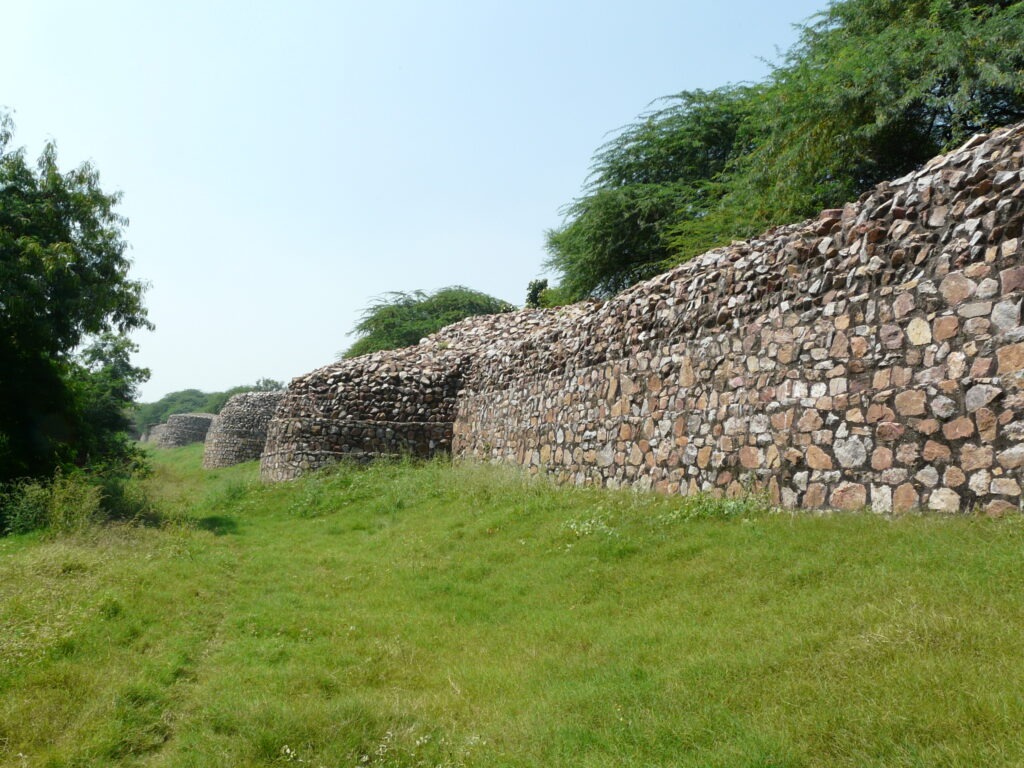
Image Source: Varun Shiv Kapur
Introduction
Lal Kot is the earliest known fortified settlement of Delhi and represents the city’s transition from legendary memory to historical reality. Built during the early medieval period, Lal Kot marks the moment when Delhi emerged as a political capital rather than merely a mythic or geographic reference. Located in present-day Mehrauli, Lal Kot forms the nucleus around which later cities of Delhi developed. Though today only fragments of its walls survive, Lal Kot remains the foundational layer of Delhi’s urban and political history.
Historical Origin and Foundation
Lal Kot was founded in the 10th–11th century CE by the Tomara Rajput ruler Anangpal Tomar, who established it as the capital of his kingdom known as Dhillika (early Delhi). The Tomaras selected this site because of its natural defensibility, elevated rocky terrain, and proximity to major trade and military routes linking the Gangetic plains with Rajasthan. Lal Kot thus became the first clearly documented political center of Delhi. Tradition also associates Anangpal Tomar with the installation of the Iron Pillar in the region, reinforcing Lal Kot’s identity as a seat of indigenous kingship.
Conquest and Expansion under the Chauhans
In the late 12th century, Lal Kot was captured by the Chauhan ruler Prithviraj Chauhan, who greatly expanded it into a larger fortified city called Qila Rai Pithora. This expansion transformed Lal Kot from a compact citadel into a major urban fortress capable of housing a large population and military establishment. After Prithviraj Chauhan’s defeat by Muhammad Ghori in 1192 CE, this fortified complex passed into the hands of the Delhi Sultanate and became the base upon which Islamic Delhi was constructed.
Geographical Setting
Lal Kot was built on the southern extension of the Aravalli ridge, one of the oldest geological formations in India. This ridge provided natural stone for construction, elevated ground for surveillance, and protection from floods. The location also allowed control over the corridor connecting North India with the western desert regions. The fort stood between present-day Mehrauli, Saket, and Vasant Kunj, commanding both the plains and the forested ridge, making it strategically superior to lowland settlements.
Urban Layout and City Planning
Lal Kot was designed as a compact walled citadel rather than a sprawling city. Its layout included massive defensive ramparts, controlled gateways, inner residential quarters, and royal or administrative spaces. The fort functioned primarily as a military and political nucleus, while civilian settlements likely extended beyond its walls. The urban design reflects an early stage of fortified city planning in North India, where defense and control were prioritized over ceremonial or aesthetic considerations.
Architectural Character and Building Material
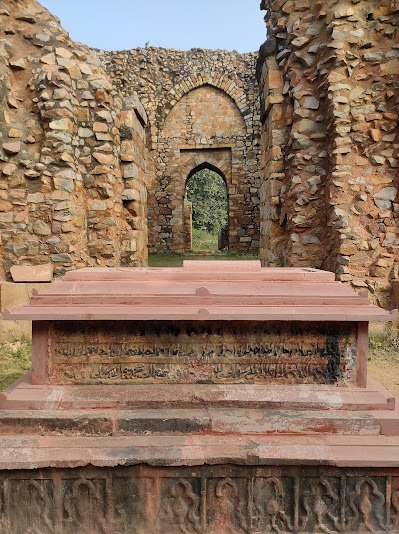
The fort was constructed mainly from locally quarried quartzite stone, bound with lime mortar and rubble masonry. The stone gives the fort its distinctive reddish-brown appearance, which explains its name: Lal meaning red and Kot meaning fort. Unlike later Mughal structures that emphasize symmetry and ornamentation, Lal Kot’s architecture is austere and utilitarian. Its walls were thick and high, reinforced with semi-circular bastions and narrow gateways to restrict enemy movement. Natural ravines and rocky outcrops were integrated into the defensive system, making the fort difficult to breach.
Military and Defensive Significance
Lal Kot functioned as a frontier capital, constantly exposed to rival Rajput clans and later to invading forces from the northwest. Its design reflects this reality through strong fortifications, elevated watch points, and limited access routes. The absence of grand palatial structures suggests that survival and security were the primary concerns of its builders. The fort represents an early phase of Indian military architecture, before the development of massive imperial citadels like Tughlaqabad or Agra Fort.
Relationship with the Qutub Complex
The later Qutb Minar complex developed just outside the walls of Lal Kot after the establishment of the Delhi Sultanate. Early mosques and Islamic structures were built using materials from earlier Rajput buildings within Lal Kot, symbolizing the political and religious transition of the region. This proximity makes Lal Kot and the Qutub complex part of a single historical landscape representing successive layers of rule rather than isolated monuments.
Cultural and Political Importance
Lal Kot marks the transition of Delhi from epic geography associated with Indraprastha to recorded political history as Dhillika or Dilli. It represents the first durable expression of kingship in the region and the beginning of Delhi as a capital city. From this nucleus grew the later medieval cities of Siri, Tughlaqabad, Jahanpanah, Firozabad, and Shahjahanabad. Every later ruler who founded a new capital in Delhi followed the model first established at Lal Kot: a walled city serving as both symbol and instrument of power.
Present Condition and Local Landscape
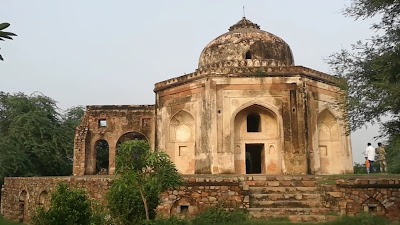
Today, the remains of Lal Kot survive as long stretches of weathered stone walls running through forested areas near Mehrauli Archaeological Park and Saket. In many places, later tombs, mosques, stepwells, and village structures are built directly against or on top of the original fortifications. This has created a unique urban palimpsest where Rajput, Sultanate, Mughal, and colonial layers coexist within the same physical space.
Archaeological and Academic Value
Lal Kot is crucial for understanding early Rajput urbanism, pre-Sultanate political organization, and the origins of Delhi as a capital city. It provides material evidence that Delhi did not begin with Islamic rule but had already developed as a fortified center under Hindu kings. Archaeological surveys of its walls and layout have helped reconstruct the early medieval landscape of the Delhi region and challenge older assumptions that the city’s history starts in the 12th century.
Symbolic Meaning
Symbolically, Lal Kot stands at the meeting point of myth and history. Where Indraprastha belongs to epic imagination, Lal Kot belongs to documented political reality. It represents indigenous kingship, early urban planning, and the birth of Delhi as a city of power rather than legend. In this sense, Lal Kot is the true starting point of historical Delhi.