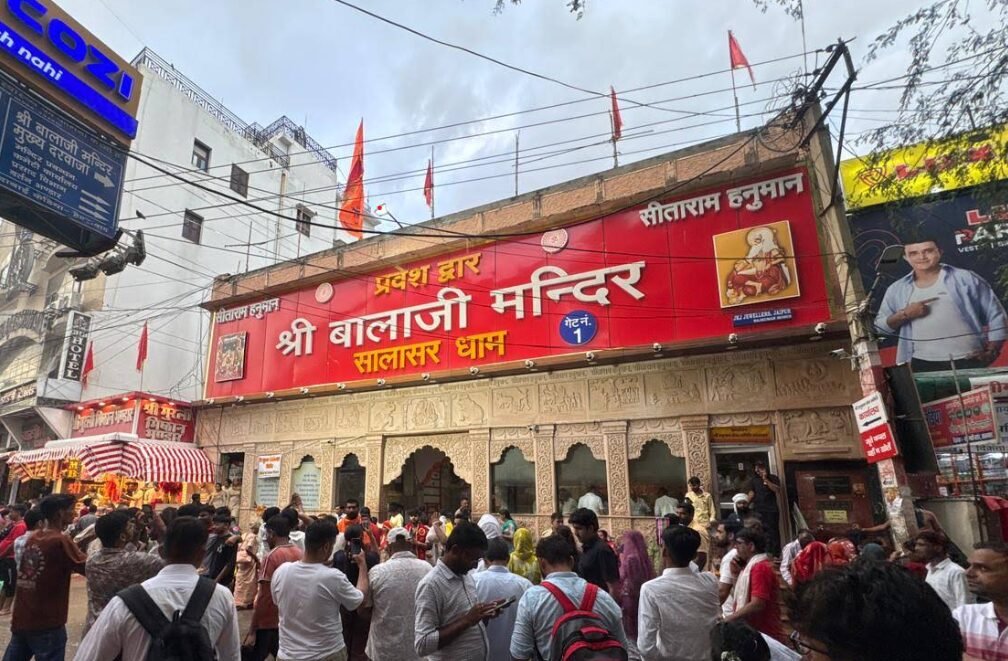
Image Source: Shree Salasar Balaji Mandir, Rajas/ Google Maps
Introduction
Shree Salasar Balaji Temple, located in the town of Salasar in Rajasthan’s Churu district, is one of the most revered pilgrimage destinations dedicated to Lord Hanuman. Known among devotees as Salasar Dham, the temple attracts pilgrims from Rajasthan and neighbouring states throughout the year. Many visit to seek the blessings of Balaji Maharaj, fulfil religious vows and participate in the rituals associated with this important Hanuman shrine.
What makes Salasar Balaji particularly distinctive is the appearance of its principal idol. Unlike the more familiar monkey-faced depictions of Lord Hanuman, the deity here is represented with a rounded, human-like face, a beard and a moustache. This unusual representation has become one of the temple’s defining features and is central to its religious identity.
The pilgrimage is not limited to the temple itself. Salasar is also part of a wider religious circuit that includes Khatu Shyam Ji, Jeen Mata and Rani Sati Temple. For visitors travelling through Rajasthan’s Shekhawati region, a visit to Salasar Balaji offers an opportunity to experience local religious traditions, devotional gatherings and the hospitality that has developed around an important pilgrimage centre.
History
The history of Salasar Balaji Temple is traditionally traced to the mid-18th century. According to the temple’s traditional account, the sacred idol was discovered in 1754 AD at Asota, a village associated with the Nagaur region of Rajasthan. A farmer reportedly found the idol while ploughing his field.
The discovery is linked with the story of Mohan Das Maharaj, a devotee of Lord Hanuman who lived in Salasar. According to the devotional narrative, Mohan Das received a divine message in a dream on the same night that the idol was discovered. The local ruler is also said to have received a vision directing the idol towards Salasar.
The idol was subsequently transported on a bullock cart. Tradition holds that the cart stopped at a particular location and could not be moved further, which devotees interpreted as a sign that the deity wished to remain there. A shrine was established at the site, and it gradually developed into the temple now known as Salasar Balaji Dham.
These accounts form an important part of the temple’s religious heritage. They should be understood as traditional narratives rather than a fully documented modern historical record. The precise details of the discovery and the divine visions belong to the devotional history through which generations of worshippers have understood the origin of the shrine.
Over time, the temple grew from a comparatively modest place of worship into a major pilgrimage destination. Facilities for devotees, accommodation, food services and transport developed around it, turning Salasar into an important centre of religious travel in northern Rajasthan.
The temple’s history is therefore significant not only because of its founding legend, but also because it illustrates how a local shrine can develop into a pilgrimage destination with a much wider regional following.
The Unique Idol of Salasar Balaji
The principal attraction of the temple is the distinctive idol of Lord Hanuman. In many Hindu temples, Hanuman is depicted with a prominent simian face, reflecting his traditional iconography. At Salasar, however, the deity has a rounded face with a beard and moustache, creating an appearance rarely encountered in other major Hanuman shrines.
According to the temple tradition, this appearance is connected with the devotional vision of Mohan Das Maharaj. The distinctive facial features are regarded by devotees as an important part of Balaji’s sacred identity.
For worshippers, the idol represents devotion, strength, courage, protection and the removal of difficulties. Hanuman is widely revered in Hindu tradition as a symbol of loyalty, discipline and service, particularly through his relationship with Lord Rama in the Ramayana.
The name Balaji is used affectionately for the deity at Salasar and in several other North Indian devotional traditions. It is important, however, not to confuse Salasar Balaji with every other temple bearing the Balaji name. Salasar is specifically associated with Lord Hanuman, whereas other Balaji temples may be dedicated to different forms of Hindu divinity.
The unusual idol is one of the reasons devotees travel long distances to Salasar. Yet the experience of visiting the temple also includes the surrounding devotional atmosphere: prayers, offerings, chanting and the shared experience of pilgrims arriving from different parts of the country.
Temple Architecture and Structure
Although the shrine began as a modest place of worship, it has developed into a substantial religious complex over the centuries. The present temple reflects successive phases of construction, decoration and expansion intended to accommodate the large number of devotees who visit Salasar.
The temple’s appearance includes decorative marble surfaces, ornate doors, metalwork and richly adorned areas around the principal deity. The sanctum, or garbhagriha, is the spiritual centre of the complex, where devotees offer prayers to Balaji Maharaj.
Notable features of the temple include:
- Marble and decorative surfaces: Light-coloured marble contributes to the temple’s distinctive appearance.
- Ornamental doors and metalwork: Decorative elements add to the ceremonial character of the interior.
- The sanctum sanctorum: The principal idol is the focus of worship and devotional offerings.
- A decorated religious interior: Floral arrangements, cloth, ornaments and other devotional decorations may vary according to rituals and festivals.
The architecture should not be understood as belonging exclusively to one clearly defined historical style. The present complex has developed over time, and its appearance reflects both religious requirements and later additions.
For pilgrims, the most important part of the architectural experience is often the movement through the temple complex towards the sanctum. During quieter periods, visitors may be able to observe decorative details more comfortably. On major festival days, crowd management and darshan arrangements become more important than leisurely architectural observation.
Visitors should follow the temple’s current instructions about footwear, photography, offerings and movement through the complex. Rules may vary by area and occasion.
Rituals and Devotional Traditions
Salasar Balaji Temple is known for several devotional practices that form an important part of the pilgrimage experience. These include coconut offerings, food offerings, aarti, prayers and the recitation of sacred texts.
Coconut Offering Tradition
One of the most recognisable traditions at Salasar is the offering of coconuts. Devotees may tie coconuts with red sacred threads at designated places within the temple complex while praying for the fulfilment of a wish or vow.
According to temple tradition, this practice is associated with the faith that sincere devotion to Balaji Maharaj can bring blessings. People may make a vow before visiting and return to express gratitude if they believe their prayer has been answered.
For pilgrims, the ritual represents faith and personal commitment. The belief that a prayer will be fulfilled is a matter of religious devotion rather than a scientifically verifiable outcome.
Visitors should follow the current instructions of temple authorities about where coconuts may be tied or offered. It is best not to assume that every part of the temple premises is available for offerings.
Savamani Prasad Offering
Another well-known practice is the Savamani offering, in which devotees arrange a substantial quantity of food as an offering to the deity. The food is subsequently distributed as prasad or shared with devotees, depending on the arrangements in place.
The amount and format of a Savamani can vary according to the tradition followed and the arrangements made by the devotee. It is therefore better not to describe every offering as exactly 50 kilograms.
The practice reflects the role of food in Hindu worship, where preparing and offering a meal can express gratitude, devotion and a desire to share blessings with others. For many pilgrims, the distribution of prasad is an important part of the religious experience.
Anyone planning a Savamani should enquire about the temple’s current procedure, advance arrangements, food preparation and distribution requirements.
Akhand Jyoti and the Sacred Flame
The sacred flame, or Akhand Jyoti, is another element associated with the temple’s devotional traditions. The temple’s traditional history states that lamps were lit in 1755 and have continued to be maintained as part of its religious practice.
For devotees, the flame symbolises enduring faith and the continuing presence of the divine. Its significance comes from the religious tradition attached to it, and descriptions of its uninterrupted history should be attributed to the temple’s own account.
Visitors should follow the rules governing access to sacred flames and other ritual spaces. Such features are places of worship rather than tourist displays.
Aarti and Devotional Singing
Daily worship includes prayers and aarti, while devotional singing and recitation of the Hanuman Chalisa form part of the wider tradition of worship associated with Hanuman.
Aarti is a ritual in which a lamp is offered before the deity, accompanied by prayers or devotional songs. At a major pilgrimage centre such as Salasar, these moments can bring together visitors from different regions, languages and backgrounds.
The timing of aarti and darshan may vary according to the temple’s schedule and special religious occasions. Pilgrims who want to attend a particular ceremony should check the current timings before setting out.
Festivals Celebrated at Salasar Balaji
Salasar becomes especially busy during its major religious festivals and annual fairs. These occasions bring together pilgrims, travelling devotional groups and visitors from across Rajasthan and neighbouring states.
The Rajasthan Tourism website identifies Chaitra Purnima and Ashwin Purnima among the temple’s major fair occasions. The temple’s own website also highlights Chaitra Purnima, associated with Hanuman Janmotsav, and Sharad Purnima.
Hanuman Jayanti and Chaitra Purnima
Hanuman Jayanti, also known as Hanuman Janmotsav, celebrates the birth of Lord Hanuman in the Hindu religious tradition. At Salasar, the occasion is associated with major devotional gatherings and the Chaitra Purnima fair.
The temple and surrounding town can become exceptionally crowded during this period. Pilgrims may arrive in groups, participate in prayers and offer worship as part of a wider religious journey.
The exact calendar date varies from year to year because it follows the Hindu lunar calendar. Travellers should check the date for the year of their visit rather than relying on a fixed Gregorian date.
Ashwin Purnima and Sharad Purnima
The autumn full moon is another important period in Salasar’s pilgrimage calendar. Rajasthan Tourism refers to an Ashwin Purnima fair, while the temple’s official website highlights Sharad Purnima.
These names are associated with the autumn full-moon period in the Hindu calendar, but event listings and naming conventions can differ. For travel planning, it is best to consult the temple’s current festival announcement for the specific year.
The fair period attracts large numbers of devotees and can significantly affect road traffic, accommodation availability and waiting times for darshan. Travellers who want to experience the festival should plan well in advance.
What to Expect During Festival Days
A festival visit can be deeply meaningful for pilgrims who want to participate in a major religious gathering. At the same time, visitors should be prepared for long queues, crowded streets and changes to ordinary transport arrangements.
If you prefer a quieter visit, consider travelling outside the main fairs and checking whether the temple has any other major events scheduled for your dates. If you attend during a festival, carry drinking water, wear comfortable footwear and follow crowd-control instructions.
Spiritual Importance of Salasar Balaji
Salasar Balaji is regarded by devotees as a Siddh Peeth, a sacred place believed to possess special spiritual significance. Worshippers visit the temple to seek blessings, strength, protection and guidance during difficult periods of life.
Many pilgrims come with personal vows or prayers related to family, work, education and other concerns. Some return to the temple after an important event in their lives as an expression of gratitude. Such practices are part of the relationship between faith, personal experience and pilgrimage.
Long-distance journeys on foot, known as padayatras, are another expression of devotion. Pilgrims may walk from their home towns or join organised groups travelling towards Salasar. The journey can involve considerable physical effort and is often understood as an act of discipline, faith and commitment.
For many visitors, the pilgrimage is not simply about reaching the temple. The journey, the shared experience of walking or travelling with other devotees, the prayers along the way and the act of offering worship all contribute to its meaning.
The temple also has a wider social role. Religious gatherings create opportunities for community participation, charitable food distribution and the continuation of devotional traditions across generations.
A traveller does not need to share the religious beliefs of the devotees to understand the importance of Salasar. Observing the rituals respectfully provides insight into the place of Hanuman worship in North Indian religious life and the way pilgrimage connects communities across regional boundaries.
Nearby Religious Sites
Salasar Balaji is part of a wider pilgrimage landscape in Rajasthan. Travellers often combine their visit with other important temples, creating a religious circuit through the Shekhawati region and adjoining parts of the state.
Khatu Shyam Ji Temple
Located in Sikar district, Khatu Shyam Ji is one of Rajasthan’s best-known pilgrimage destinations. The temple is associated with Barbarika, a figure from the Mahabharata tradition who is worshipped as Khatu Shyam Ji.
The shrine attracts large crowds, particularly during its annual fair. A visit can be combined with Salasar Balaji, although the order of travel depends on the starting point, transport and time available.
Jeen Mata Temple
Jeen Mata Temple, in the Sikar region, is an important Hindu pilgrimage site dedicated to the goddess Jeen Mata. It is set in a landscape of hills and rural settlements and attracts devotees throughout the year, with especially heavy attendance during major fairs.
Pilgrims visiting both Jeen Mata and Salasar can experience two different forms of religious worship within the broader cultural landscape of Rajasthan.
Rani Sati Temple, Jhunjhunu
Rani Sati Temple in Jhunjhunu is another major religious destination in the Shekhawati region. Known for its elaborate temple complex and devotional traditions, it is frequently included in itineraries that explore the religious sites of northern Rajasthan.
These destinations are not all in the immediate neighbourhood of Salasar, so travellers should check road distances and allow adequate time for each visit. A multi-temple journey is often more comfortable when planned over two or more days rather than rushed into a single day.
How to Reach Salasar Balaji
Location: Salasar town, Churu district, Rajasthan, India.
Salasar is connected by road with towns and cities across Rajasthan. The temple is located within the town, and the final approach is generally straightforward once visitors reach Salasar. Travel times depend on the starting point, traffic, festival crowds and road conditions.
By Road
Salasar can be reached by car, taxi and bus from major towns and cities in Rajasthan. Travellers commonly approach from Jaipur, Sikar, Sujangarh and Bikaner, while long-distance visitors may travel from Delhi or other northern Indian cities.
During the main fairs, road traffic and parking arrangements can change substantially. Check local advisories and allow additional time to reach the temple.
By Rail
Sujangarh railway station is one of the nearest convenient railheads, approximately 25–30 kilometres from Salasar by road. Ratangarh, Lakshmangarh and Sikar may also be useful depending on the train service and the traveller’s onward route.
After arriving at a nearby station, visitors can look for taxis, buses or other local transport to Salasar. Train schedules and onward connections should be checked for the travel date, particularly during festival periods when demand may be high.
By Air
Jaipur International Airport is a major air gateway for travellers heading to Salasar. It is roughly 170–185 kilometres away by road, depending on the route and starting point within Jaipur.
From the airport, visitors can hire a taxi or travel onward by public transport with suitable connections. Although Jaipur is a useful gateway, it is not immediately next to Salasar, so travellers should allow several hours for the onward journey.
Practical Travel Advice
Before travelling, check the temple’s latest darshan schedule, festival announcements and local road conditions. If you plan to attend a specific aarti or arrive during a major fair, leave additional time for queues and traffic.
The temple’s published timings can differ between information pages, so it is better to confirm the current schedule close to the date of travel rather than rely on an old online listing.
Best Time to Visit
Salasar Balaji can be visited throughout the year, but the most suitable time depends on whether the priority is comfortable weather or participation in a major religious gathering.
October to March is generally a comfortable period for travel in this part of Rajasthan. Daytime temperatures are often more pleasant than during the hot season, although winter mornings and nights can be cold.
March and April may be particularly important for pilgrims interested in Chaitra Purnima and Hanuman Janmotsav. However, the weather can become warm, and the temple may be extremely crowded during the fair.
September and October can coincide with the autumn full-moon fair period, depending on the Hindu lunar calendar. Travellers should check the official event dates and prepare for substantial crowds.
May and June are generally hot in Rajasthan, making midday travel less comfortable. If visiting during these months, plan around the heat, carry water and avoid unnecessary outdoor waiting where possible.
The monsoon period can bring some relief from summer heat, although rainfall and local road conditions may affect travel plans.
For a relatively comfortable pilgrimage, the cooler months outside the major fairs are a practical choice. For devotees who want to experience the temple at its most festive, a major fair can be rewarding, but it requires more preparation and patience.
Pilgrim Facilities and Visitor Etiquette
Salasar is an established pilgrimage town with accommodation, food services and facilities intended for devotees. The temple’s official website lists numerous dharamshalas and other lodging options, although availability, prices and services vary.
Travellers should confirm accommodation arrangements directly before arrival, especially during festivals. If you need accessible facilities, are travelling with older family members or have specific dietary requirements, check these details in advance.
A few practical considerations can make the visit more comfortable:
- Follow instructions about footwear, bags, photography and offerings.
- Wear comfortable clothing suitable for a religious setting and the weather.
- Carry drinking water, particularly during hot months and long queues.
- Keep valuables secure in crowded areas.
- Allow extra time during festivals and follow crowd-control instructions.
- Ask temple staff where specific offerings should be made.
- Avoid blocking entrances or ritual areas while taking photographs.
The town’s religious atmosphere is shaped by the participation of devotees, so patience and respect are important, particularly when the temple is crowded.
Conclusion
Shree Salasar Balaji Temple is one of Rajasthan’s most significant pilgrimage destinations dedicated to Lord Hanuman. Its distinctive bearded and moustached idol, the traditional story of its origin, and its major fairs have given Salasar Dham a special place in the religious life of northern India.
The temple is more than a single place of worship. Its coconut offerings, Savamani tradition, aarti ceremonies and devotional gatherings reflect the many ways in which pilgrims express faith and maintain a connection with Balaji Maharaj. The surrounding town has developed to support visitors, while nearby temples make Salasar part of a wider religious journey through Rajasthan.
For travellers, the experience can be planned around a quiet darshan outside the major fairs or a more crowded visit during Chaitra Purnima or the autumn full-moon period. Both offer different perspectives on the temple, provided visitors plan according to their needs and follow local guidance.
Whether the purpose is a personal vow, a family pilgrimage or an exploration of Rajasthan’s religious heritage, Salasar Balaji offers an opportunity to understand the enduring place of Hanuman devotion in Indian spiritual life.