Image Source: amitav sengupta/ Google Maps
Introduction
The Gaurishankar Temple in Jagatsukh is one of the most important historic temples in the upper Kullu Valley of Himachal Pradesh. Located approximately 6–12 km from Manali, depending on the starting point, this historic shrine is dedicated to Shiva and Gauri (Parvati), symbolising the divine union associated with creation, balance and cosmic energy.
The temple is particularly admired for its early Himalayan stone architecture, carved details and historical associations, making it an important cultural landmark for travellers interested in the heritage of the Manali region. Unlike the better-known wooden temples around Manali, the stone structure at Jagatsukh provides an opportunity to explore another architectural tradition that developed in the western Himalaya.
The temple also has a close connection with the history of Jagatsukh itself. The village was once an important political centre of the Kullu kingdom, and its surviving religious buildings reflect a time when royal authority, local communities and temple traditions were closely connected.
Historical Background
Jagatsukh was once an important settlement in the Kullu kingdom and is traditionally described as an early capital before the royal centre shifted to Naggar and subsequently to Sultanpur, in present day Kullu. The village was formerly known as Nast, and its historical importance is reflected in its collection of old temples and religious sites.
The Gaurishankar Temple is generally associated with the early medieval period. Architectural descriptions and heritage records commonly place its origins around the 8th–9th century CE, although dating early Himalayan temples can be complicated when structures have been repaired, altered or rebuilt over time. The surviving building and its sculptural remains provide evidence of older temple traditions in the Kullu Valley.
The temple is significant because it reflects the influence of Nagara-style temple architecture, which developed across northern India. Its stonework connects Jagatsukh with a wider history of temple building rather than representing an isolated local style.
For centuries, the shrine has remained part of the religious landscape of the village. Its continued presence also helps explain why Jagatsukh is worth visiting beyond its scenic surroundings: the settlement preserves evidence of the cultural and political history of the Kullu kingdom.
Jagatsukh as an early capital
Jagatsukh’s former status as a capital gives the temple additional historical importance. Political centres often attracted religious patronage, skilled builders and artistic traditions, leaving behind temples that can help historians understand how a region developed.
The temple should therefore be seen as part of a wider heritage landscape that includes the nearby Sandhya Gayatri Temple and other historic features of Jagatsukh. Visiting these sites together gives a more complete picture of the village’s past.
Architecture
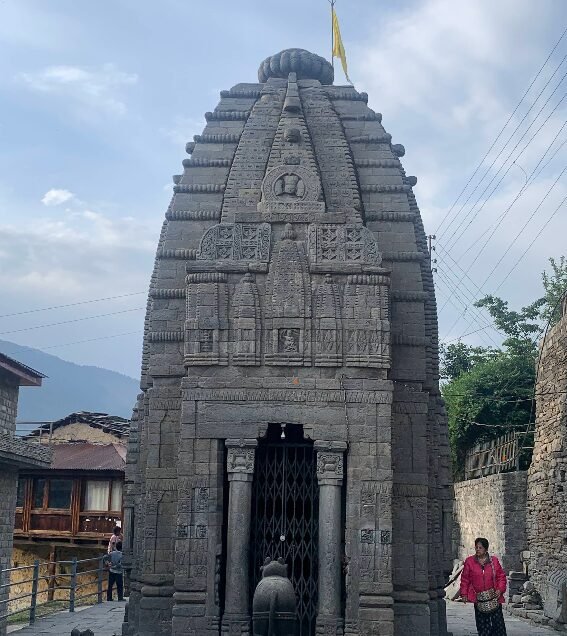
The temple is an important example of stone shikhara-style architecture, a form associated with North Indian temples. Its structure is especially notable in the Kullu Valley, where traditional wooden construction and combinations of stone and timber are also prominent.
Key architectural features
- Stone shikhara (tower): The rising tower above the sanctum gives the temple its distinctive outline and reflects the Nagara tradition of North Indian temple architecture.
- Carved entrance and stone details: Decorative carvings and sculptural elements provide clues to the artistic practices of the period. Some older fragments may belong to earlier phases of the temple site.
- Sanctum: The inner shrine houses the principal object of worship. The temple is associated with Shiva, with Gauri representing Parvati and the divine pairing expressed in its name.
- Stone sculptures: Carved figures and architectural motifs help distinguish the building from the timber temples commonly encountered elsewhere around Manali.
The temple’s stone construction makes it a valuable example of the diversity of Himalayan religious architecture. Although Kath-Khuni construction, which combines timber and stone, is strongly associated with traditional buildings in the region, it is not the only architectural tradition found in Himachal Pradesh.
What to look for during your visit: Notice the proportions of the tower, the transition from the exterior structure to the sanctum and the surviving carved details. Older temple sites can preserve fragments from earlier phases of construction, so even smaller architectural features may have historical significance.
It is also worth remembering that the Gaurishankar Temple at Jagatsukh is different from the better-known Gauri Shankar Temple at Naggar, near Naggar Castle. Both are historic stone temples in the Kullu Valley, but they are separate monuments with their own locations and histories.
Religious Significance
The temple is dedicated to Shiva and Gauri (Parvati). In Hindu tradition, their divine union represents complementary aspects of existence, including consciousness and energy, stability and transformation, and the balance that sustains the universe.
Devotees visit the temple to seek blessings for:
- marital harmony and family well being.
- prosperity and good fortune.
- spiritual well being and devotion.
Shiva worship has a long history in the Kullu Valley, where temples dedicated to the deity form an important part of the region’s religious landscape. Jagatsukh’s Gaurishankar Temple is one of the historic shrines that reflects this tradition.
During important Hindu festivals, particularly those associated with Shiva, devotees may visit temples across the region for prayer and worship. However, the specific festival calendar and rituals followed at this individual shrine should be confirmed locally rather than assumed from customs elsewhere in the valley.
The wider Kullu region is also known for its village deity traditions, in which local temples and deities play important roles in community life. These traditions vary from village to village, making local accounts and temple caretakers valuable sources of information for visitors interested in the area’s living religious heritage.
The Village of Jagatsukh
The temple stands in the village of Jagatsukh, which retains a traditional Himalayan atmosphere despite its proximity to the tourist centre of Manali.
The village is known for:
- Traditional houses and village lanes: Older buildings and everyday village life offer a contrast to Manali’s commercial centre.
- Terraced fields and apple orchards: Cultivation and horticulture contribute to the landscape around the settlement.
- Views towards the surrounding mountains: Visibility depends on the weather, season and the precise location within the village.
- Historic temples: The Gaurishankar and Sandhya Gayatri temples make Jagatsukh an interesting destination for cultural sightseeing.
A visit here can be particularly rewarding for travellers who enjoy exploring places beyond the main tourist circuit. Instead of focusing only on mountain viewpoints or adventure activities, you can spend time looking at the village’s architecture, religious sites and relationship with the surrounding landscape.
Spring and summer bring greener scenery, while autumn can offer clear weather and views towards the mountains. Winter is colder, and snowfall is possible, although it is not guaranteed in the village itself.
How to reach Jagatsukh
Jagatsukh is reached by road from Manali along the route towards Naggar. Depending on your starting point and the precise temple entrance, the journey is roughly 6–12 km.
You can travel by taxi or private vehicle, or use local transport where available. Allow time to walk through the village if the vehicle cannot reach the temple entrance directly. Check the location on a current map before departure, particularly if you plan to visit more than one temple in Jagatsukh.
Nearby Attractions
Visitors exploring Jagatsukh often combine their visit to Gaurishankar Temple with other nearby sites:
- Sandhya Gayatri Temple: Another important shrine in Jagatsukh. Visiting both temples helps travellers understand the village’s religious and architectural heritage.
- Hadimba Devi Temple: A well-known wooden temple in Manali, set among deodar trees. It offers a useful architectural comparison with Jagatsukh’s stone shrine.
- Old Manali: A historic settlement with traditional village lanes, temples, cafés and views of the surrounding mountains.
If you have additional time, you can also plan a separate excursion to Naggar, where Naggar Castle and the Gauri Shankar Temple near the castle provide another perspective on the history and architecture of the Kullu Valley. Remember that the Naggar temple is a separate monument from the Gaurishankar Temple in Jagatsukh.
For a relaxed heritage outing, it is sensible to explore Jagatsukh’s temples together before returning to Manali. Hadimba Devi Temple and Old Manali can be visited as part of a separate town sightseeing circuit.
Interesting fact:
The Gaurishankar Temple at Jagatsukh, sometimes described in heritage material as a miniature Shiva temple, is recognised for its early stone architecture and its connection with the history of the former Kullu capital. Architectural research places it among the region’s important early surviving temples. Its stone tower and carved details show that the Kullu Valley’s religious architecture was not limited to timber construction.
The temple is also a reminder that the history of Manali extends beyond the modern tourist town. The surrounding villages preserve older layers of settlement, religious practice and artistic traditions that help explain how the cultural landscape of the Kullu Valley developed.