Image Source: S Nadeem A Jafri
About Kati Ghati Gateway
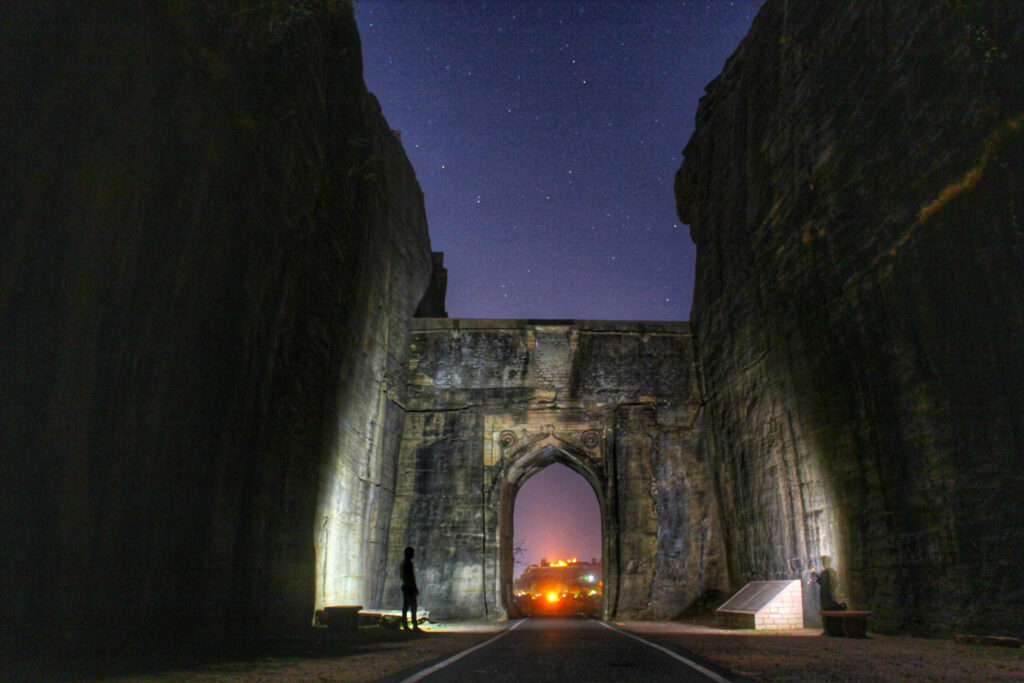
Kati Ghati Gateway is one of the most remarkable historical landmarks in Chanderi, Madhya Pradesh. Located about 3 km from the Chanderi Bus Stand, this magnificent rock-cut gateway serves as the traditional entrance to the historic town. Surrounded by rugged hills and steep cliffs, the monument instantly captures the attention of visitors with its impressive scale and unique craftsmanship.
What makes Kati Ghati truly extraordinary is that it was carved out of a single massive rock. The gateway stands as a symbol of the engineering brilliance and artistic skills of the craftsmen who lived centuries ago. For travelers exploring the rich heritage of Chanderi, Kati Ghati is a must-visit attraction that offers a fascinating glimpse into the region’s medieval past.
History of Kati Ghati Gateway
Kati Ghati Gateway dates back to the late 15th century and holds great historical significance. According to inscriptions found at the site, the gateway was commissioned in 1495 AD by Jiman Khan, the son of Sher Khan, who served as the Governor of Chanderi during that period. One of the inscriptions is written in Devanagari script and provides valuable information about the monument’s construction.
The gateway is an architectural marvel, standing approximately 80 feet high and 39 feet wide. Situated at an elevation of around 230 feet, it once served as an important passage connecting the regions of Malwa and Bundelkhand. The strategic location of the gateway made it a vital route for travelers, traders, and armies moving through the area.
The Legend Behind Kati Ghati
A popular local legend is associated with the construction of Kati Ghati. It is said that the Sultan of Malwa was planning a visit to Chanderi and desired a grand entrance that would leave a lasting impression. To fulfill this vision, Jiman Khan was entrusted with the task of creating a magnificent gateway.
After searching extensively for a capable craftsman, a skilled artisan accepted the challenge. He worked tirelessly day and night, carving the enormous passage through solid rock. When the construction was finally completed, Jiman Khan arrived to inspect the masterpiece.
Although the gateway was magnificent, it was discovered that no provision had been made for installing a gate or door. This oversight meant that the passage could not be sealed during times of conflict, potentially leaving the town vulnerable to enemy attacks.
According to local folklore, the craftsman was devastated by this mistake. Unable to bear the disappointment and guilt, he tragically ended his life. It is believed that his grave lies near the gateway, serving as a reminder of the dedication and sacrifice involved in creating this remarkable monument.
Today, Kati Ghati stands not only as an architectural wonder but also as a monument steeped in history, legend, and local folklore.
Architecture and Significance
The most striking feature of Kati Ghati is its massive rock-cut design. Unlike conventional gateways built using stone blocks, this monument was carved directly from a single rock face. The towering structure showcases the precision and ingenuity of medieval builders.
As visitors pass through the gateway, they are greeted by dramatic views of the surrounding hills and the historic landscape of Chanderi. The site offers excellent opportunities for photography and provides a unique introduction to the town’s rich cultural heritage.
How to Reach Kati Ghati Gateway
By Road
Kati Ghati Gateway is located around 3 km from Chanderi Bus Stand and can be easily reached by auto-rickshaw, taxi, or private vehicle. The roads leading to the monument are well-connected to major parts of Chanderi.
By Rail
The nearest railway station is Lalitpur Railway Station, approximately 40 km away. Visitors can hire a taxi or take local transport from the station to reach Chanderi.
By Air
The nearest airports are Raja Bhoj Airport in Bhopal and Gwalior Airport. From either airport, travelers can continue their journey by road to Chanderi.
Best Time to Visit
The ideal time to visit Kati Ghati is between October and March when the weather is pleasant for sightseeing and exploring Chanderi’s historical monuments.
Nearby Attractions
- Chanderi Fort – A magnificent hilltop fort offering panoramic views of the town.
- Badal Mahal Gate – An iconic gateway known for its elegant architecture.
- Jama Masjid – One of the largest and oldest mosques in the region.
- Koshak Mahal – A grand palace showcasing Afghan architectural influences.
- Shahzadi Ka Roza – A beautiful tomb associated with local legends and history.
- Parameshwar Tal – A peaceful historical water reservoir surrounded by scenic views.
Maps
FAQs
1. What is Kati Ghati Gateway famous for?
Kati Ghati Gateway is famous for being a massive entrance carved out of a single rock and for its historical importance as the traditional gateway to Chanderi.
2. Who built Kati Ghati Gateway?
The gateway was commissioned by Jiman Khan, son of Sher Khan, in 1495 AD during the medieval period.
3. How far is Kati Ghati Gateway from Chanderi town?
The monument is located approximately 3 km from the Chanderi Bus Stand.
4. Is there an entry fee to visit Kati Ghati Gateway?
Generally, visitors can view the gateway without a significant entry charge, though it is advisable to check local regulations before visiting.
5. What is the best time to visit Kati Ghati?
The winter season from October to March is considered the best time due to comfortable weather conditions.
6. Why is the gateway called Kati Ghati?
The name “Kati Ghati” roughly translates to a “cut pass” or “cut gorge,” referring to the passage that was carved through a massive rock hill to create the gateway.
7. How much time is needed to explore Kati Ghati?
Most visitors spend around 30 minutes to 1 hour exploring the gateway, taking photographs, and enjoying the surrounding views.